Department of Medicine, Center for Clinical Pharmacology, Center for Craniofacial and Dental Genetics, University of Pittsburgh, Pittsburgh, Pennsylvania, United States of America.
Department of Medicine, Hillman Cancer Center, University of Pittsburgh Cancer Institute, Pittsburgh, Pennsylvania, United States of America.
PLoS One. 2014 Jan 27;9(1):e86375. doi: 10.1371/journal.pone.0086375. eCollection 2014.
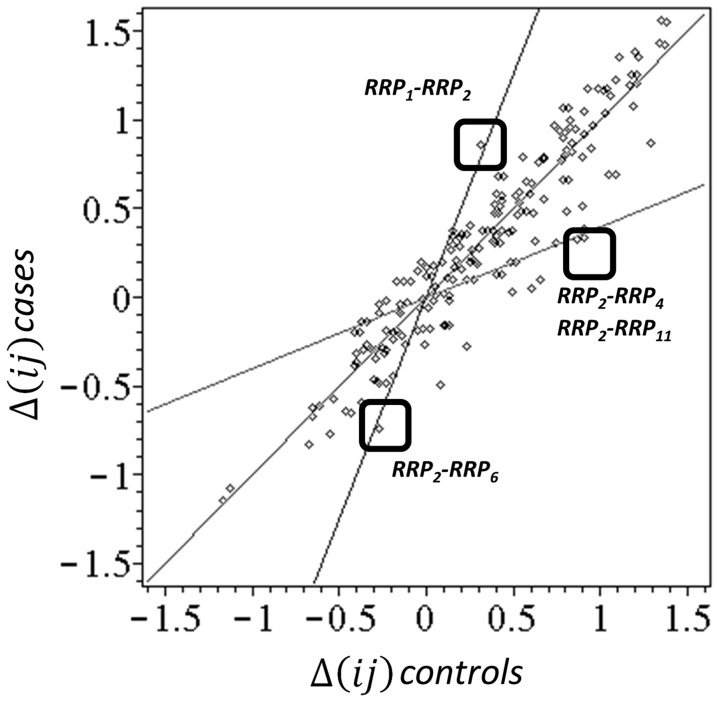
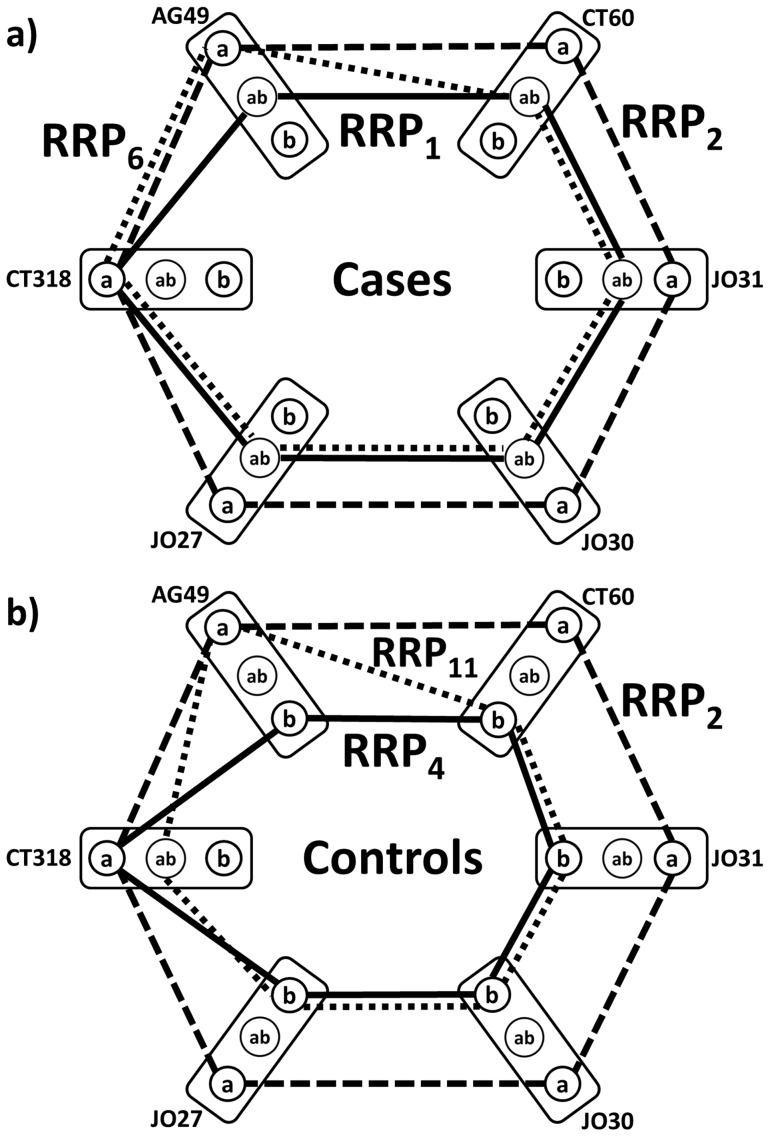
Adjuvant therapy of stage IIB/III melanoma with interferon reduces relapse and mortality by up to 33% but is accompanied by toxicity-related complications. Polymorphisms of the CTLA-4 gene associated with autoimmune diseases could help in identifying interferon treatment benefits. We previously genotyped 286 melanoma patients and 288 healthy (unrelated) individuals for six CTLA-4 polymorphisms (SNP). Previous analyses found no significant differences between the distributions of CTLA-4 polymorphisms in the melanoma population vs. controls, no significant difference in relapse free and overall survivals among patients and no correlation between autoimmunity and specific alleles. We report new analysis of these CTLA-4 genetic profiles, using Network Phenotyping Strategy (NPS). It is graph-theory based method, analyzing the SNP patterns. Application of NPS on CTLA-4 polymorphism captures allele relationship pattern for every patient into 6-partite mathematical graph P. Graphs P are combined into weighted 6-partite graph S, which subsequently decomposed into reference relationship profiles (RRP). Finally, every individual CTLA-4 genotype pattern is characterized by the graph distances of P from eight identified RRP's. RRP's are subgraphs of S, collecting equally frequent binary allele co-occurrences in all studied loci. If S topology represents the genetic "dominant model", the RRP's and their characteristic frequencies are identical to expectation-maximization derived haplotypes and maximal likelihood estimates of their frequencies. The graph-representation allows showing that patient CTLA-4 haplotypes are uniquely different from the controls by absence of specific SNP combinations. New function-related insight is derived when the 6-partite graph reflects allelic state of CTLA-4. We found that we can use differences between individual P and specific RRPs to identify patient subpopulations with clearly different polymorphic patterns relatively to controls as well as to identify patients with significantly different survival.
辅助治疗 IIB/III 期黑色素瘤的干扰素可降低 33%的复发率和死亡率,但也伴有与毒性相关的并发症。与自身免疫性疾病相关的 CTLA-4 基因多态性可帮助识别干扰素治疗的获益。我们之前对 286 名黑色素瘤患者和 288 名健康(无关)个体进行了 CTLA-4 6 个基因多态性(SNP)的基因分型。之前的分析发现黑色素瘤患者与对照组之间 CTLA-4 多态性的分布无显著差异,患者的无复发生存率和总生存率无显著差异,自身免疫与特定等位基因之间无相关性。我们报告了对这些 CTLA-4 遗传谱的新分析,使用网络表型策略(NPS)。它是一种基于图论的方法,分析 SNP 模式。应用 NPS 分析 CTLA-4 多态性时,将每个患者的等位基因关系模式捕获到 6 部分数学图 P 中。将图 P 组合成加权 6 部分图 S,然后将其分解为参考关系谱(RRP)。最后,每个个体 CTLA-4 基因型模式的特征是图 P 与 8 个已识别的 RRP 之间的距离。RRP 是 S 的子图,收集所有研究位点中相同频率的二元等位基因共现。如果 S 的拓扑结构代表遗传“显性模型”,则 RRP 及其特征频率与期望最大化衍生的单倍型和它们频率的最大似然估计相同。图形表示允许显示患者 CTLA-4 单倍型与对照明显不同,因为缺乏特定 SNP 组合。当 6 部分图反映 CTLA-4 的等位基因状态时,会得出新的与功能相关的见解。我们发现,我们可以使用个体 P 与特定 RRP 之间的差异来识别相对于对照具有明显不同多态性模式的患者亚群,以及识别具有显著不同生存率的患者。