Division of Rehabilitation Sciences.
Department of Internal Medicine, The University of Texas Medical Branch, Galveston, TX; and.
J Nutr. 2014 Jun;144(6):876-80. doi: 10.3945/jn.113.185280. Epub 2014 Jan 29.
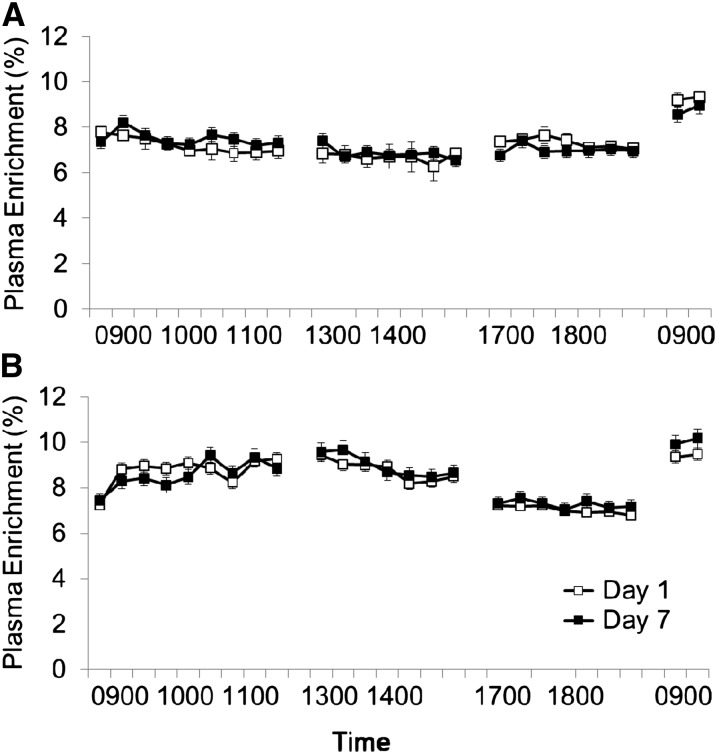
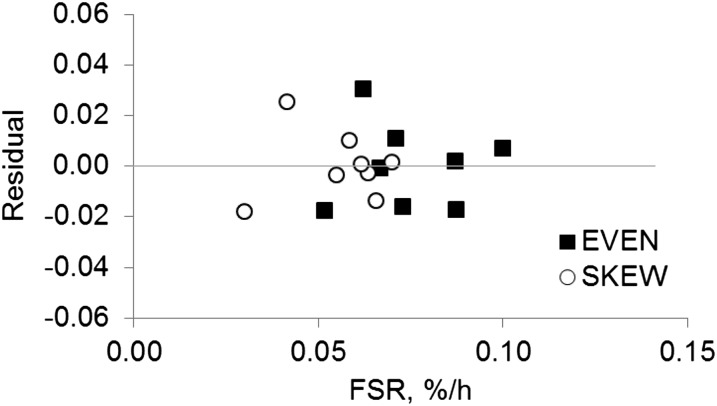
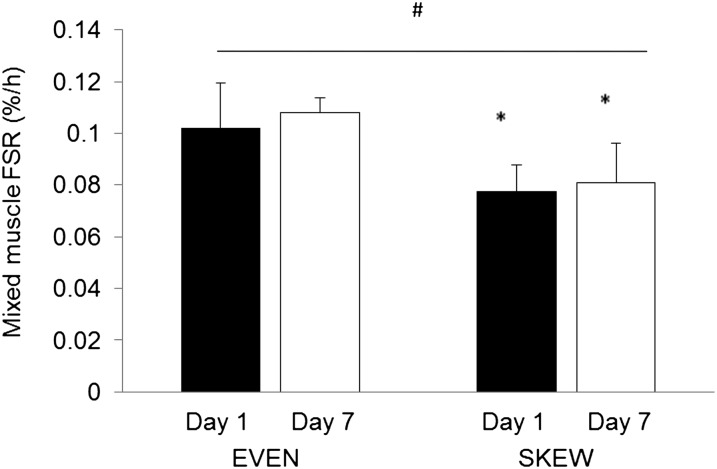
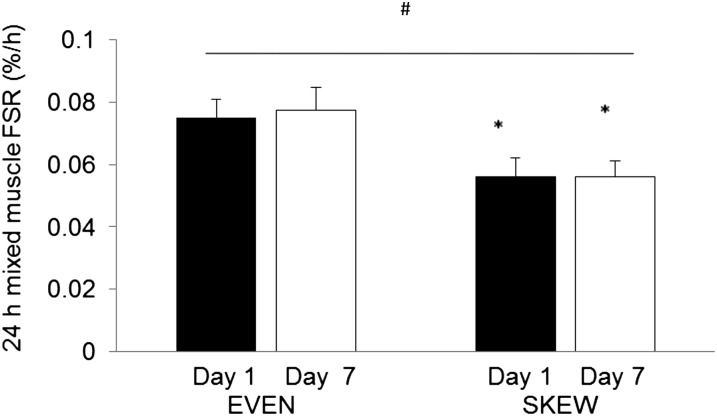
The RDA for protein describes the quantity that should be consumed daily to meet population needs and to prevent deficiency. Protein consumption in many countries exceeds the RDA; however, intake is often skewed toward the evening meal, whereas breakfast is typically carbohydrate rich and low in protein. We examined the effects of protein distribution on 24-h skeletal muscle protein synthesis in healthy adult men and women (n = 8; age: 36.9 ± 3.1 y; BMI: 25.7 ± 0.8 kg/m2). By using a 7-d crossover feeding design with a 30-d washout period, we measured changes in muscle protein synthesis in response to isoenergetic and isonitrogenous diets with protein at breakfast, lunch, and dinner distributed evenly (EVEN; 31.5 ± 1.3, 29.9 ± 1.6, and 32.7 ± 1.6 g protein, respectively) or skewed (SKEW; 10.7 ± 0.8, 16.0 ± 0.5, and 63.4 ± 3.7 g protein, respectively). Over 24-h periods on days 1 and 7, venous blood samples and vastus lateralis muscle biopsy samples were obtained during primed (2.0 μmol/kg) constant infusion [0.06 μmol/(kg⋅min)] of l-[ring-(13)C6]phenylalanine. The 24-h mixed muscle protein fractional synthesis rate was 25% higher in the EVEN (0.075 ± 0.006%/h) vs. the SKEW (0.056 ± 0.006%/h) protein distribution groups (P = 0.003). This pattern was maintained after 7 d of habituation to each diet (EVEN vs. SKEW: 0.077 ± 0.006 vs. 0.056 ± 0.006%/h; P = 0.001). The consumption of a moderate amount of protein at each meal stimulated 24-h muscle protein synthesis more effectively than skewing protein intake toward the evening meal.
RDA 描述了每日应摄入的蛋白质量,以满足人群需求并预防蛋白质缺乏。许多国家的蛋白质摄入量超过了 RDA;然而,这种摄入量往往偏向于晚餐,而早餐通常富含碳水化合物,蛋白质含量较低。我们研究了蛋白质分布对健康成年男女(n=8;年龄:36.9±3.1 岁;BMI:25.7±0.8kg/m2)24 小时骨骼肌蛋白质合成的影响。通过使用 7 天交叉喂养设计和 30 天洗脱期,我们测量了肌肉蛋白质合成对早餐、午餐和晚餐均匀分布(EVEN;分别为 31.5±1.3、29.9±1.6 和 32.7±1.6g 蛋白质)或倾斜分布(SKEW;10.7±0.8、16.0±0.5 和 63.4±3.7g 蛋白质)的等能量和等氮饮食的反应。在第 1 天和第 7 天的 24 小时期间,在持续静脉输注(2.0μmol/kg)[0.06μmol/(kg·min)]l-[ring-(13)C6]苯丙氨酸期间,采集静脉血样和股外侧肌活检样本。与 SKEW(0.056±0.006%/h)蛋白质分布组相比,EVEN(0.075±0.006%/h)蛋白质分布组的 24 小时混合肌肉蛋白合成率高出 25%(P=0.003)。这种模式在适应每种饮食 7 天后仍然存在(EVEN 与 SKEW:0.077±0.006 与 0.056±0.006%/h;P=0.001)。每餐适量摄入蛋白质比将蛋白质摄入量倾斜到晚餐更有效地刺激 24 小时肌肉蛋白质合成。