Department of Psychology, Eberhard Karls University Tuebingen, Germany.
Knowledge Media Research Center Tuebingen, Germany.
Front Psychol. 2014 Jan 22;4:1021. doi: 10.3389/fpsyg.2013.01021. eCollection 2013.
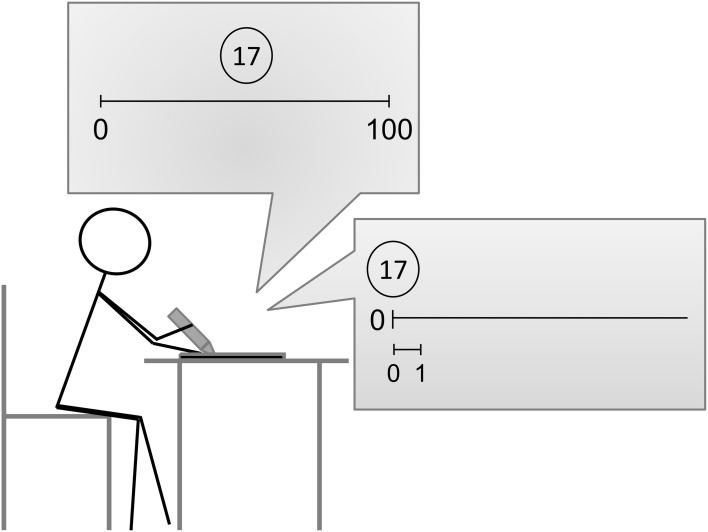
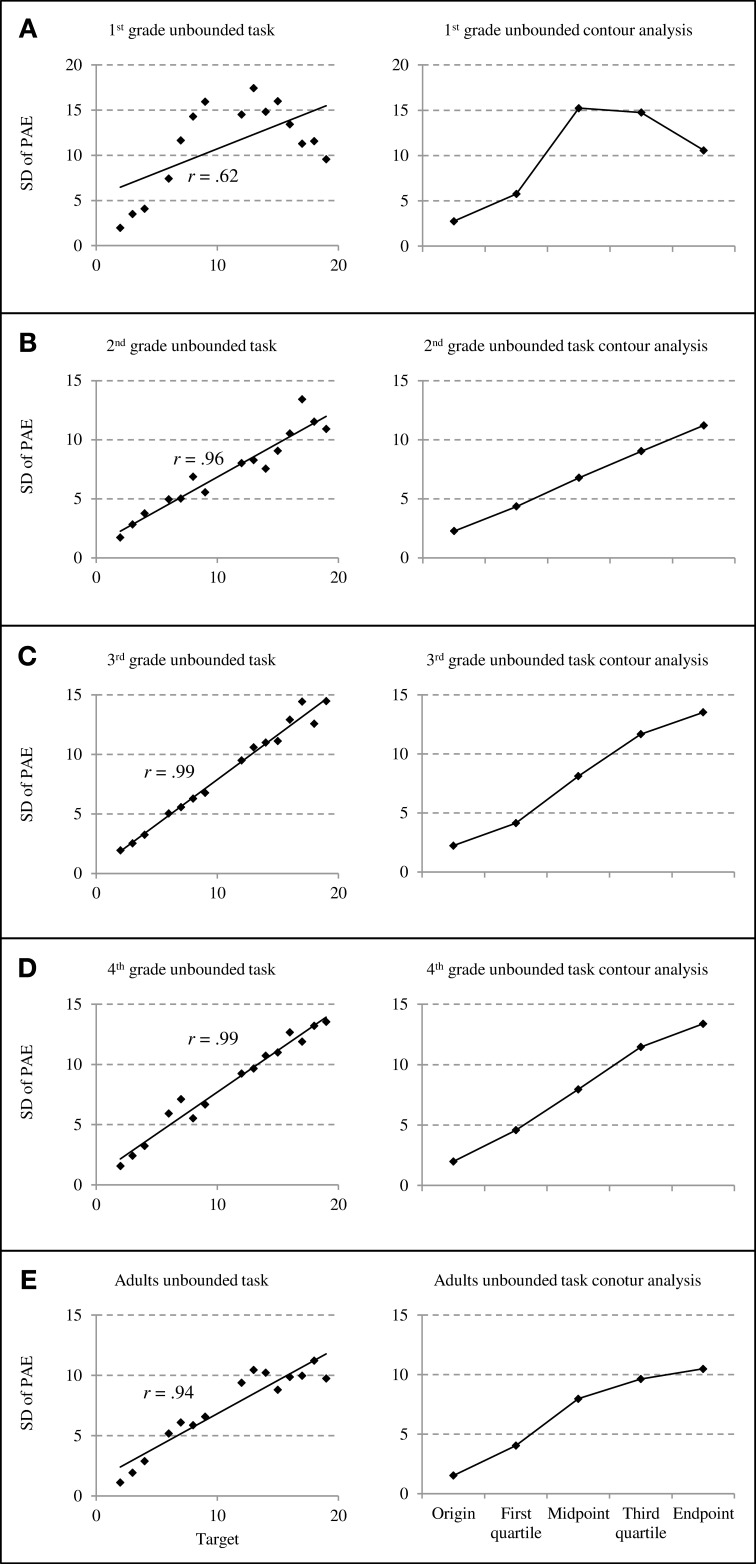
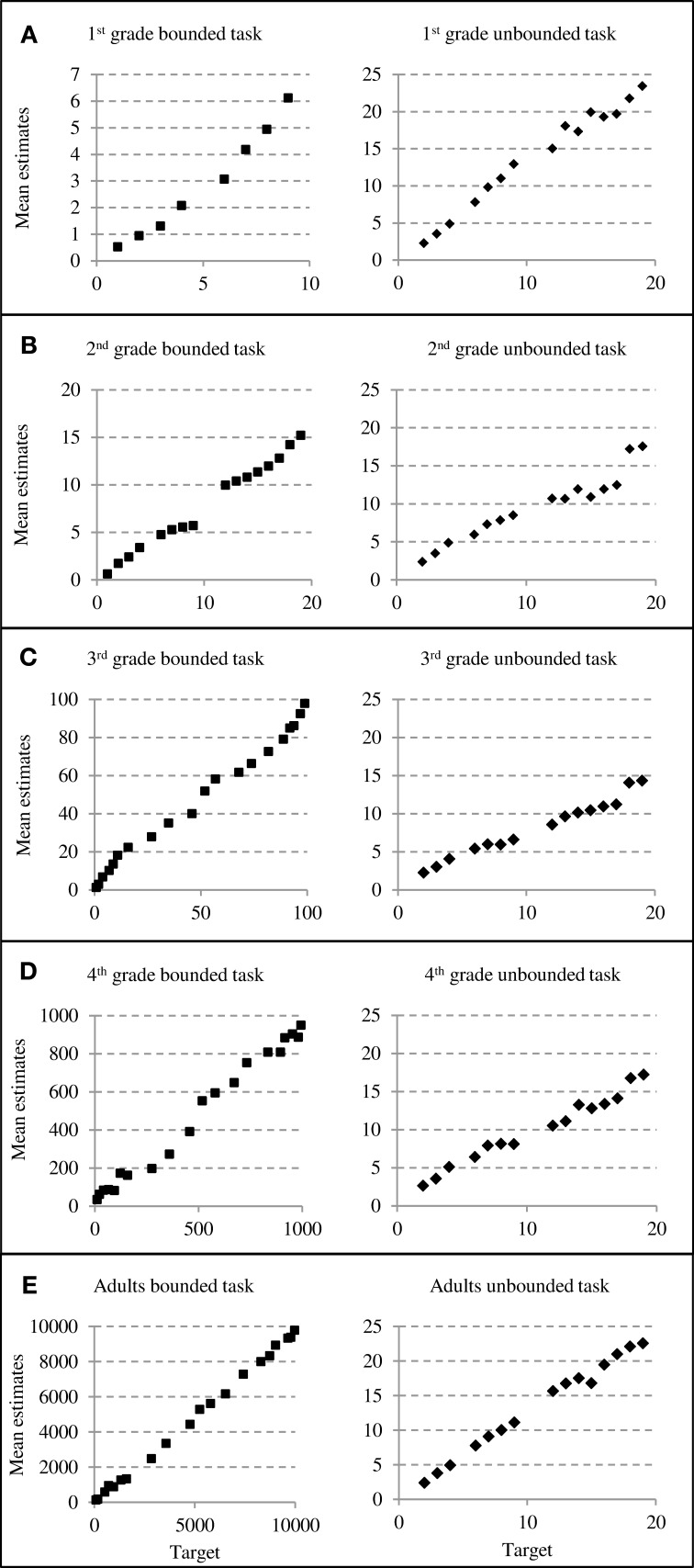
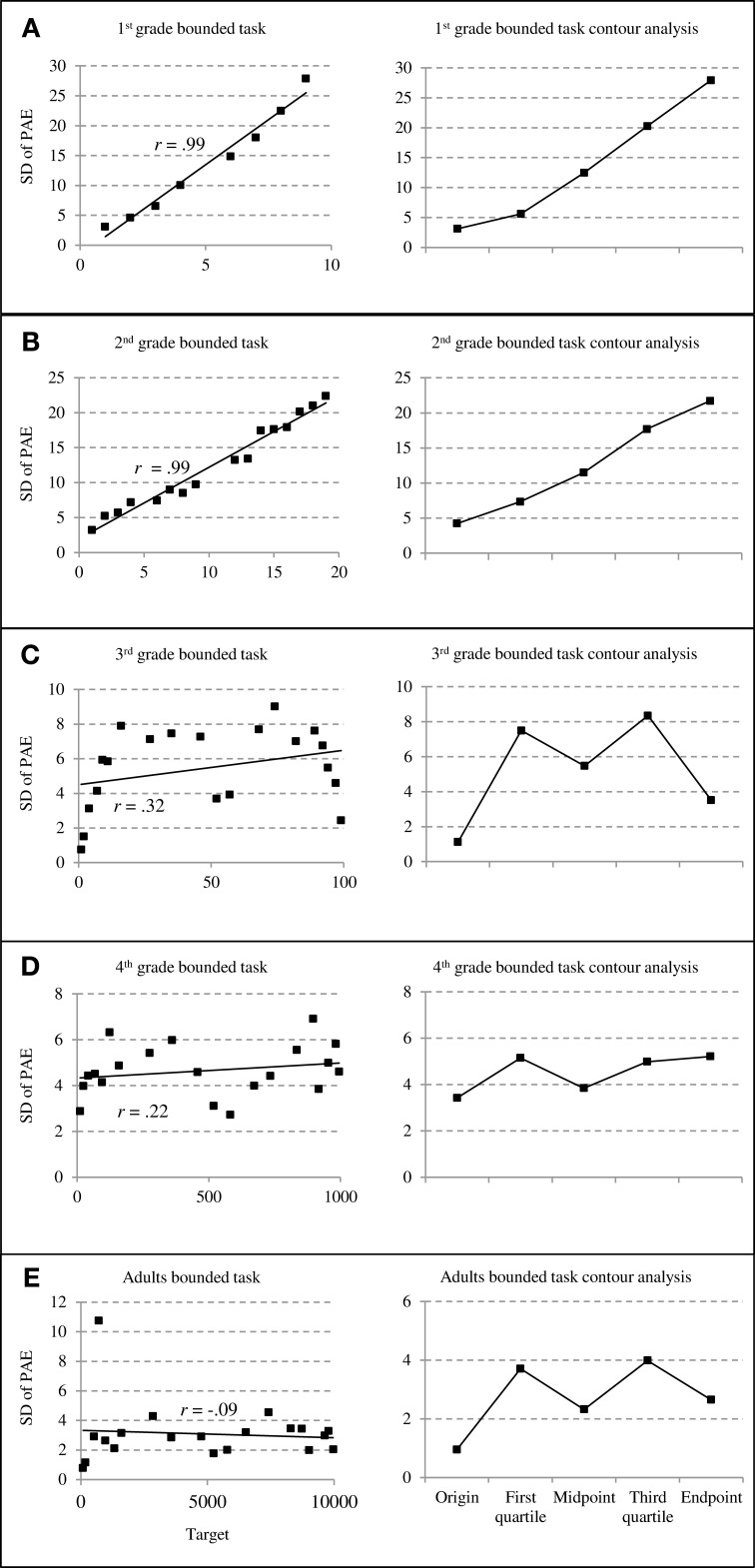
Number line estimation (i.e., indicating the position of a given number on a physical line) is a standard assessment of children's spatial representation of number magnitude. Importantly, there is an ongoing debate on the question in how far the bounded task version with start and endpoint given (e.g., 0 and 100) might induce specific estimation strategies and thus may not allow for unbiased inferences on the underlying representation. Recently, a new unbounded version of the task was suggested with only the start point and a unit fixed (e.g., the distance from 0 to 1). In adults this task provided a less biased index of the spatial representation of number magnitude. Yet, so far there are no children data available for the unbounded number line estimation task. Therefore, we conducted a cross-sectional study on primary school children performing both, the bounded and the unbounded version of the task. We observed clear evidence for systematic strategic influences (i.e., the consideration of reference points) in the bounded number line estimation task for children older than grade two whereas there were no such indications for the unbounded version for any one of the age groups. In summary, the current data corroborate the unbounded number line estimation task to be a valuable tool for assessing children's spatial representation of number magnitude in a systematic and unbiased manner. Yet, similar results for the bounded and the unbounded version of the task for first- and second-graders may indicate that both versions of the task might assess the same underlying representation for relatively younger children-at least in number ranges familiar to the children assessed. This is of particular importance for inferences about the nature and development of children's magnitude representation.
数字线估计(即,指示给定数字在物理线上的位置)是评估儿童数量大小空间表示的标准方法。重要的是,对于给定起点和终点的有界任务版本(例如,0 和 100)是否会引起特定的估计策略,以及是否可以对基础表示进行无偏推断,这方面存在持续的争论。最近,提出了一种新的无界版本的任务,只有起点和一个单位固定(例如,从 0 到 1 的距离)。在成年人中,这个任务提供了一个更无偏的数量大小空间表示的指标。然而,到目前为止,对于无界数字线估计任务,还没有儿童的数据。因此,我们对小学生进行了横断面研究,他们执行了有界和无界版本的任务。我们观察到,对于二年级以上的儿童,在有界数字线估计任务中存在明显的系统策略影响(即,参考点的考虑),而对于任何一个年龄组的无界版本,都没有这种迹象。总之,目前的数据证实,无界数字线估计任务是一种评估儿童数量大小空间表示的系统和无偏方法的有价值工具。然而,对于一年级和二年级学生的有界和无界版本的任务,类似的结果可能表明,两个版本的任务都可以评估相对较年轻的儿童的相同基础表示-至少在评估儿童熟悉的数字范围内是这样。这对于关于儿童数量表示的本质和发展的推断尤其重要。