Department of Nutrition Science, Friedman School of Nutrition Science and Policy, Tufts University, Boston, Massachusetts; Jean Mayer USDA Human Nutrition Research Center on Aging, Tufts University, Boston, Massachusetts.
Pediatr Blood Cancer. 2014 Jul;61(7):1263-9. doi: 10.1002/pbc.24960. Epub 2014 Jan 30.
A high prevalence of obesity has been increasingly recognized in survivors of pediatric ALL. However, longitudinal patterns of weight change during and after treatment, and associated factors, are less well elucidated.
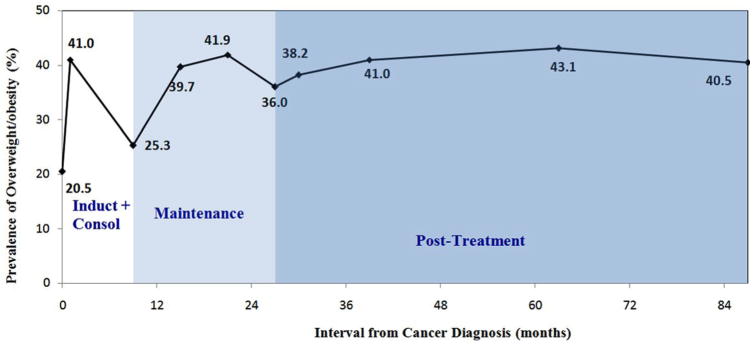
In a retrospective cohort of 83 pediatric patients with ALL diagnosed between 1985 and 2010, we examined body mass index (BMI) status at several key time points: diagnosis; end of induction; end of consolidation; every 6 months during maintenance; and yearly for up to 5 years post-treatment.
At diagnosis, 21% were overweight (BMI = 85-94.9th percentile) or obese (BMI ≥ 95th percentile). At the end of treatment and 5 years post-treatment, approximately 40% were overweight or obese. The mean BMI z-score was 0.2 (58th percentile) at diagnosis and increased significantly during induction (Δ = 0.5, P < 0.0001). It increased again during the first 6 months of maintenance (Δ = 0.2, P < 0.01) and did not significantly change over the remainder of maintenance (BMI z-score at the end of treatment = 0.8, 79th percentile) and 5 years post-treatment (BMI z-score = 0.7, 76th percentile). High BMI z-score at diagnosis was associated with an increased risk of being overweight/obese at treatment completion (OR = 2.9, 95% CI: 1.6-5.1). Weight gain during treatment was associated with being overweight/obese 5 years post-treatment (OR = 3.8, 95% CI: 1.1-12.5).
Children with ALL are at risk of becoming overweight/obese early in treatment. Increases in weight are maintained throughout treatment and beyond. Lifestyle interventions are needed targeting weight control early during treatment, particularly for patients overweight/obese at diagnosis and those who experience substantial weight gain during treatment.
儿科急性淋巴细胞白血病(ALL)幸存者中肥胖症的发病率不断上升。然而,治疗期间和治疗后体重变化的纵向模式以及相关因素还不太清楚。
在 1985 年至 2010 年间诊断为 ALL 的 83 名儿科患者的回顾性队列中,我们检查了几个关键时间点的体重指数(BMI)状况:诊断时;诱导治疗结束时;巩固治疗结束时;维持治疗期间每 6 个月;以及治疗后长达 5 年的每年。
诊断时,21%的患者超重(BMI=85-94.9 百分位)或肥胖(BMI≥95 百分位)。治疗结束时和治疗后 5 年,约有 40%的患者超重或肥胖。诊断时平均 BMI z 评分为 0.2(58 百分位),在诱导治疗期间显著增加(Δ=0.5,P<0.0001)。在维持治疗的前 6 个月再次增加(Δ=0.2,P<0.01),在维持治疗的其余时间内没有显著变化(治疗结束时的 BMI z 评分=0.8,79 百分位)和治疗后 5 年(BMI z 评分=0.7,76 百分位)。诊断时高 BMI z 评分与治疗结束时超重/肥胖的风险增加相关(OR=2.9,95%CI:1.6-5.1)。治疗期间的体重增加与治疗后 5 年超重/肥胖相关(OR=3.8,95%CI:1.1-12.5)。
ALL 患儿在治疗早期有超重/肥胖的风险。体重增加在治疗期间和之后一直持续。需要针对治疗早期的体重控制进行生活方式干预,特别是针对诊断时超重/肥胖和治疗期间体重明显增加的患者。