Norton James E, Lytle Andrew G, Shen Shixue, Tzvetkov Evgeni P, Dorfmeier Corin L, McGettigan James P
Department of Microbiology and Immunology, Jefferson Medical College, Thomas Jefferson University, Philadelphia, Pennsylvania, United States of America.
Department of Microbiology and Immunology, Jefferson Medical College, Thomas Jefferson University, Philadelphia, Pennsylvania, United States of America ; Jefferson Vaccine Center, Jefferson Medical College, Thomas Jefferson University, Philadelphia, Pennsylvania, United States of America.
PLoS One. 2014 Jan 29;9(1):e87098. doi: 10.1371/journal.pone.0087098. eCollection 2014.
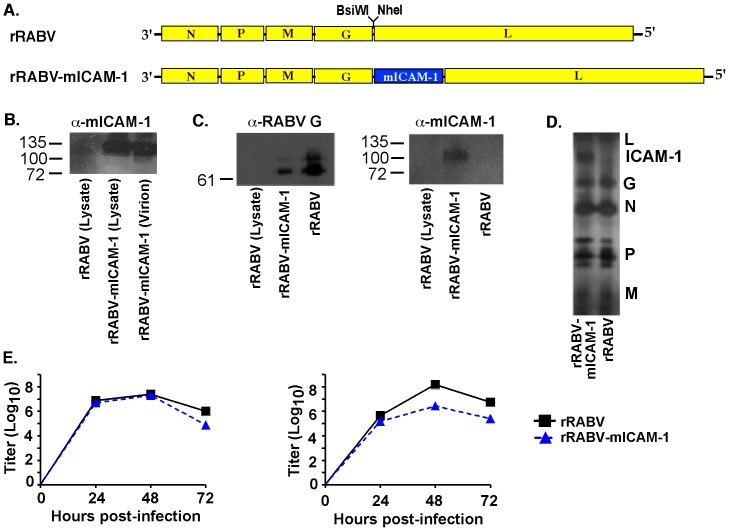
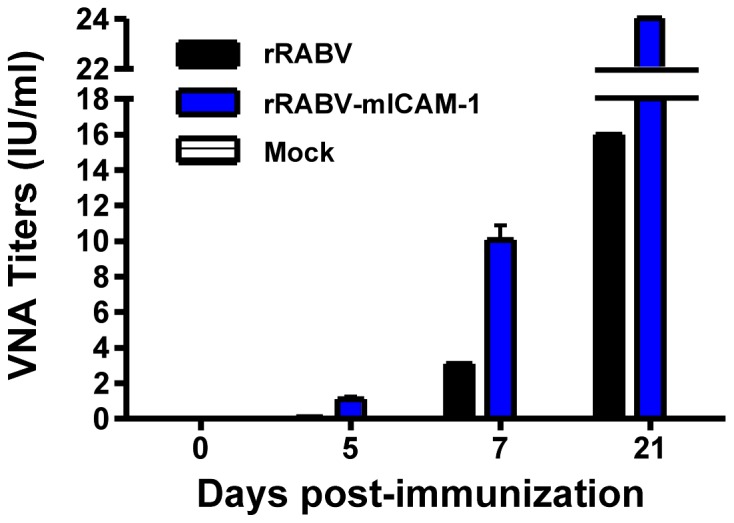
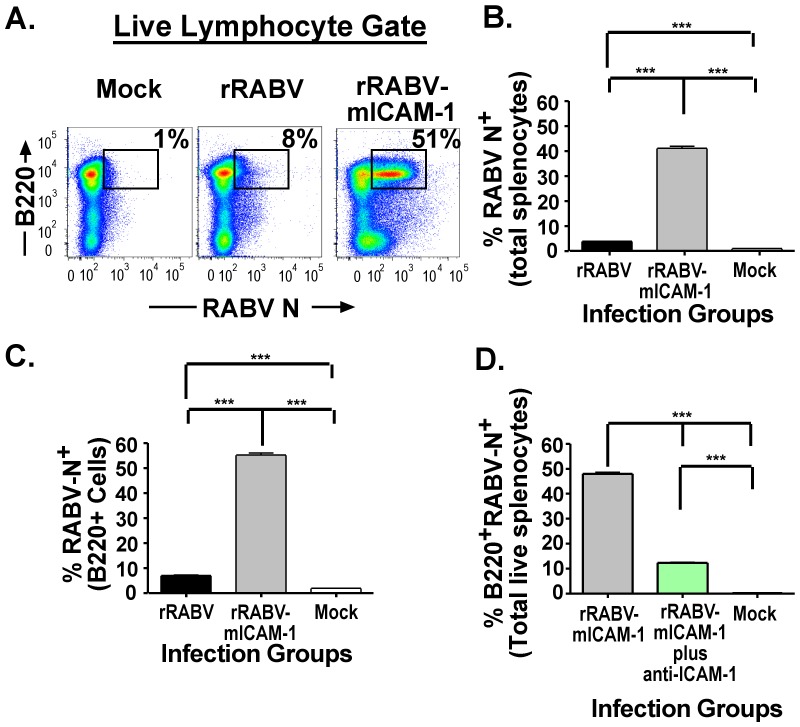
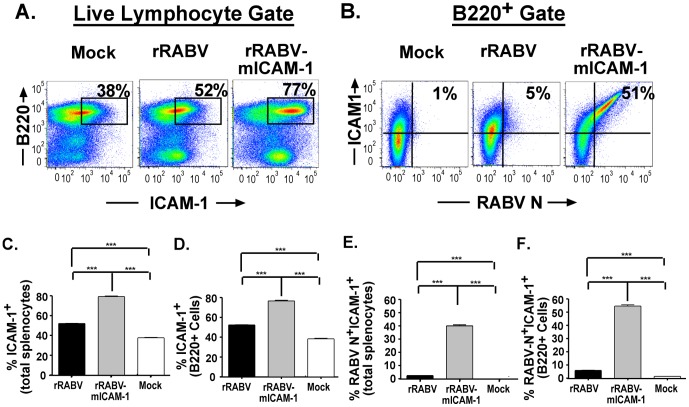
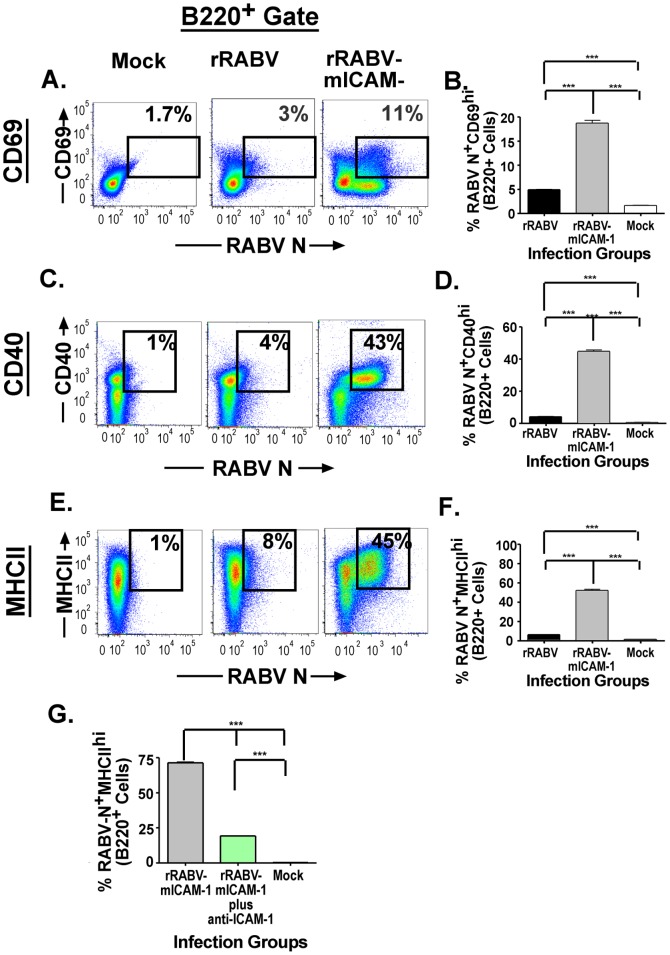
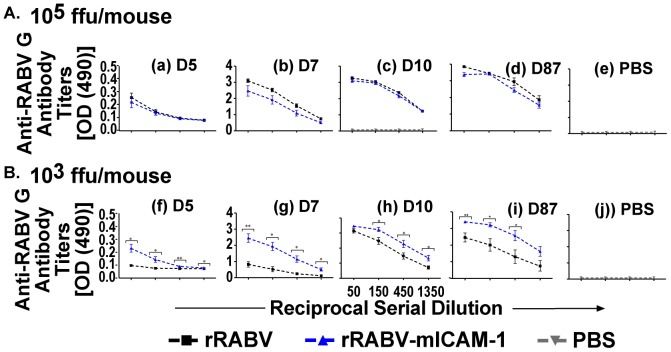
We have previously shown that live-attenuated rabies virus (RABV)-based vaccines infect and directly activate murine and human primary B cells in-vitro, which we propose can be exploited to help develop a single-dose RABV-based vaccine. Here we report on a novel approach to utilize the binding of Intracellular Adhesion Molecule-1 (ICAM-1) to its binding partner, Lymphocyte Function-associated Antigen-1 (LFA-1), on B cells to enhance B cell activation and RABV-specific antibody responses. We used a reverse genetics approach to clone, recover, and characterize a live-attenuated recombinant RABV-based vaccine expressing the murine Icam1 gene (rRABV-mICAM-1). We show that the murine ICAM-1 gene product is incorporated into virus particles, potentially exposing ICAM-1 to extracellular binding partners. While rRABV-mICAM-1 showed 10-100-fold decrease in viral titers on baby hamster kidney cells compared to the parental virus (rRABV), rRABV-mICAM-1 infected and activated primary murine B cells in-vitro more efficiently than rRABV, as indicated by significant upregulation of CD69, CD40, and MHCII on the surface of infected B cells. ICAM-1 expression on the virus surface was responsible for enhanced B cell infection since pre-treating rRABV-mICAM-1 with a neutralizing anti-ICAM-1 antibody reduced B cell infection to levels observed with rRABV alone. Furthermore, 100-fold less rRABV-mICAM-1 was needed to induce antibody titers in immunized mice equivalent to antibody titers observed in rRABV-immunized mice. Of note, only 10(3) focus forming units (ffu)/mouse of rRABV-mICAM-1 was needed to induce significant anti-RABV antibody titers as early as five days post-immunization. As both speed and potency of antibody responses are important in controlling human RABV infection in a post-exposure setting, these data show that expression of Icam1 from the RABV genome, which is then incorporated into the virus particle, is a promising strategy for the development of a single-dose RABV vaccine that requires only a minimum of virus.
我们之前已经表明,基于减毒活狂犬病病毒(RABV)的疫苗在体外能感染并直接激活小鼠和人类原代B细胞,我们认为这可用于帮助开发单剂量的基于RABV的疫苗。在此,我们报告一种新方法,利用细胞间黏附分子-1(ICAM-1)与其在B细胞上的结合伴侣淋巴细胞功能相关抗原-1(LFA-1)的结合,来增强B细胞活化和RABV特异性抗体反应。我们采用反向遗传学方法克隆、拯救并鉴定了一种表达小鼠Icam1基因的基于减毒活重组RABV的疫苗(rRABV-mICAM-1)。我们发现小鼠ICAM-1基因产物被整合到病毒颗粒中,可能使ICAM-1暴露于细胞外结合伴侣。虽然与亲本病毒(rRABV)相比,rRABV-mICAM-1在幼仓鼠肾细胞上的病毒滴度降低了10至100倍,但rRABV-mICAM-1在体外感染并激活原代小鼠B细胞的效率比rRABV更高,这表现为受感染B细胞表面的CD69、CD40和MHCII显著上调。病毒表面的ICAM-1表达导致B细胞感染增强,因为用中和性抗ICAM-1抗体预处理rRABV-mICAM-1可将B细胞感染降低至单独使用rRABV时观察到的水平。此外,在免疫小鼠中诱导与rRABV免疫小鼠中观察到的抗体滴度相当的抗体滴度,所需的rRABV-mICAM-1量要少100倍。值得注意的是,早在免疫后五天,仅需10³蚀斑形成单位(ffu)/小鼠的rRABV-mICAM-1就能诱导出显著的抗RABV抗体滴度。由于抗体反应的速度和效力在暴露后情况下控制人类RABV感染中都很重要,这些数据表明,从RABV基因组表达并随后整合到病毒颗粒中的Icam1,是开发仅需极少量病毒的单剂量RABV疫苗的一种有前景的策略。