Sorbonne Universités, UPMC Univ Paris 06, Institute of Ecology and Environmental Sciences - Paris, Paris, France.
CNRS, Institute of Ecology and Environmental Sciences - Paris, Campus AgroParisTech, Thiverval-Grignon, France.
PLoS One. 2014 Jan 28;9(1):e87217. doi: 10.1371/journal.pone.0087217. eCollection 2014.
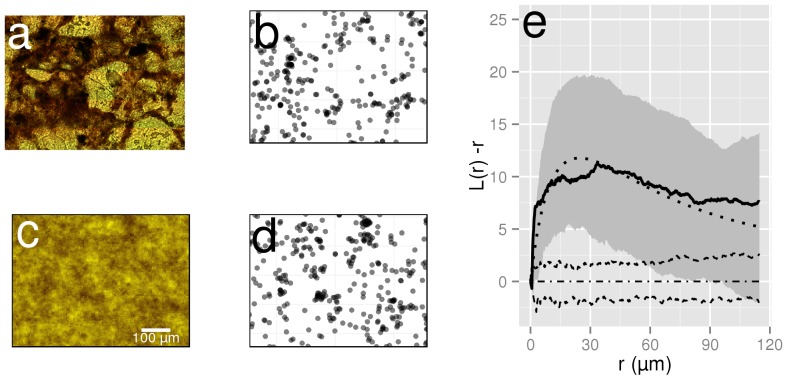
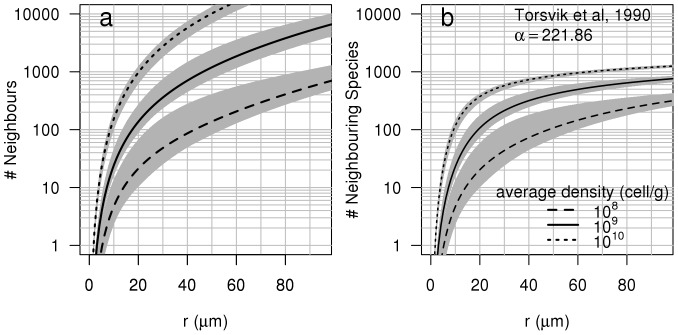
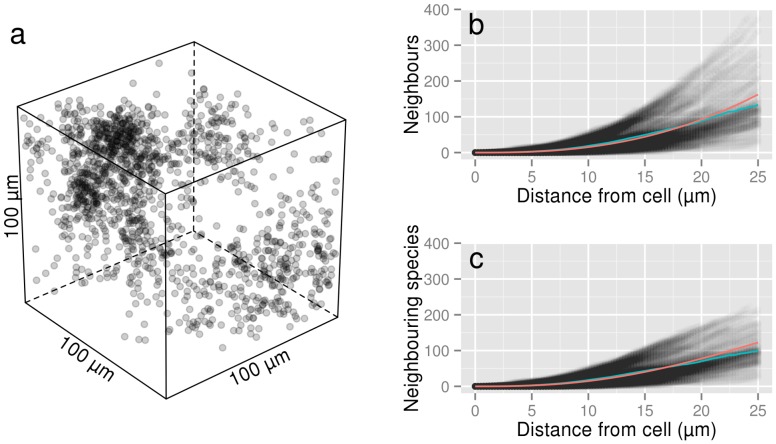
Despite an exceptional number of bacterial cells and species in soils, bacterial diversity seems to have little effect on soil processes, such as respiration or nitrification, that can be affected by interactions between bacterial cells. The aim of this study is to understand how bacterial cells are distributed in soil to better understand the scaling between cell-to-cell interactions and what can be measured in a few milligrams, or more, of soil. Based on the analysis of 744 images of observed bacterial distributions in soil thin sections taken at different depths, we found that the inter-cell distance was, on average 12.46 µm and that these inter-cell distances were shorter near the soil surface (10.38 µm) than at depth (>18 µm), due to changes in cell densities. These images were also used to develop a spatial statistical model, based on Log Gaussian Cox Processes, to analyse the 2D distribution of cells and construct realistic 3D bacterial distributions. Our analyses suggest that despite the very high number of cells and species in soil, bacteria only interact with a few other individuals. For example, at bacterial densities commonly found in bulk soil (10(8) cells g(-1) soil), the number of neighbours a single bacterium has within an interaction distance of ca. 20 µm is relatively limited (120 cells on average). Making conservative assumptions about the distribution of species, we show that such neighbourhoods contain less than 100 species. This value did not change appreciably as a function of the overall diversity in soil, suggesting that the diversity of soil bacterial communities may be species-saturated. All in all, this work provides precise data on bacterial distributions, a novel way to model them at the micrometer scale as well as some new insights on the degree of interactions between individual bacterial cells in soils.
尽管土壤中有大量的细菌细胞和种类,但细菌多样性似乎对土壤过程(如呼吸或硝化作用)影响不大,这些过程可能受到细菌细胞之间相互作用的影响。本研究旨在了解细菌细胞在土壤中的分布方式,以便更好地理解细胞间相互作用的尺度,以及可以从几毫克或更多的土壤中测量到什么。本研究基于对取自不同深度的土壤薄片中观察到的细菌分布的 744 张图像的分析,发现细胞间距离平均为 12.46 µm,并且这些细胞间距离在土壤表面附近(10.38 µm)比在深处(>18 µm)更短,这是由于细胞密度的变化。这些图像还被用于开发一种基于对数高斯 Cox 过程的空间统计模型,以分析细胞的 2D 分布并构建现实的 3D 细菌分布。我们的分析表明,尽管土壤中有非常多的细胞和种类,但细菌只与少数其他个体相互作用。例如,在通常在土壤中发现的细菌密度(10(8)个细胞 g(-1)土壤)下,单个细菌在大约 20 µm 的相互作用距离内的邻居数量相对有限(平均 120 个细胞)。基于对物种分布的保守假设,我们表明这样的邻居中包含的物种不到 100 种。这个值并没有随着土壤中整体多样性的变化而显著变化,这表明土壤细菌群落的多样性可能已经达到了物种饱和的程度。总之,这项工作提供了关于细菌分布的精确数据,为在微米尺度上对其进行建模提供了一种新方法,并且为了解土壤中单个细菌细胞之间的相互作用程度提供了一些新的见解。