Department of Nephrology, Lund University, Lund, Sweden.
Department of Nephrology, Lund University, Lund, Sweden ; Department of Internal Medicine, UAE University, Al-Ain, United Arab Emirates.
PLoS One. 2014 Jan 29;9(1):e87857. doi: 10.1371/journal.pone.0087857. eCollection 2014.
Monocyte chemoattractant protein-1 (MCP-1), which is up regulated in kidney diseases, is considered a marker of kidney inflammation. We examined the value of urine MCP-1 in predicting the outcome in idiopathic glomerulonephritis.
Between 1993 and 2004, 165 patients (68 females) diagnosed with idiopathic proteinuric glomerulopathy and with serum creatinine <150 µmol/L at diagnosis were selected for the study. Urine concentrations of MCP-1 were analyzed by ELISA in early morning spot urine samples collected on the day of the diagnostic kidney biopsy. The patients were followed until 2009. The progression rate to end-stage kidney disease was calculated using Kaplan-Meier survival analysis. End-stage kidney disease (ESKD) was defined as the start of kidney replacement therapy during the study follow-up time.
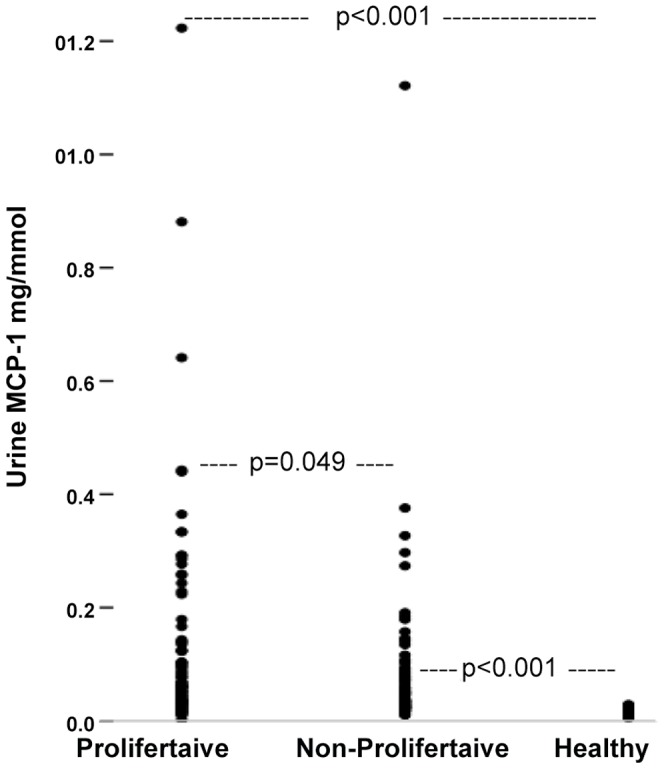
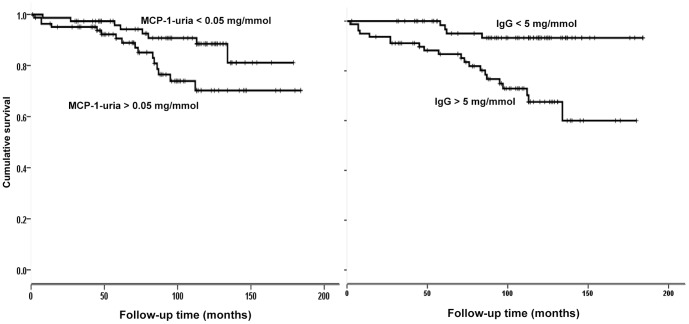
Patients with proliferative glomerulonephritis had significantly higher urinary MCP-1 excretion levels than those with non-proliferative glomerulonephritis (p<0.001). The percentage of patients whose kidney function deteriorated significantly was 39.0% in the high MCP-1 excretion group and 29.9% in the low MCP-1 excretion group. However, after adjustment for confounding variables such as glomerular filtration rate (GFR) and proteinuria, there was no significant association between urine MCP-1 concentration and progression to ESKD, (HR=1.75, 95% CI=0.64-4.75, p=0.27).
Our findings indicate that progression to end-stage kidney disease in patients with idiopathic glomerulopathies is not associated with urine MCP-1 concentrations at the time of diagnosis.
单核细胞趋化蛋白-1(MCP-1)在肾脏疾病中上调,被认为是肾脏炎症的标志物。我们研究了尿 MCP-1 在预测特发性肾小球肾炎患者预后中的价值。
1993 年至 2004 年间,选择了 165 例(68 名女性)诊断为特发性蛋白尿性肾小球病且诊断时血清肌酐<150µmol/L 的患者进行研究。采用 ELISA 法分析晨尿标本中 MCP-1 的浓度,这些标本均于诊断性肾活检当天清晨采集。对患者进行随访至 2009 年。采用 Kaplan-Meier 生存分析计算进展为终末期肾病的速率。终末期肾病(ESKD)定义为研究随访期间开始进行肾脏替代治疗。
增生性肾小球肾炎患者的尿 MCP-1 排泄水平明显高于非增生性肾小球肾炎患者(p<0.001)。肾功能明显恶化的患者中,高 MCP-1 排泄组的比例为 39.0%,低 MCP-1 排泄组的比例为 29.9%。然而,在调整肾小球滤过率(GFR)和蛋白尿等混杂变量后,尿 MCP-1 浓度与进展为 ESKD 之间无显著相关性(HR=1.75,95%CI=0.64-4.75,p=0.27)。
我们的研究结果表明,特发性肾小球病患者进展为终末期肾病与诊断时尿 MCP-1 浓度无关。