Liu Yehao, Li Yuhui, Liu Kaiyong, Shen Jie
School of Public Health, Anhui Medical University, Hefei, Anhui Province, People's Republic of China.
Department of Biological and Environmental Engineering, Hefei Univeristy, Hefei, Anhui Province, People's Republic of China.
PLoS One. 2014 Feb 3;9(2):e85323. doi: 10.1371/journal.pone.0085323. eCollection 2014.
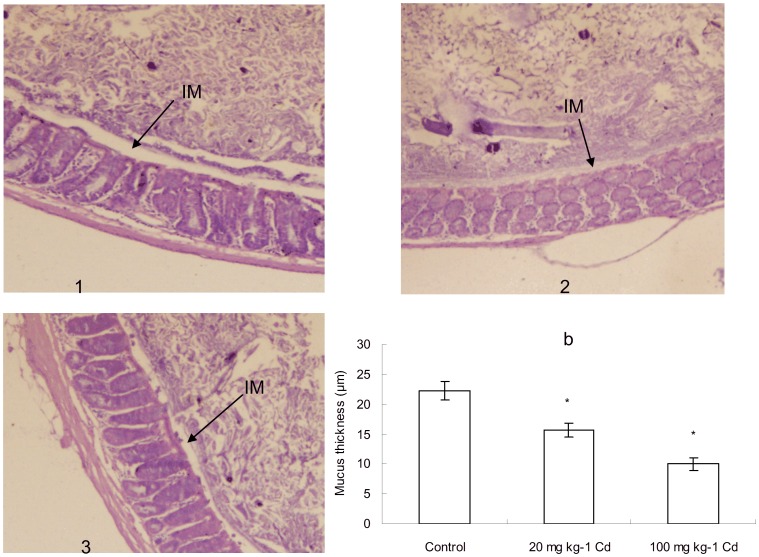
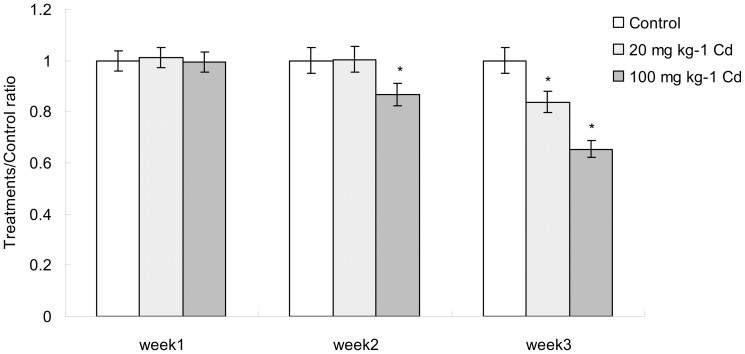
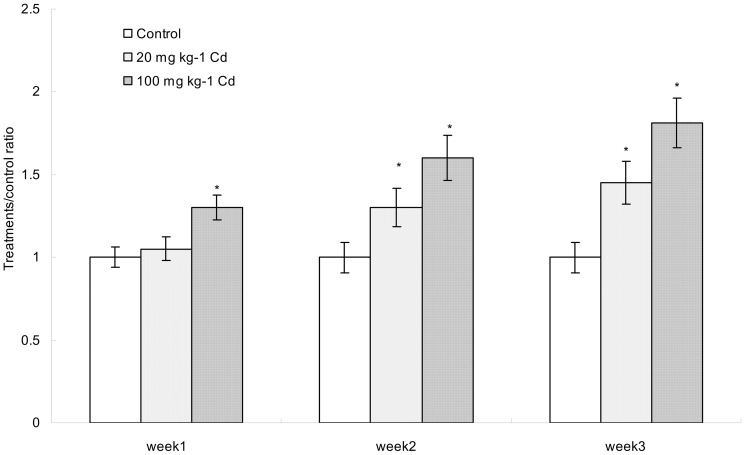
Cadmium (Cd), one of the heavy metals, is an important environmental pollutant and a potent toxicant to organism. It poses a severe threat to the growth of the organism, and also has been recognized as a human carcinogen. However, the toxicity of cadmium and its influences on microbiota in mammal's intestine are still unclear. In our experiment, the changes of intestinal microbiota in two groups of mice were investigated, which were supplied with 20 and 100 mg kg(-1) cadmium chloride respectively for 3 weeks. The control group was treated with water free from cadmium chloride only. This study demonstrated that Cd accumulated in some tissues of mice after Cd administration and the gut barrier was impaired. Cd exposure also significantly elevated the colonic level of TNF-α. On the other hand, Cd-treatment could slow down the growth of gut microbiota and reduced the abundance of total intestinal bacteria of the mice. Among them, the growth of Bacteroidetes was significantly suppressed while Firmicutes growth was not. The probiotics including Lactobacillus and Bifidobacterium were notably inhibited. We also observed that the copies of key genes involved in the metabolism of carbohydrates to short-chain fatty acids (SCFAs) were lower in Cd-treated groups than control. As a result, the levels of short-chain fatty acids in colonic decreased significantly. In summary, this study provides valuable insight into the effects of Cd intake on mice gut microbiota.
镉(Cd)是重金属之一,是一种重要的环境污染物,对生物体具有很强的毒性。它对生物体的生长构成严重威胁,并且已被确认为人类致癌物。然而,镉的毒性及其对哺乳动物肠道微生物群的影响仍不清楚。在我们的实验中,研究了两组小鼠肠道微生物群的变化,这两组小鼠分别给予20和100 mg kg(-1)的氯化镉,持续3周。对照组仅用不含氯化镉的水处理。本研究表明,镉给药后在小鼠的一些组织中积累,并且肠道屏障受损。镉暴露还显著提高了结肠中TNF-α的水平。另一方面,镉处理会减缓肠道微生物群的生长,并降低小鼠肠道细菌总数。其中,拟杆菌的生长受到显著抑制,而厚壁菌的生长则不受影响。包括乳酸杆菌和双歧杆菌在内的益生菌受到显著抑制。我们还观察到,与碳水化合物代谢为短链脂肪酸(SCFAs)相关的关键基因的拷贝数在镉处理组中低于对照组。结果,结肠中短链脂肪酸的水平显著降低。总之,本研究为镉摄入对小鼠肠道微生物群的影响提供了有价值的见解。