Poussin Karine, Pilati Camilla, Couchy Gabrielle, Calderaro Julien, Bioulac-Sage Paulette, Bacq Yannick, Paradis Valérie, Leteurtre Emmanuelle, Sturm Nathalie, Ramos Jeanne, Guettier Catherine, Bardier-Dupas Armelle, Boulai Anais, Wendum Dominique, Selves Janick, Izard Tina, Nault Jean-Charles, Zucman-Rossi Jessica
INSERM, UMR-674; Génomique fonctionnelle des tumeurs solides; IUH; Paris, France ; Université Paris Descartes; Labex Immuno-oncology; Sorbonne Paris Cité; Faculté de Médecine; Paris, France.
INSERM, UMR-674; Génomique fonctionnelle des tumeurs solides; IUH; Paris, France ; Université Paris Descartes; Labex Immuno-oncology; Sorbonne Paris Cité; Faculté de Médecine; Paris, France ; Assistance Publique-Hôpitaux de Paris; Department of Pathology; CHU Henri Mondor; Créteil, France.
Oncoimmunology. 2013 Dec 1;2(12):e27090. doi: 10.4161/onci.27090. Epub 2014 Jan 3.
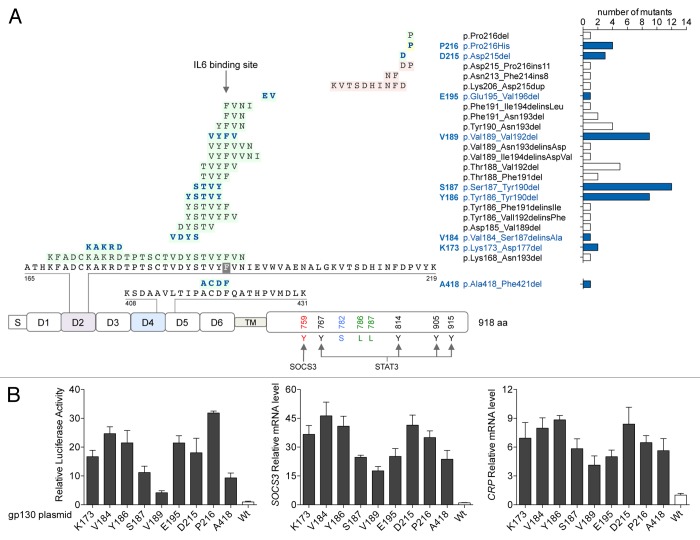
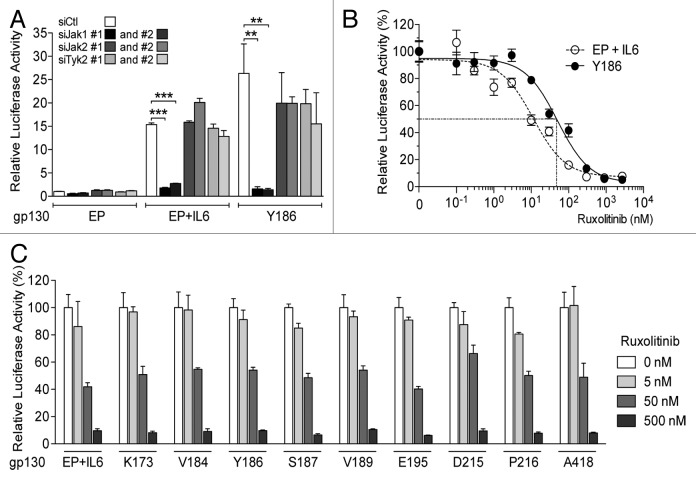
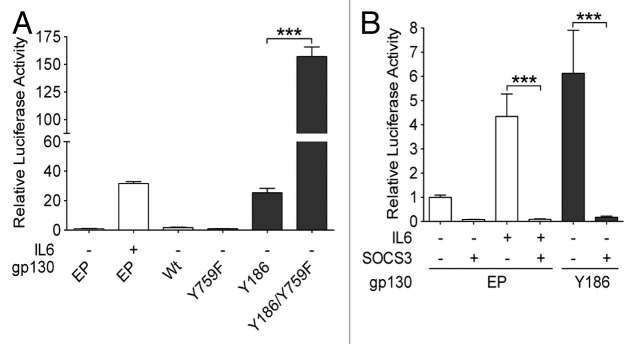
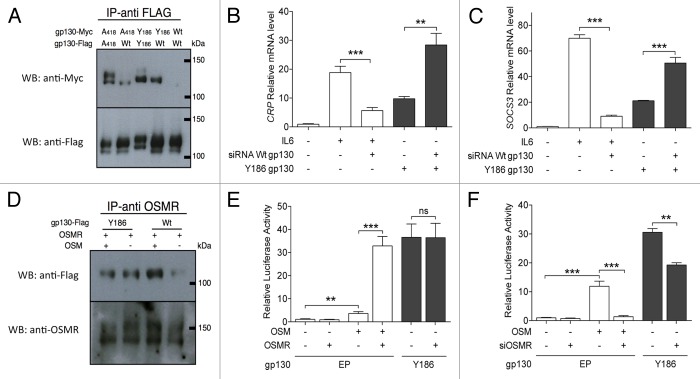
Inflammatory hepatocellular adenomas (IHCAs) are benign liver lesions that can be characterized histologically by the presence of an inflammatory infiltrate and at the molecular level by the overexpression of acute phase inflammatory response genes. Recurrent somatic mutations of the interleukin-6 (IL-6) signal transducer ( locus, encoding the critical component of the IL-6 signal transduction machinery gp130, are present in 60% of IHCAs and in a subset (2%) of hepatocellular carcinoma (HCCs). By screening of 256 human hepatic adenoma specimens (the largest genetic analysis of performed to date in this setting), we identified 24 distinct somatic mutations among 66 mutant adenomas. The functional analysis of nine different gp130 mutants expressed in hepatic cancer cell lines consistently revealed the constitutive and IL-6-independent activation of the JAK/STAT signaling pathway. We further demonstrated that the signaling activity of mutant gp130 in IHCA remains responsive to suppressor of cytokine signaling 3 (SOCS3), a physiological gp130 inhibitor. Specifically, cells expressing a double mutant variant of gp130 with a disrupted SOCS3-binding site at residue 759 (Y186/Y759F) displayed a hyperactivation of signal transducer and activator of transcription 3 (STAT3) as compared with cells expressing the endogenous IHCA-associated Y186 gp130 mutant. Notably, we identified that constitutive signaling via gp130 in IHCA requires the Janus kinase family member JAK1, but not JAK2 or tyrosine kinase 2. In support of this notion, AG490, a tyrosine kinase inhibitor that selectively blocks JAK2, had no effect on gp130 activity. In stark contrast, we showed that ruxolitinib, a JAK1/JAK2-selective tyrosine kinase inhibitor used to treat patients with myelofibrosis, dramatically impaired JAK1-STAT signaling downstream of all IHCA-associated gp130 mutants. In conclusion, our findings provide a rationale for the use of JAK1 inhibitors for the treatment of HCAs expressing mutant gp130 as well as a subset of HCCs that bear similar mutations.
炎症性肝细胞腺瘤(IHCAs)是良性肝脏病变,在组织学上其特征为存在炎症浸润,在分子水平上则表现为急性期炎症反应基因的过表达。白细胞介素-6(IL-6)信号转导子(编码IL-6信号转导机制关键成分gp130的基因座)的复发性体细胞突变存在于60%的IHCAs以及一部分(2%)肝细胞癌(HCCs)中。通过对256例人类肝腺瘤标本进行筛查(这是迄今为止在该领域进行的最大规模基因分析),我们在66例突变腺瘤中鉴定出24种不同的体细胞突变。对在肝癌细胞系中表达的9种不同gp130突变体进行功能分析,一致揭示了JAK/STAT信号通路的组成性和IL-6非依赖性激活。我们进一步证明,IHCA中突变gp130的信号活性对细胞因子信号抑制因子3(SOCS3)(一种生理性gp130抑制剂)仍有反应。具体而言,与表达内源性IHCA相关Y186 gp130突变体的细胞相比,表达在第759位残基(Y186/Y759F)处具有破坏的SOCS3结合位点的gp130双突变变体的细胞表现出信号转导和转录激活因子3(STAT3)的过度激活。值得注意的是,我们发现IHCA中通过gp130的组成性信号传导需要Janus激酶家族成员JAK1,而不是JAK2或酪氨酸激酶2。支持这一观点的是,选择性阻断JAK2的酪氨酸激酶抑制剂AG490对gp130活性没有影响。与之形成鲜明对比的是,我们发现用于治疗骨髓纤维化患者的JAK1/JAK2选择性酪氨酸激酶抑制剂鲁索替尼显著损害了所有与IHCA相关的gp130突变体下游的JAK1-STAT信号传导。总之,我们的研究结果为使用JAK1抑制剂治疗表达突变gp130的HCA以及一部分具有相似突变的HCC提供了理论依据。