Concha-Benavente Fernando, Srivastava Raghvendra M, Ferrone Soldano, Ferris Robert L
Department of Immunology; University of Pittsburgh; Pittsburgh, PA USA.
Department of Otolaryngology; University of Pittsburgh; Pittsburgh, PA USA.
Oncoimmunology. 2013 Dec 1;2(12):e27215. doi: 10.4161/onci.27215. Epub 2013 Dec 5.
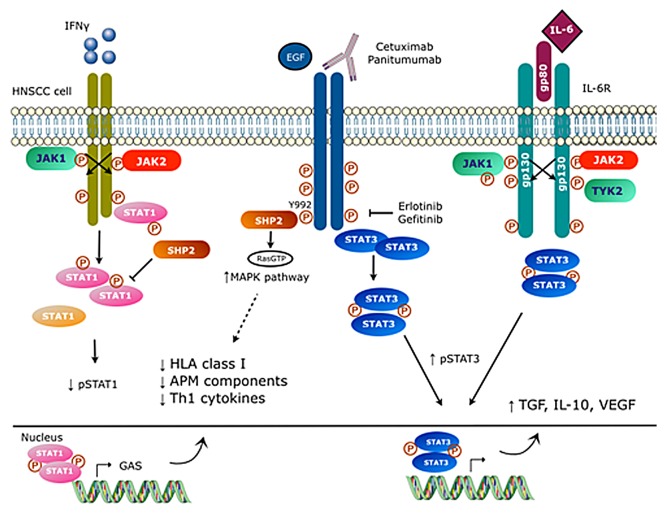
The epidermal growth factor receptor (EGFR) supports the escape of malignant cells from immunosurveillance by inhibiting the activation of signal transducer and activator of transcription 1 (STAT1) while promoting that of STAT3. We have recently demonstrated that protein tyrosine phosphatase, non-receptor type 11 (PTNP11, best known as SHP2), a phosphatase that operates downstream of EGFR, is responsible for the dephosphorylation of active STAT1 and for the inhibition of the antigen-processing machinery (APM), hence favoring tumor immunoescape. Thus, EGFR signaling may skew the tumor microenvironment to suppress cellular immune responses.
表皮生长因子受体(EGFR)通过抑制信号转导和转录激活因子1(STAT1)的激活,同时促进STAT3的激活,来支持恶性细胞逃避免疫监视。我们最近证明,蛋白酪氨酸磷酸酶非受体11型(PTNP11,最广为人知的是SHP2),一种在EGFR下游起作用的磷酸酶,负责活性STAT1的去磷酸化以及对抗抗原加工机制(APM),从而促进肿瘤免疫逃逸。因此,EGFR信号传导可能会使肿瘤微环境发生偏差,以抑制细胞免疫反应。