Department of Psychology, University of Maryland , College Park, MD , USA.
Department of Psychology, Peking University , Beijing , China.
Front Psychiatry. 2014 Jan 29;5:7. doi: 10.3389/fpsyt.2014.00007. eCollection 2014.
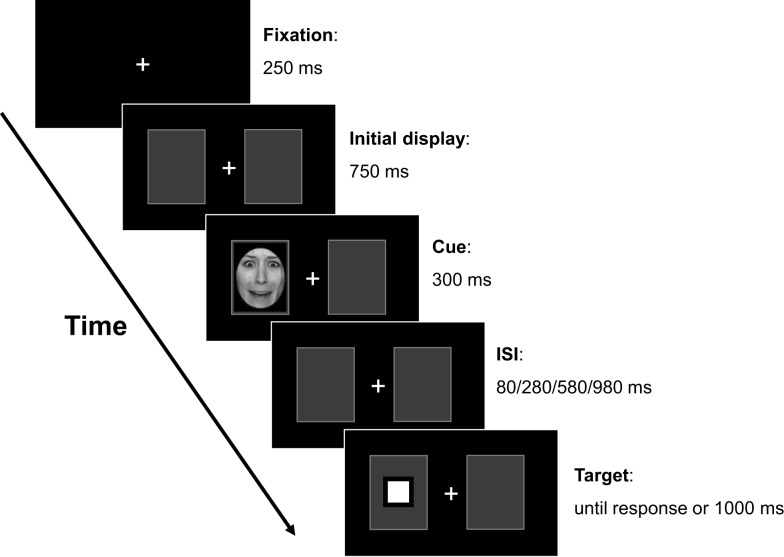
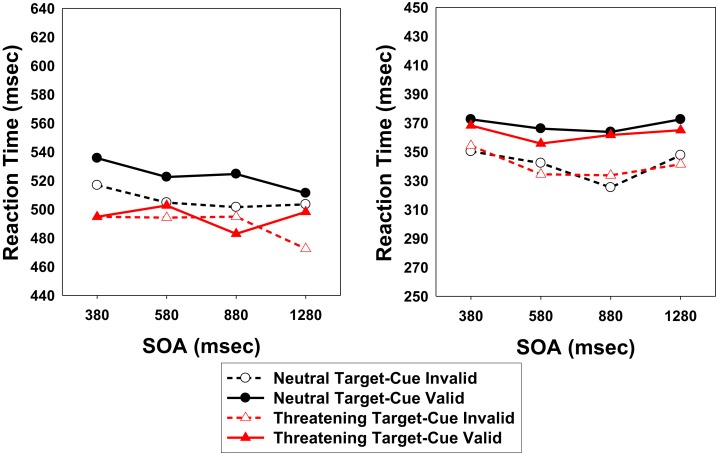
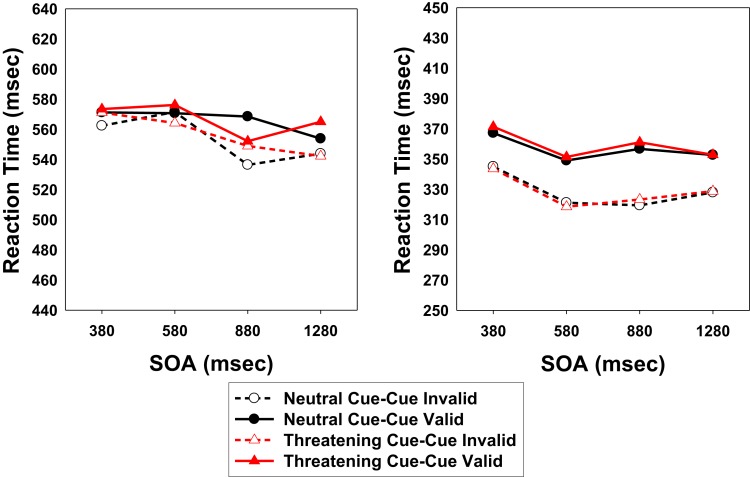
Attention deficits are prominent among the core symptoms of schizophrenia. A recent meta-analysis has suggested that patients with schizophrenia have a deficit in endogenous disengagement of attention. In this research, we used a standard spatial cueing paradigm to examine whether the attention deficit of such patients is due to impaired attentional disengagement or defective novelty detection/habituation processes. In a spatial cueing procedure with peripheral non-predictive cues and a detection task, we manipulated the valence of either the cue or the target (i.e., a threatening vs. scrambled face) in two separate experiments. The control group exhibited a smaller inhibition of return (IOR) effect only when the target had an emotional load, not when the cue had an emotional load. In the patient group, a larger emotional effect appeared when the threatening face was the target; by contrast, no effect of valence was observed when the threatening face was the cue: IOR was delayed or completely absent independently of valence. The present findings are in conflict with the hypothesis that IOR is due to the disengagement of attention and the subsequent inhibition to return. Instead, they seem to suggest a cost in detecting new information at a previously cued location. From this perspective, it seems that patients with schizophrenia might have a deficit in detecting new information and considering it as new in the current context.
注意缺陷是精神分裂症的核心症状之一。最近的一项荟萃分析表明,精神分裂症患者存在内源性注意力分散缺陷。在这项研究中,我们使用了标准的空间提示范式来检验这些患者的注意力缺陷是否是由于注意力分散受损或新颖性检测/习惯化过程有缺陷所致。在一个带有外周非预测线索和检测任务的空间线索程序中,我们在两个单独的实验中操纵了线索或目标的效价(即威胁面孔与乱码面孔)。控制组仅在目标具有情绪负荷时表现出较小的返回抑制(IOR)效应,而在线索具有情绪负荷时则没有。在患者组中,当威胁面孔是目标时,出现了更大的情绪效应;相比之下,当威胁面孔是线索时,没有观察到效价的影响:IOR 延迟或完全不存在,而与效价无关。这些发现与 IOR 是由于注意力分散和随后对返回的抑制的假设相矛盾。相反,它们似乎表明在先前提示的位置检测新信息存在成本。从这个角度来看,精神分裂症患者似乎在检测新信息并将其视为当前情境中的新信息方面存在缺陷。