Group of Radiation Biology and Tumor Physiology, Department of Radiation Biology, Institute for Cancer Research, Oslo University Hospital, Nydalen, Box 4953, Oslo N-0424, Norway.
BMC Cancer. 2014 Feb 15;14:92. doi: 10.1186/1471-2407-14-92.
Cancer patients with primary tumors showing extensive hypoxia and highly elevated interstitial fluid pressure (IFP) have poor prognosis. The potential of diffusion-weighted magnetic resonance imaging (DW-MRI) in assessing the hypoxic fraction, IFP, and metastatic propensity of tumors was investigated in this study.
A-07 and R-18 melanoma xenografts were used as general models of human cancer. DW-MRI was performed at 1.5 T, and maps of the apparent diffusion coefficient (ADC) were produced with in-house-made software developed in Matlab. Pimonidazole was used as a hypoxia marker. Tumor cell density and hypoxic fraction were assessed by quantitative analysis of histological sections. IFP was measured with a Millar catheter. Metastatic propensity was determined by examining tumor-bearing mice for pulmonary micrometastases post mortem.
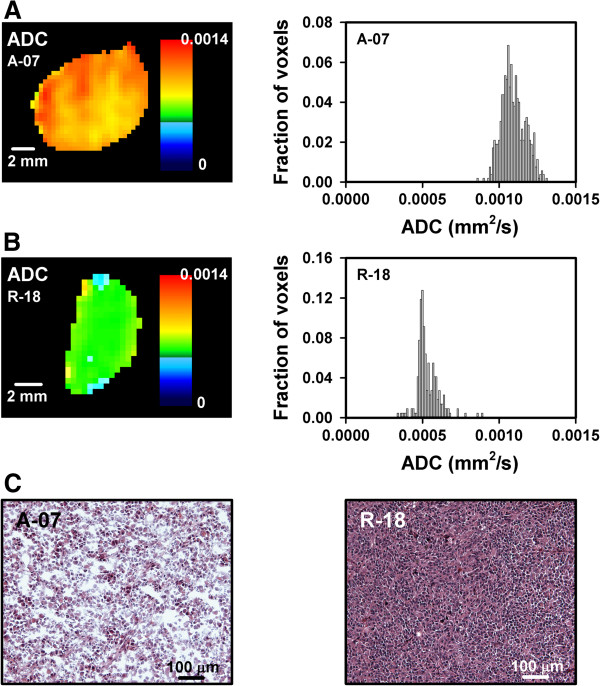
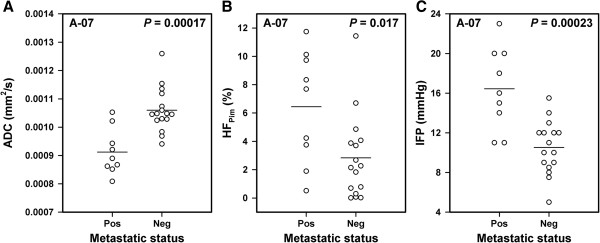
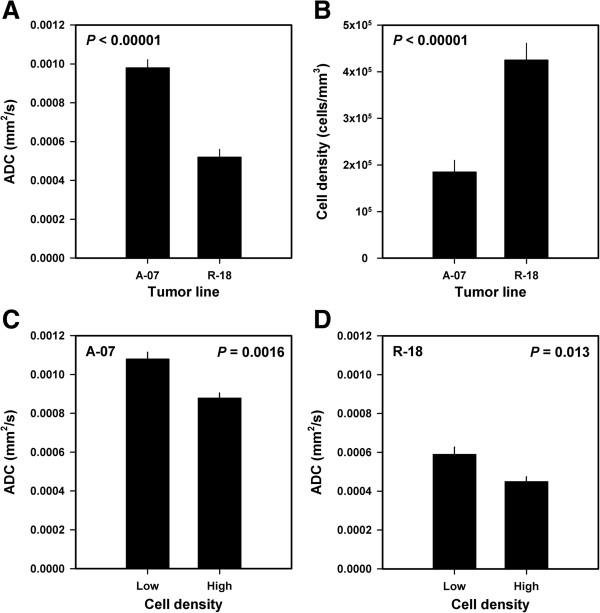
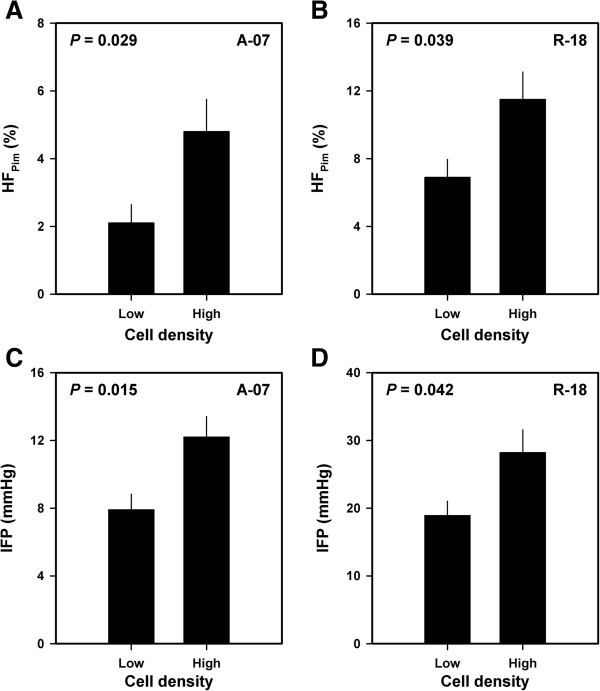
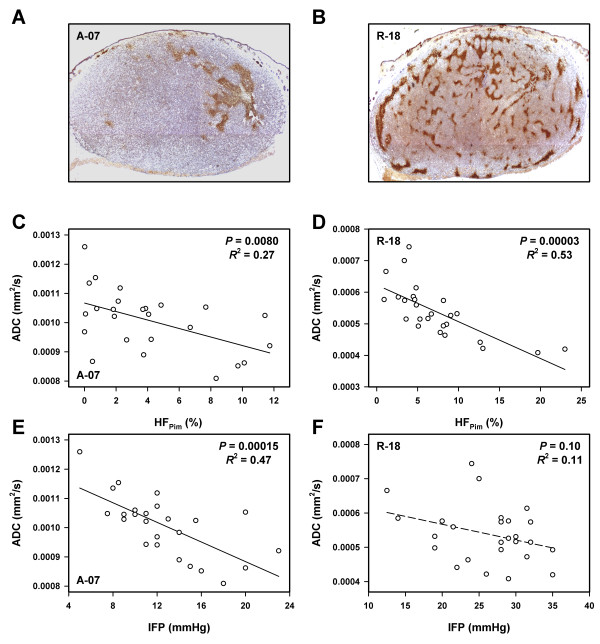
ADC decreased with increasing tumor cell density, independent of whether the A-07 and R-18 data were analyzed separately or together. In the A-07 line, ADC decreased with increasing hypoxic fraction and increasing IFP and was lower in metastatic than in nonmetastatic tumors, and in the R-18 line, ADC decreased with increasing hypoxic fraction. There was a strong inverse correlation between ADC and hypoxic fraction as well as between ADC and IFP across the two tumor lines, primarily because low ADC as well as high hypoxic fraction and high IFP were associated with high cell density.
Low ADC is a potentially useful biomarker of poor prognosis in cancer, since low ADC is mainly a consequence of high cell density, and high cell density may lead to increased hypoxia and interstitial hypertension and, therefore, increased microenvironment-associated metastasis.
原发肿瘤表现出广泛缺氧和高间质液压力(IFP)的癌症患者预后较差。本研究旨在探讨扩散加权磁共振成像(DW-MRI)在评估肿瘤缺氧分数、IFP 和转移倾向方面的潜力。
A-07 和 R-18 黑色素瘤异种移植被用作人类癌症的一般模型。在 1.5 T 下进行 DW-MRI,并使用在 Matlab 中开发的内部软件生成表观扩散系数(ADC)图。使用 pimonidazole 作为缺氧标志物。通过对肿瘤细胞密度和缺氧分数进行定量分析来评估肿瘤细胞密度和缺氧分数。使用 Millar 导管测量 IFP。通过对死后荷瘤小鼠进行肺微转移检查来确定转移倾向。
ADC 随肿瘤细胞密度的增加而降低,无论 A-07 和 R-18 数据是单独分析还是一起分析。在 A-07 系中,ADC 随缺氧分数和 IFP 的增加而降低,在转移性肿瘤中低于非转移性肿瘤,在 R-18 系中,ADC 随缺氧分数的增加而降低。在这两个肿瘤系中,ADC 与缺氧分数之间以及 ADC 与 IFP 之间存在很强的负相关,主要是因为低 ADC 以及高缺氧分数和高 IFP 与高细胞密度有关。
低 ADC 是癌症预后不良的一个潜在有用的生物标志物,因为低 ADC 主要是由于细胞密度高所致,而高细胞密度可能导致缺氧和间质高血压增加,从而导致微环境相关转移增加。