Wahyuni Yuni, Stahl-Hermes Vanessa, Ballester Ana-Rosa, de Vos Ric C H, Voorrips Roeland E, Maharijaya Awang, Molthoff Jos, Zamora Marcela Viquez, Sudarmonowati Enny, Arisi Ana Carolina Maisonnave, Bino Raoul J, Bovy Arnaud G
Wageningen UR Plant Breeding, 6708 PB Wageningen, The Netherlands ; Research Centre for Biotechnology, Indonesian Institute of Sciences, Jl. Raya Bogor KM. 46, Cibinong, Bogor, 16910 Indonesia.
Wageningen UR Plant Breeding, 6708 PB Wageningen, The Netherlands ; Departamento de Ciência e Tecnologia de Alimentos, Centro de Ciências Agrárias, Universidade Federal de Santa Catarina, Rod. Admar Gonzaga, 1346, Florianópolis, SC 88034-001 Brazil.
Mol Breed. 2014;33(3):503-518. doi: 10.1007/s11032-013-9967-0. Epub 2013 Oct 23.
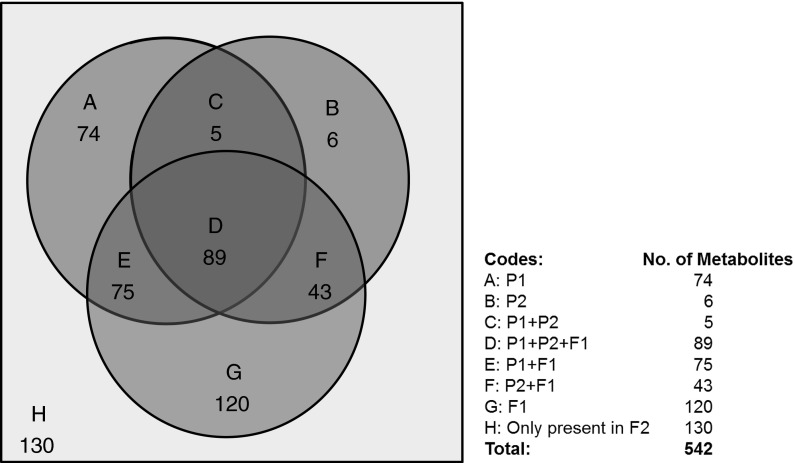
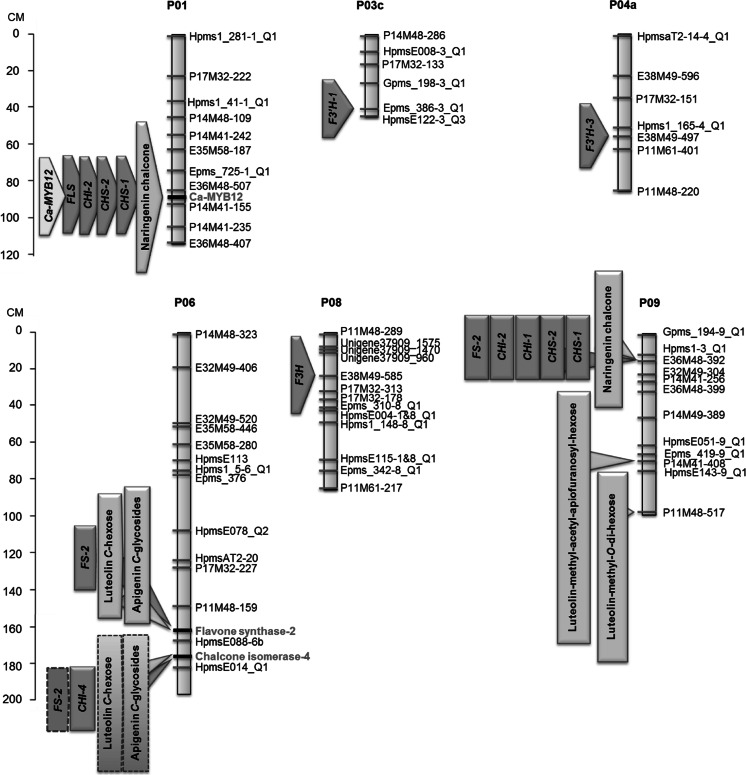
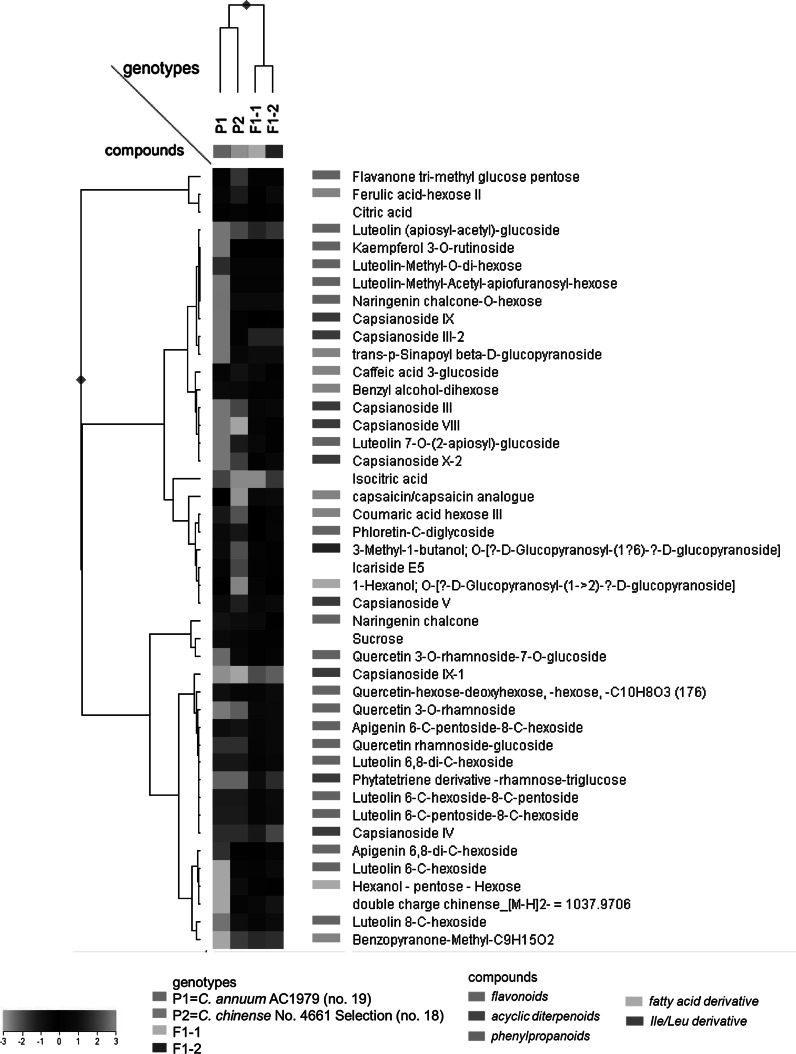
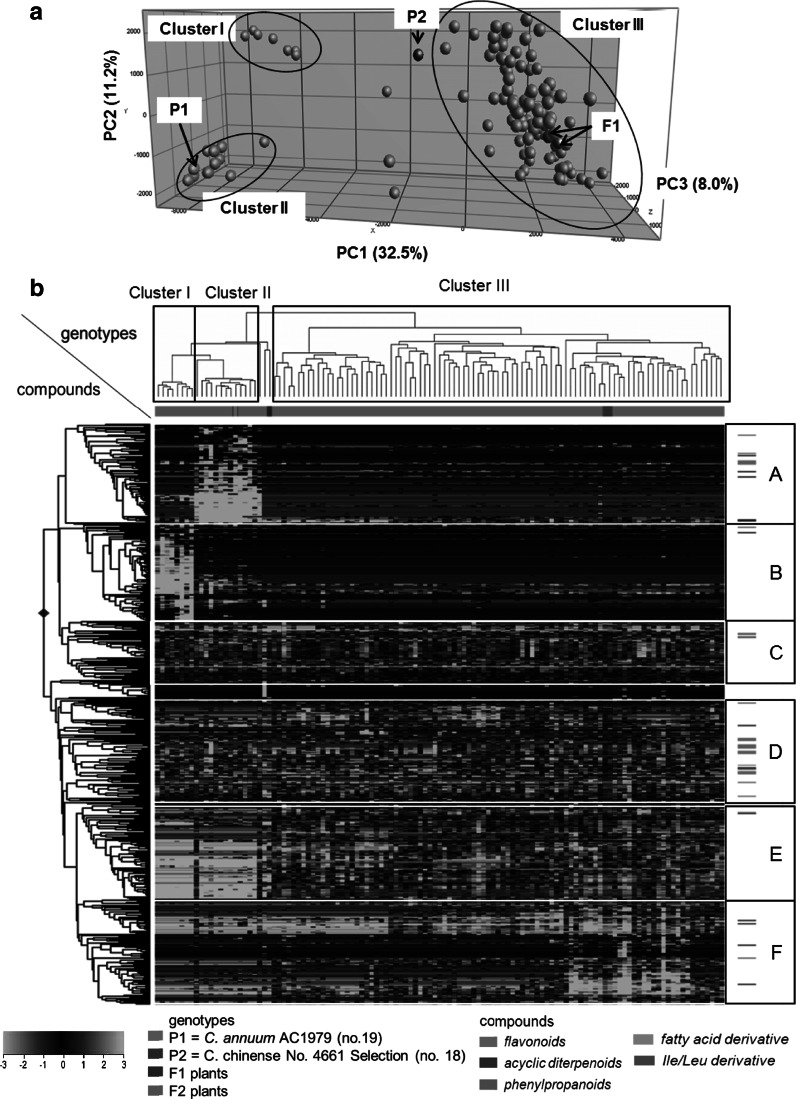
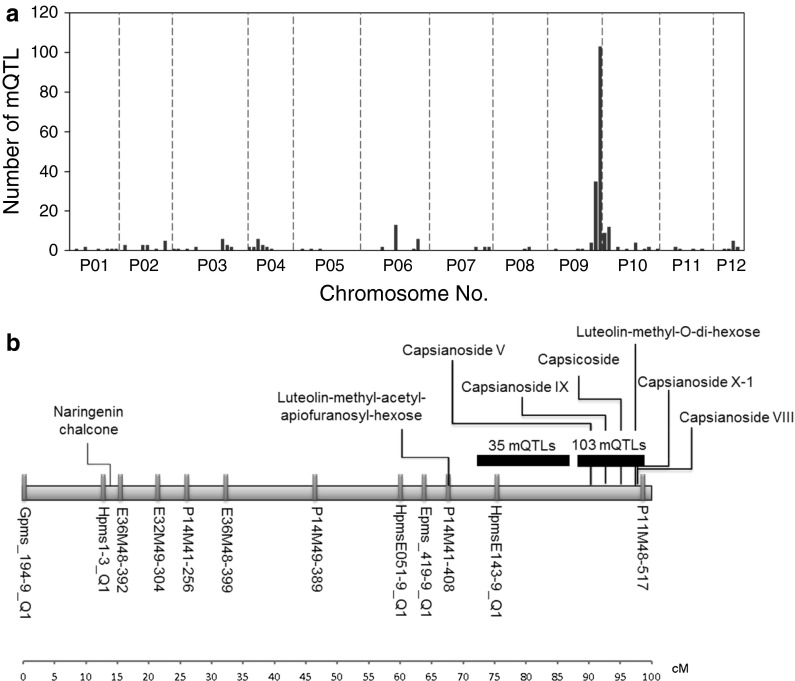
Untargeted LCMS profiling of semi-polar metabolites followed by metabolite quantitative trait locus (mQTL) analysis was performed in ripe pepper fruits of 113 F2 plants derived from a cross between AC1979 (no. 19) and No. 4661 Selection (no. 18). The parental accessions were selected based on their variation in fruit morphological characteristics and fruit content of some target phytonutrients. Clear segregation of fruit colour and fruit metabolite profiles was observed in the F2 population. The F2 plants formed three clusters based on their metabolite profiles. Of the total of 542 metabolites, 52 could be annotated, including a range of flavonoids, such as flavone -glycosides, flavonol -glycosides and naringenin chalcone, as well as several phenylpropanoids, a capsaicin analogue, fatty acid derivatives and amino acid derivatives. Interval mapping revealed 279 mQTLs in total. Two mQTL hotspots were found on chromosome 9. These two chromosomal regions regulated the relative levels of 35 and 103 metabolites, respectively. Analysis also revealed an mQTL for a capsaicin analogue, located on chromosome 7. Confirmation of flavonoid mQTLs using a set of six flavonoid candidate gene markers and their corresponding expression data (expression QTLs) indicated the - transcription factor gene on chromosome 1 and the gene encoding flavone synthase (-) on chromosome 6 as likely causative genes determining the variation in naringenin chalcone and flavone -glycosides, respectively, in this population. The combination of large-scale metabolite profiling and QTL analysis provided valuable insight into the genomic regions and genes important for the production of (secondary) metabolites in pepper fruit. This will impact breeding strategies aimed at optimising the content of specific metabolites in pepper fruit.
对113株F2代辣椒成熟果实进行了半极性代谢物的非靶向液相色谱-质谱分析,并进行了代谢物数量性状位点(mQTL)分析。这些F2代植株源自AC1979(第19号)和4661选系(第18号)的杂交。亲本材料是根据其果实形态特征和某些目标植物营养素的果实含量差异来选择的。在F2群体中观察到果实颜色和果实代谢物谱的明显分离。F2代植株根据其代谢物谱形成了三个簇。在总共542种代谢物中,有52种可以注释,包括一系列黄酮类化合物,如黄酮糖苷、黄酮醇糖苷和柚皮素查耳酮,以及几种苯丙烷类化合物、一种辣椒素类似物、脂肪酸衍生物和氨基酸衍生物。区间作图总共揭示了279个mQTL。在9号染色体上发现了两个mQTL热点。这两个染色体区域分别调节35种和103种代谢物的相对水平。分析还揭示了一个位于7号染色体上的辣椒素类似物的mQTL。使用一组六个黄酮类候选基因标记及其相应的表达数据(表达QTL)对黄酮类mQTL进行的验证表明,1号染色体上的转录因子基因和6号染色体上编码黄酮合酶(-)的基因分别可能是决定该群体中柚皮素查耳酮和黄酮糖苷变异的致病基因。大规模代谢物谱分析和QTL分析的结合为辣椒果实中(次生)代谢物产生的重要基因组区域和基因提供了有价值的见解。这将影响旨在优化辣椒果实中特定代谢物含量的育种策略。