Marshall Peter J, Saby Joni N, Meltzoff Andrew N
Department of Psychology, Temple University, Philadelphia, United States.
Institute for Learning & Brain Sciences, University of Washington, Seattle, United States.
Int J Psychol Res (Medellin). 2013 Oct 1;6:22-29. doi: 10.21500/20112084.714.
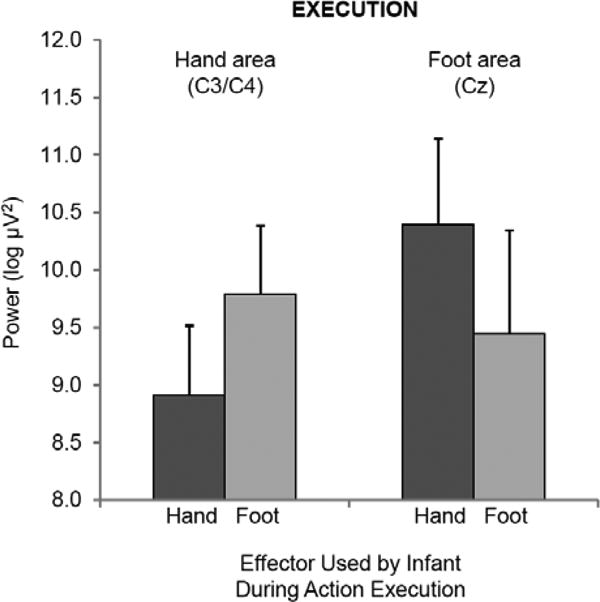
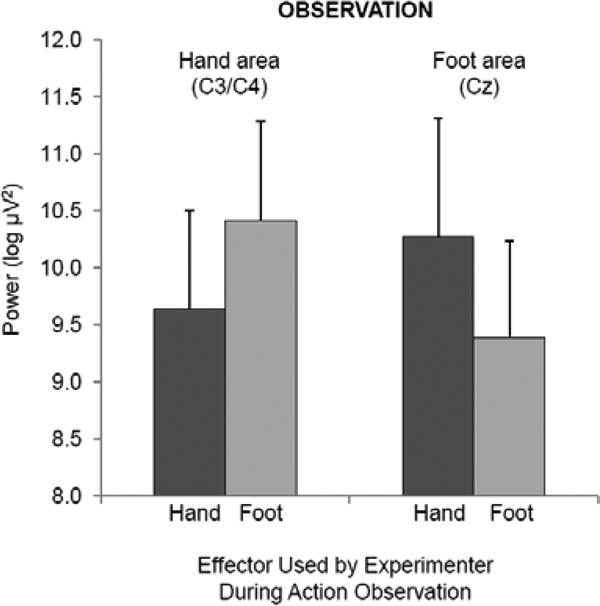
A leading question in developmental social-cognitive neuroscience concerns the nature and function of neural links between action perception and production in early human development. Here we document a somatotopic pattern of activity of the sensorimotor EEG mu rhythm in 14-month-old infants. EEG was recorded during interactive trials in which infants activated a novel object using their own hands or feet ("execution" trials) and watched an experimenter use her hands or feet to achieve the same goal ("observation" trials). At central electrodes overlying sensorimotor hand areas (C3/C4), mu rhythm power was reduced (indicating greater cortical activation) during infants' execution of hand acts compared to foot acts. For the central electrode overlying the sensorimotor foot area (Cz), mu power was reduced during the execution of foot versus hand acts. Strikingly similar somatotopic patterns were found in both the action execution and observation conditions. We hypothesize that these somatotopic patterns index an intercorporeal mapping of corresponding body parts between self and other. We further propose that infants' ability to identify self-other equivalences at the level of body parts underlies infant imitation and is an ontogenetic building block for the feelings of intersubjectivity we experience when socially engaged with other people.
发展社会认知神经科学中的一个主要问题涉及人类早期发育中动作感知与产生之间神经联系的本质和功能。在此,我们记录了14个月大婴儿感觉运动脑电μ节律的躯体定位活动模式。在互动试验中记录脑电图,在这些试验中,婴儿用自己的手或脚激活一个新物体(“执行”试验),并观看实验者用她的手或脚达到相同目标(“观察”试验)。在覆盖感觉运动手部区域的中央电极(C3/C4)处,与脚部动作相比,婴儿执行手部动作时μ节律功率降低(表明皮层激活增强)。对于覆盖感觉运动足部区域的中央电极(Cz),执行足部动作与手部动作时μ功率降低。在动作执行和观察条件下都发现了惊人相似的躯体定位模式。我们假设这些躯体定位模式指示了自我与他人之间相应身体部位的体间映射。我们进一步提出,婴儿在身体部位层面识别自我与他人等效性的能力是婴儿模仿的基础,并且是我们在与他人进行社交互动时体验到的主体间性感受的个体发生基石。