Department of Human Genetics, Leiden University Medical Center, Leiden, the Netherlands.
Prosensa Therapeutics, Leiden, the Netherlands.
Mol Ther Nucleic Acids. 2014 Feb 18;3(2):e148. doi: 10.1038/mtna.2014.1.
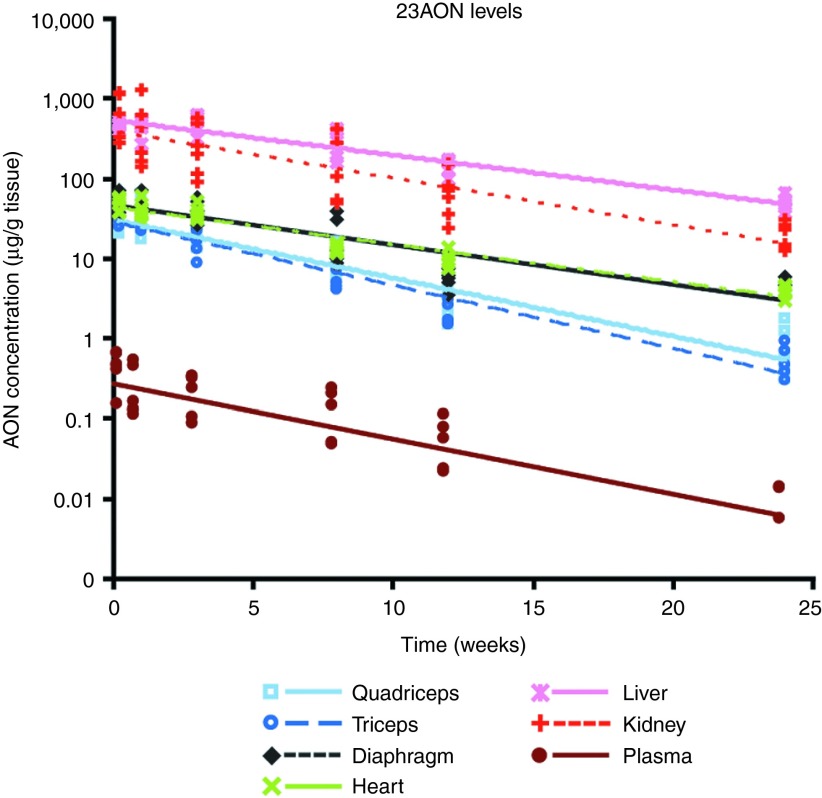
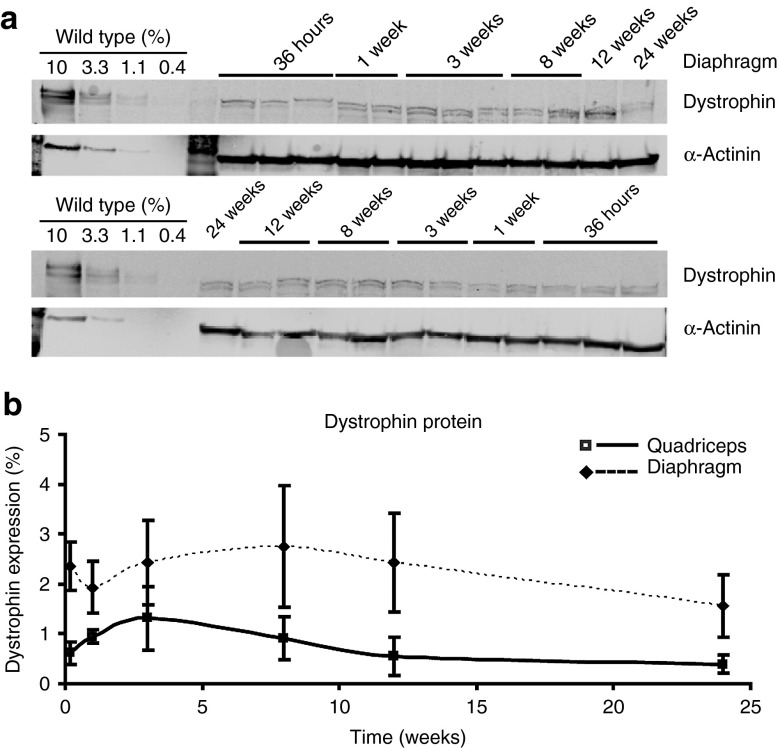
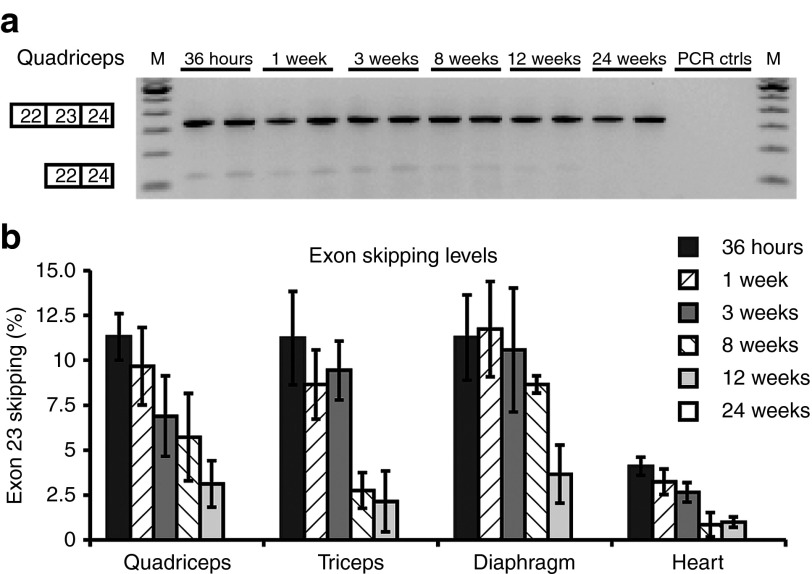
Antisense-mediated exon skipping is currently in clinical development for Duchenne muscular dystrophy (DMD) to amend the consequences of the underlying genetic defect and restore dystrophin expression. Due to turnover of compound, transcript, and protein, chronic treatment with effector molecules (antisense oligonucleotides) will be required. To investigate the dynamics and persistence of antisense 2'-O-methyl phosphorothioate oligonucleotides, exon skipping, and dystrophin expression after dosing was concluded, mdx mice were treated subcutaneously for 8 weeks with 100 mg/kg oligonucleotides twice weekly. Thereafter, mice were sacrificed at different time points after the final injection (36 hours-24 weeks). Oligonucleotide half-life was longer in heart (65 days) compared with that in skeletal muscle, liver, and kidney (35 days). Exon skipping half-lives varied between 33 and 53 days, whereas dystrophin protein showed a long half-life (>100 days). Oligonucleotide and exon-skipping levels peaked in the first week and declined thereafter. By contrast, dystrophin expression peaked after 3-8 weeks and then slowly declined, remaining detectable after 24 weeks. Concordance between levels of oligonucleotides, exon skipping, and proteins was observed, except in heart, wherein high oligonucleotide levels but low exon skipping and dystrophin expression were seen. Overall, these results enhance our understanding of the pharmacokinetics and pharmacodynamics of 2'-O-methyl phosphorothioate oligos used for the treatment of DMD.Molecular Therapy-Nucleic Acids (2014) 3, e148; doi:10.1038/mtna.2014.1; published online 18 February 2014.
反义介导的外显子跳跃目前正在开发用于杜氏肌营养不良症(DMD)的临床治疗,以纠正潜在遗传缺陷的后果并恢复肌营养不良蛋白的表达。由于化合物、转录本和蛋白质的周转率,需要用效应分子(反义寡核苷酸)进行慢性治疗。为了研究反义 2'-O-甲基硫代磷酸酯寡核苷酸、外显子跳跃和肌营养不良蛋白表达的动力学和持久性,在给药结束后,mdx 小鼠接受 100mg/kg 寡核苷酸每周两次皮下治疗 8 周。此后,在最后一次注射后不同时间点(36 小时-24 周)处死小鼠。寡核苷酸在心脏中的半衰期(65 天)长于在骨骼肌、肝脏和肾脏中的半衰期(35 天)。外显子跳跃半衰期在 33 到 53 天之间变化,而肌营养不良蛋白显示出较长的半衰期(>100 天)。寡核苷酸和外显子跳跃水平在第一周达到峰值,然后下降。相比之下,肌营养不良蛋白表达在 3-8 周后达到峰值,然后缓慢下降,在 24 周后仍可检测到。寡核苷酸、外显子跳跃和蛋白质的水平之间存在一致性,除了在心脏中,观察到高寡核苷酸水平但低外显子跳跃和肌营养不良蛋白表达。总的来说,这些结果增强了我们对用于治疗 DMD 的 2'-O-甲基硫代磷酸酯寡核苷酸的药代动力学和药效动力学的理解。分子治疗-核酸(2014 年)3,e148;doi:10.1038/mtna.2014.1;在线发布 2014 年 2 月 18 日。