Lionel Karen Ruby, John Jacob, Sen Nagamani
Department of Anaesthesiology, Christian Medical College, Vellore, Tamil Nadu, India.
Department of Community Health, Christian Medical College, Vellore, Tamil Nadu, India.
Indian J Crit Care Med. 2014 Jan;18(1):21-5. doi: 10.4103/0972-5229.125431.
Although large studies have demonstrated the association between hyperglycemia and adverse intensive care unit (ICU) outcomes, it is yet unclear which subset of patients benefit from tight sugar control in ICU. Recent evidence suggests that stress induced hyperglycemia (SIH) and co-incidentally detected diabetes mellitus are different phenomena with different prognoses. Differentiating SIH from diabetic hyperglycemia is challenging in ICU settings. We followed a cohort of trauma patients admitted to a surgical intensive care unit (SICU) to evaluate if initial glycated hemoglobin A (HbA1c) level predicts the outcome of admission.
A cohort of 120 consecutive admissions to SICU following trauma were recruited and admission blood sugar and HbA1c were measured. Outcomes were prospectively measured by blinded ICU doctors. A logistic regression model was developed to assess if HbA1c predicts poor outcomes in these settings.
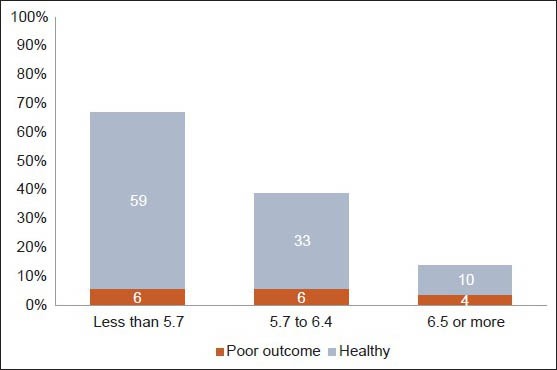
Nearly 24% of the participants had HbA1c ≥ 6. Those with HbA1c ≥ 6 had 3.14 times greater risk of poor outcome at the end of hospital stay when compared to those with HbA1c < 6 and this risk increased to an odds ratio of 4.57 on adjusting for other significant predictors: Acute Physiology and Chronic Health Evaluation II, injury severity score, admission blood sugar and age at admission.
Substantial proportion of trauma admissions has underlying diabetes. HbA1c, a measure of pre admission glycaemic status is an important predictor of ICU outcome in trauma patients.
尽管大型研究已证明高血糖与重症监护病房(ICU)不良预后之间存在关联,但目前尚不清楚哪些患者亚组能从ICU严格血糖控制中获益。近期证据表明,应激性高血糖(SIH)和偶然检测出的糖尿病是具有不同预后的不同现象。在ICU环境中区分SIH和糖尿病性高血糖具有挑战性。我们对一批入住外科重症监护病房(SICU)的创伤患者进行了随访,以评估初始糖化血红蛋白A(HbA1c)水平是否能预测入院结局。
招募了120例连续入住SICU的创伤患者,并测量其入院时的血糖和HbA1c。由不知情的ICU医生前瞻性地测量结局。建立了一个逻辑回归模型,以评估HbA1c在这些情况下是否能预测不良结局。
近24%的参与者HbA1c≥6。与HbA1c<6的参与者相比,HbA1c≥6的参与者在住院期末不良结局的风险高3.14倍,在调整其他重要预测因素(急性生理与慢性健康状况评分II、损伤严重程度评分、入院血糖和入院年龄)后,这一风险增加至比值比为4.57。
相当一部分创伤入院患者存在潜在糖尿病。HbA1c作为入院前血糖状态的一项指标,是创伤患者ICU结局的重要预测因素。