• 文献检索
  • 文档翻译
  • 深度研究
  • 学术资讯
  • Suppr Zotero 插件Zotero 插件
  • 邀请有礼
  • 套餐&价格
  • 历史记录
应用&插件
Suppr Zotero 插件Zotero 插件浏览器插件Mac 客户端Windows 客户端微信小程序
定价
高级版会员购买积分包购买API积分包
服务
文献检索文档翻译深度研究API 文档MCP 服务
关于我们
关于 Suppr公司介绍联系我们用户协议隐私条款
关注我们

Suppr 超能文献

核心技术专利:CN118964589B侵权必究
粤ICP备2023148730 号-1Suppr @ 2026

文献检索

告别复杂PubMed语法,用中文像聊天一样搜索,搜遍4000万医学文献。AI智能推荐,让科研检索更轻松。

立即免费搜索

文件翻译

保留排版,准确专业,支持PDF/Word/PPT等文件格式,支持 12+语言互译。

免费翻译文档

深度研究

AI帮你快速写综述,25分钟生成高质量综述,智能提取关键信息,辅助科研写作。

立即免费体验

韩国毛癣菌感染发病率降低:21 年间(1992-2012 年)6250 例病例分析。

Decreasing incidence of Trichophyton mentagrophytes in Korea: analysis of 6,250 cases during the last 21-year-period (1992-2012).

机构信息

Department of Dermatology, Kyungpook National University School of Medicine, Daegu, Korea.

Institute of Medical Mycology, Catholic Skin Clinic, Daegu, Korea.

出版信息

J Korean Med Sci. 2014 Feb;29(2):272-6. doi: 10.3346/jkms.2014.29.2.272. Epub 2014 Jan 28.

DOI:10.3346/jkms.2014.29.2.272
PMID:24550657
原文链接:https://pmc.ncbi.nlm.nih.gov/articles/PMC3924009/
Abstract

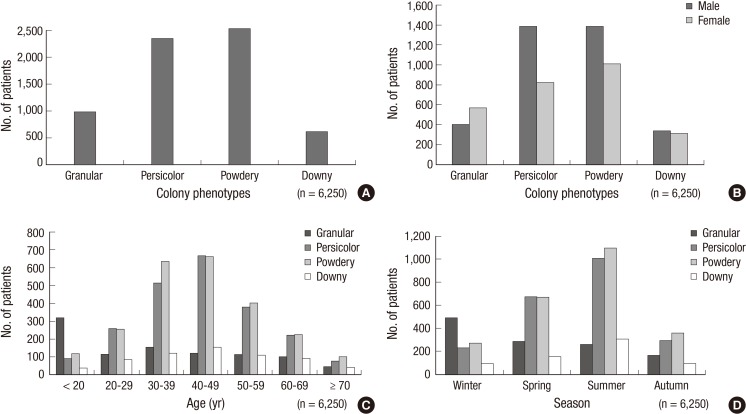
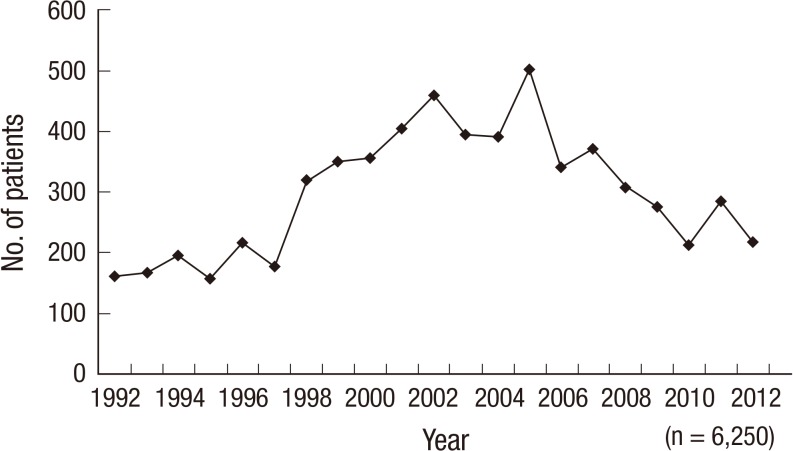
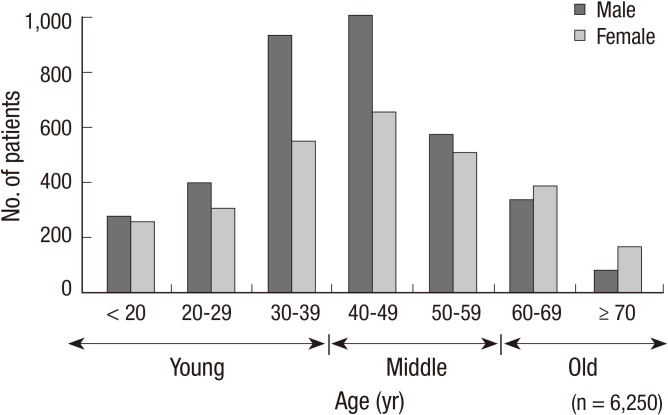
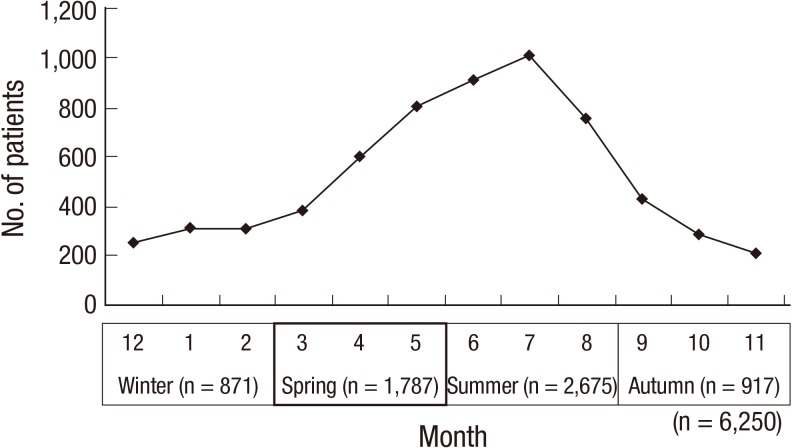
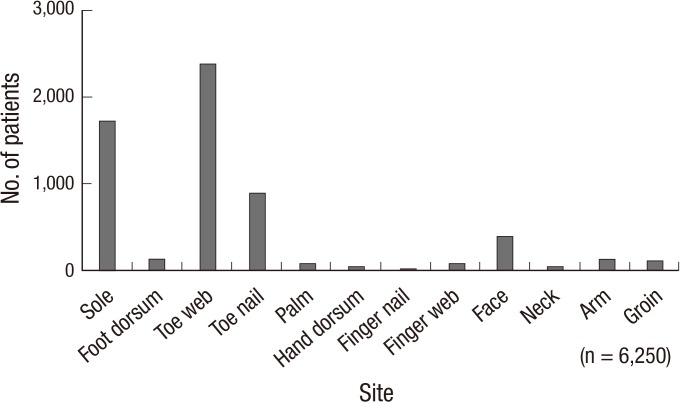
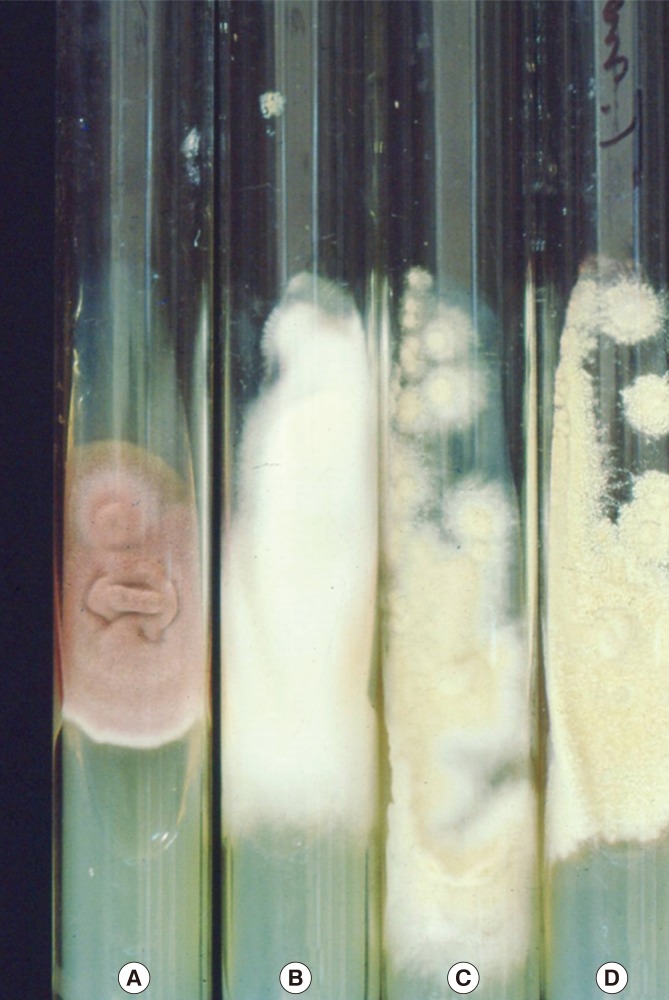
Trichophyton mentagrophytes is the second common dermatophyte in Korea. However, few reports have been issued on the epidemiological and mycological characteristics of T. mentagrophytes in Korea based on long-term, large-scale study. The purpose of this study was to elucidate the epidemiological and mycological characteristics of T. mentagrophytes in Korea. During the 21-yr-period from 1992 to 2012, 6,250 patients with T. mentagrophytes were surveyed to determine annual incidence and the distribution of subjects by age, sex, season, involved sites, and place of residence. T. mentagrophytes infections were confirmed by fungal culture. In addition, the colony appearance of T. mentagrophytes was classified as granular, persicolor, powdery, or downy. Epidemiological analysis showed that annual incidence reached a peak in 2005, and then gradually decreased. T. mentagrophytes infection was most common in July, and was found predominantly in middle-aged adults, especially in those in their forties. Mycological analysis showed a powdery colony appearance was the most common, followed by persicolor and granular colonies. Toewebs were most frequently involved. This investigation on T. mentagrophytes provides insights into its incidence and characteristics.

摘要

须癣毛癣菌是韩国第二常见的皮肤癣菌。然而,基于长期的大规模研究,有关韩国须癣毛癣菌的流行病学和真菌学特征的报道甚少。本研究旨在阐明韩国须癣毛癣菌的流行病学和真菌学特征。在 1992 年至 2012 年的 21 年间,对 6250 例须癣毛癣菌患者进行了调查,以确定年度发病率以及按年龄、性别、季节、受累部位和居住地划分的患者分布情况。通过真菌培养来确认须癣毛癣菌感染。此外,还将须癣毛癣菌的菌落外观分为颗粒状、多彩状、粉状或绒毛状。流行病学分析显示,年度发病率在 2005 年达到高峰,随后逐渐下降。须癣毛癣菌感染最常见于 7 月,主要发生在中年成年人中,尤其是 40 多岁的人群。真菌学分析显示,粉状菌落外观最为常见,其次是多彩状和颗粒状菌落。脚趾间是最常受累的部位。这项对须癣毛癣菌的调查深入了解了其发病率和特征。
https://cdn.ncbi.nlm.nih.gov/pmc/blobs/8d32/3924009/d5c5abcb3a3a/jkms-29-272-g007.jpg
https://cdn.ncbi.nlm.nih.gov/pmc/blobs/8d32/3924009/a1c0d7b8572a/jkms-29-272-g001.jpg
https://cdn.ncbi.nlm.nih.gov/pmc/blobs/8d32/3924009/77394b02ab37/jkms-29-272-g002.jpg
https://cdn.ncbi.nlm.nih.gov/pmc/blobs/8d32/3924009/544056691471/jkms-29-272-g003.jpg
https://cdn.ncbi.nlm.nih.gov/pmc/blobs/8d32/3924009/a609290c8bde/jkms-29-272-g004.jpg
https://cdn.ncbi.nlm.nih.gov/pmc/blobs/8d32/3924009/05fa021afae9/jkms-29-272-g005.jpg
https://cdn.ncbi.nlm.nih.gov/pmc/blobs/8d32/3924009/f96488e97fab/jkms-29-272-g006.jpg
https://cdn.ncbi.nlm.nih.gov/pmc/blobs/8d32/3924009/d5c5abcb3a3a/jkms-29-272-g007.jpg
https://cdn.ncbi.nlm.nih.gov/pmc/blobs/8d32/3924009/a1c0d7b8572a/jkms-29-272-g001.jpg
https://cdn.ncbi.nlm.nih.gov/pmc/blobs/8d32/3924009/77394b02ab37/jkms-29-272-g002.jpg
https://cdn.ncbi.nlm.nih.gov/pmc/blobs/8d32/3924009/544056691471/jkms-29-272-g003.jpg
https://cdn.ncbi.nlm.nih.gov/pmc/blobs/8d32/3924009/a609290c8bde/jkms-29-272-g004.jpg
https://cdn.ncbi.nlm.nih.gov/pmc/blobs/8d32/3924009/05fa021afae9/jkms-29-272-g005.jpg
https://cdn.ncbi.nlm.nih.gov/pmc/blobs/8d32/3924009/f96488e97fab/jkms-29-272-g006.jpg
https://cdn.ncbi.nlm.nih.gov/pmc/blobs/8d32/3924009/d5c5abcb3a3a/jkms-29-272-g007.jpg

相似文献

1
Decreasing incidence of Trichophyton mentagrophytes in Korea: analysis of 6,250 cases during the last 21-year-period (1992-2012).韩国毛癣菌感染发病率降低:21 年间(1992-2012 年)6250 例病例分析。
J Korean Med Sci. 2014 Feb;29(2):272-6. doi: 10.3346/jkms.2014.29.2.272. Epub 2014 Jan 28.
2
Increasing Prevalence of Trichophyton rubrum Identified through an Analysis of 115,846 Cases over the Last 37 Years.通过对过去37年里115846例病例的分析发现红色毛癣菌的患病率在上升。
J Korean Med Sci. 2015 May;30(5):639-43. doi: 10.3346/jkms.2015.30.5.639. Epub 2015 Apr 15.
3
Relationship Between Phenotypic and Genotypic Characteristics of Trichophyton mentagrophytes Strains Isolated from Patients with Dermatophytosis.从皮肤癣菌病患者分离出的须癣毛癣菌菌株的表型与基因型特征之间的关系
Mycopathologia. 2017 Jun;182(5-6):487-493. doi: 10.1007/s11046-017-0110-3. Epub 2017 Jan 18.
4
Skin Infection due to Trichophyton tonsurans Still Occurs in People in Korea but not as Outbreaks.须癣毛癣菌引起的皮肤感染在韩国人中仍有发生,但并非以暴发形式出现。
J Korean Med Sci. 2016 Feb;31(2):296-300. doi: 10.3346/jkms.2016.31.2.296. Epub 2016 Jan 13.
5
Molecular identification of isolates of the complex.复合体分离株的分子鉴定。
Int J Med Sci. 2020 Jan 1;17(1):45-52. doi: 10.7150/ijms.35173. eCollection 2020.
6
Identification and subtyping of Trichophyton mentagrophytes by random amplified polymorphic DNA.
Mycoses. 2001;44(5):157-65. doi: 10.1046/j.1439-0507.2001.00633.x.
7
[The effect of Tween-80 on the differentiation of Trichophyton mentagrophytes and Trichophyton rubrum strains with FT-IR spectroscopy].[吐温-80对须发癣菌和红色毛癣菌菌株分化的傅里叶变换红外光谱效应]
Mikrobiyol Bul. 2014 Jul;48(3):449-60. doi: 10.5578/mb.7926.
8
Molecular Epidemiological Analysis of the Spreading Conditions of Trichophyton in Long-Term Care Facilities in Japan.
Jpn J Infect Dis. 2018 Nov 22;71(6):462-466. doi: 10.7883/yoken.JJID.2018.090. Epub 2018 Aug 31.
9
A case of tinea manuum caused by Trichophyton mentagrophytes var. erinacei: the first isolation in Korea.由须癣毛癣菌猬变种引起的手部癣病例:韩国首例分离病例。
Mycoses. 2009 May;52(3):287-90. doi: 10.1111/j.1439-0507.2008.01556.x. Epub 2008 Jul 11.
10
Infections caused by Trichophyton raubitschekii: clinical and epidemiological features.劳氏毛癣菌引起的感染:临床和流行病学特征
Mycoses. 1990 Sep-Oct;33(9-10):499-506. doi: 10.1111/myc.1990.33.9-10.499.

引用本文的文献

1
Epidemiology of Dermatophytes in Belgium: A 5 Years' Survey.比利时的皮肤真菌流行病学:一项为期 5 年的调查。
Mycopathologia. 2021 Jun;186(3):399-409. doi: 10.1007/s11046-021-00542-4. Epub 2021 Apr 26.
2
[Tinea barbae profunda due to Trichophyton mentagrophytes : Case report and review].须发癣菌引起的深部须癣:病例报告及文献复习
Hautarzt. 2019 Aug;70(8):601-611. doi: 10.1007/s00105-019-4407-7.
3
Low But Continuous Occurrence of Infection in the Study on 198 Cases in South Korea from 1979 to 2016.1979年至2016年韩国198例病例研究中感染发生率低但持续存在

本文引用的文献

1
Decreasing prevalence of Microsporum canis infection in Korea: through analysis of 944 cases (1993-2009) and review of our previous data (1975-1992).韩国犬小孢子菌感染流行率的降低:通过对 944 例病例(1993-2009 年)的分析和对我们以往数据(1975-1992 年)的回顾。
Mycopathologia. 2012 Apr;173(4):235-9. doi: 10.1007/s11046-011-9497-4. Epub 2011 Dec 21.
2
Epidemiology of dermatophyte infection in Auckland, New Zealand.新西兰奥克兰皮肤癣菌感染的流行病学
Australas J Dermatol. 2003 Nov;44(4):263-6. doi: 10.1046/j.1440-0960.2003.00005.x.
3
[Effects of temperature, humidity, minor injury and washing on penetration of dermatophytes into human stratum corneum].
Ann Dermatol. 2018 Aug;30(4):427-431. doi: 10.5021/ad.2018.30.4.427. Epub 2018 Jun 28.
4
Deep Dermatophytosis Caused by Zoophilic Strain of Trichophyton interdigitale with Successful Treatment of Itraconazole.由指间毛癣菌亲动物性菌株引起的深部皮肤癣菌病及伊曲康唑的成功治疗
Mycopathologia. 2017 Aug;182(7-8):715-720. doi: 10.1007/s11046-017-0120-1. Epub 2017 Feb 2.
5
The Epidemiology of Dermatophyte Infection in Southeastern Korea (1979~2013).韩国东南部皮肤癣菌感染的流行病学(1979 - 2013年)
Ann Dermatol. 2016 Aug;28(4):524-7. doi: 10.5021/ad.2016.28.4.524. Epub 2016 Jul 26.
6
Increasing Prevalence of Trichophyton rubrum Identified through an Analysis of 115,846 Cases over the Last 37 Years.通过对过去37年里115846例病例的分析发现红色毛癣菌的患病率在上升。
J Korean Med Sci. 2015 May;30(5):639-43. doi: 10.3346/jkms.2015.30.5.639. Epub 2015 Apr 15.
7
Prevalence of fungal infections using National Health Insurance data from 2009-2013, South Korea.2009-2013 年韩国国家健康保险数据中的真菌感染流行率。
Epidemiol Health. 2014 Sep 11;36:e2014017. doi: 10.4178/epih/e2014017. eCollection 2014.
Nihon Ishinkin Gakkai Zasshi. 2003;44(4):269-71. doi: 10.3314/jjmm.44.269.