Hekmatpou D, PhD (Nursing), Assistant Professor, Faculty Member of Arak University of Medical Sciences, Arak, Iran.
Dr. Moeini L, MD, Specialist in Pulmonary Diseases, Assistant Professor, Faculty Member of Arak University of Medical Sciences, Arak, Iran.
Pak J Med Sci. 2013 Nov;29(6):1349-53. doi: 10.12669/pjms.296.3365.
Wet cupping is a traditional bloodletting method recommended for controlling of respiratory disease complications. This study aimed to compare the efficacy of wet cupping vs. venesection on arterial O2 saturation level of smokers.
This is a randomized controlled clinical trial which started with simple sampling of smokers. After administering spirometery, participants (N = 110 male smokers) with positive pulmonary function test (PFT), who manifested Chronic Obstructive Pulmonary Disease (COPD), were randomly assigned to intervention and control groups. The two groups were assessed in terms of demographic data, rate of hemoglobin (Hb), hematocrit (Hct), and arterial O2 saturation. Then, the intervention participants underwent wet cupping whereas venesection was performed on the control participants. At four stages after the two treatments, pulse oximetery was performed. Data was analyzed using SPSS (Version 17).
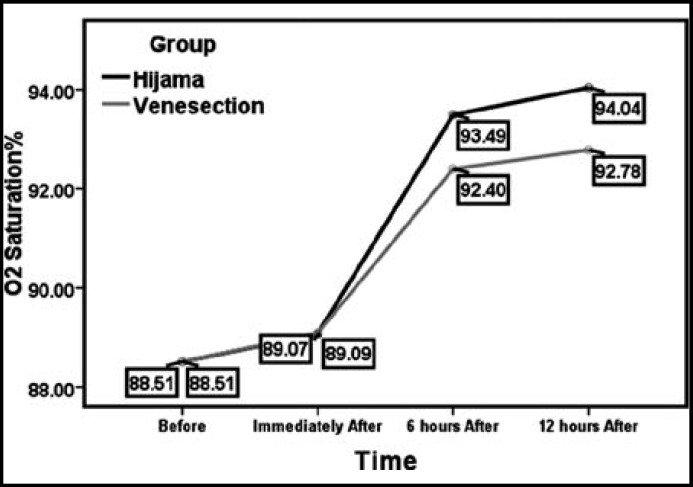
Result shows that mean arterial O2 sat level increased at three stages, namely before, immediately after, and 6 and 12 hrs after these two treatments (p ≤ 0.001). This indicates that wet cupping and venesection alike were effective on O2 sat level in the two groups, but the increasing pattern was maintained 12 hrs afterward only in those participants who had received wet cupping (p ≤ 0.001). Moreover, the results of repeated measure ANOVA between the two groups at the four stages showed that there were significant differences between the means of O2 saturation level at the 6- and 12-hrs stages (F = 66.92, p ≤ 0.001).
Wet cupping caused a continued O2 saturation in the intervention group even up to 12 hrs afterward. Participants expressed liveliness and improved respiration after wet cupping. Therefore, wet cupping is recommended for promoting the health of cigarette smokers.
拔罐是一种传统的放血疗法,用于控制呼吸系统疾病的并发症。本研究旨在比较拔罐与放血对吸烟者动脉血氧饱和度的影响。
这是一项随机对照临床试验,首先采用简单抽样法对吸烟者进行抽样。在进行肺功能检查后,对表现出慢性阻塞性肺疾病(COPD)且肺功能检查阳性的男性吸烟者(N=110)进行随机分组,分为干预组和对照组。评估两组的人口统计学数据、血红蛋白(Hb)、红细胞压积(Hct)和动脉血氧饱和度。然后,对干预组进行拔罐治疗,对对照组进行放血治疗。在两种治疗后的四个阶段,使用脉搏血氧仪进行评估。使用 SPSS(版本 17)进行数据分析。
结果表明,两种治疗后,动脉血氧饱和度水平在三个阶段(治疗前、治疗后即刻以及治疗后 6 小时和 12 小时)均有所升高(p≤0.001)。这表明拔罐和放血对两组的血氧饱和度水平均有影响,但只有接受拔罐治疗的患者在 12 小时后仍保持血氧饱和度升高的趋势(p≤0.001)。此外,对两组在四个阶段的重复测量方差分析结果表明,在 6 小时和 12 小时阶段,两组的血氧饱和度均值存在显著差异(F=66.92,p≤0.001)。
拔罐治疗在干预组中引起了持续的血氧饱和度升高,甚至在 12 小时后仍能维持。患者在拔罐治疗后表现出活力增强和呼吸改善。因此,建议拔罐用于促进吸烟者的健康。