Department of Molecular, Cellular, and Biomedical Sciences, University of New Hampshire, Durham, New Hampshire, United States of America.
PLoS Biol. 2014 Feb 18;12(2):e1001790. doi: 10.1371/journal.pbio.1001790. eCollection 2014 Feb.
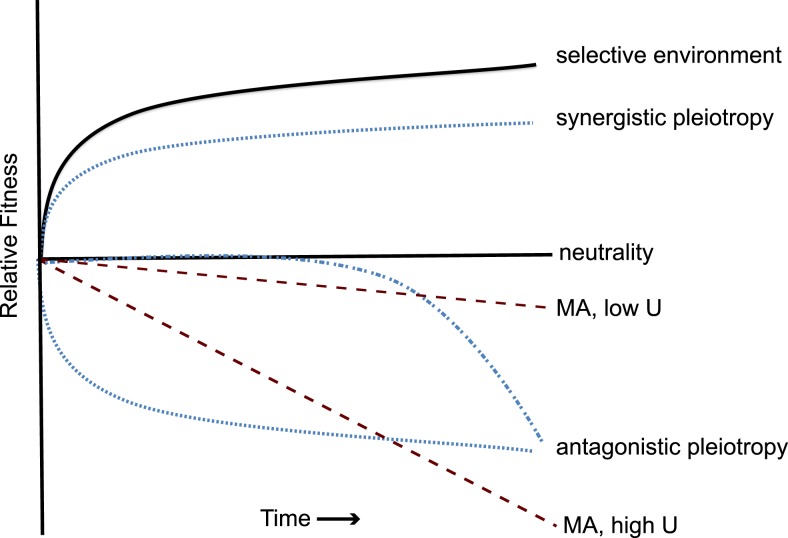
Examples of ecological specialization abound in nature but the evolutionary and genetic causes of tradeoffs across environments are typically unknown. Natural selection itself may favor traits that improve fitness in one environment but reduce fitness elsewhere. Furthermore, an absence of selection on unused traits renders them susceptible to mutational erosion by genetic drift. Experimental evolution of microbial populations allows these potentially concurrent dynamics to be evaluated directly, rather than by historical inference. The 50,000 generation (and counting) Lenski Long-Term Evolution Experiment (LTEE), in which replicate E. coli populations have been passaged in a simple environment with only glucose for carbon and energy, has inspired multiple studies of their potential specialization. Earlier in this experiment, most changes were the side effects of selection, both broadening growth potential in some conditions and narrowing it in others, particularly in assays of diet breadth and thermotolerance. The fact that replicate populations experienced similar losses suggested they were becoming specialists because of tradeoffs imposed by selection. However a new study in this issue of PLOS Biology by Nicholas Leiby and Christopher Marx revisits these lines with powerful new growth assays and finds a surprising number of functional gains as well as losses, the latter of which were enriched in populations that had evolved higher mutation rates. Thus, these populations are steadily becoming glucose specialists by the relentless pressure of mutation accumulation, which has taken 25 years to detect. More surprising, the unpredictability of functional changes suggests that we still have much to learn about how the best-studied bacterium adapts to grow on the best-studied sugar.
自然界中存在着大量生态特化的例子,但环境之间权衡取舍的进化和遗传原因通常是未知的。自然选择本身可能有利于在一种环境中提高适应性的特征,但在其他环境中降低适应性。此外,对未使用特征的选择缺失会使它们容易受到遗传漂变的突变侵蚀。微生物种群的实验进化允许直接评估这些潜在的并发动态,而不是通过历史推断。 Lenski 长期进化实验(LTEE)已经进行了 5 万代(并且还在继续),在这个实验中,复制的大肠杆菌种群在只有葡萄糖作为碳源和能源的简单环境中传代,激发了对它们潜在特化的多项研究。在这个实验的早期,大多数变化都是选择的副作用,既拓宽了某些条件下的生长潜力,又在其他条件下缩小了生长潜力,特别是在饮食广度和耐热性的测定中。复制种群经历相似损失的事实表明,由于选择施加的权衡取舍,它们正在成为特化种。然而,Nicholas Leiby 和 Christopher Marx 在本期《PLOS Biology》上的一项新研究通过强大的新生长测定重新研究了这些线索,发现了令人惊讶的大量功能增益和损失,后者在进化出更高突变率的种群中更为丰富。因此,这些种群通过积累突变的无情压力逐渐成为葡萄糖特化种,这需要 25 年的时间才能检测到。更令人惊讶的是,功能变化的不可预测性表明,我们还有很多关于研究最充分的细菌如何适应生长在研究最充分的糖上的知识需要学习。