Nachar Walid, Busseuil David, Shi Yanfen, Mihalache-Avram Teodora, Mecteau Mélanie, Rhéaume Eric, Tardif Jean-Claude
Montreal Heart Institute and Université de Montréal, Montreal, Quebec, Canada.
Montreal Heart Institute and Université de Montréal, Montreal, Quebec, Canada ; Department of Medicine, Université de Montréal, Montreal, Quebec, Canada.
PLoS One. 2014 Feb 18;9(2):e89331. doi: 10.1371/journal.pone.0089331. eCollection 2014.
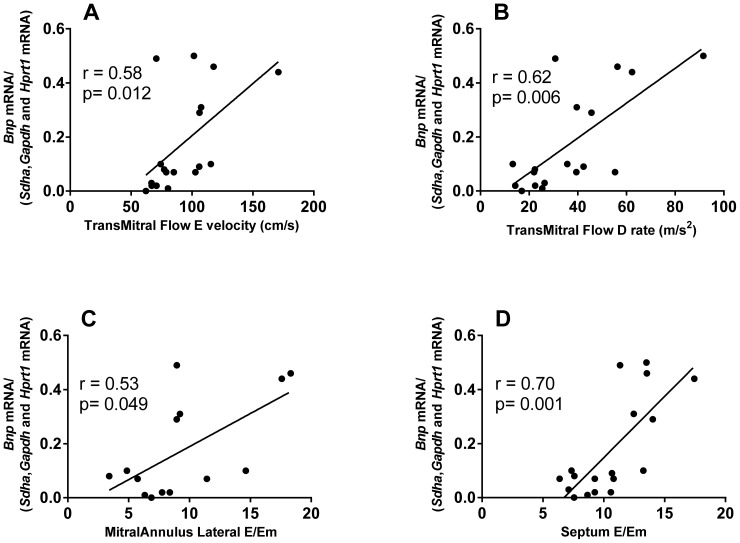
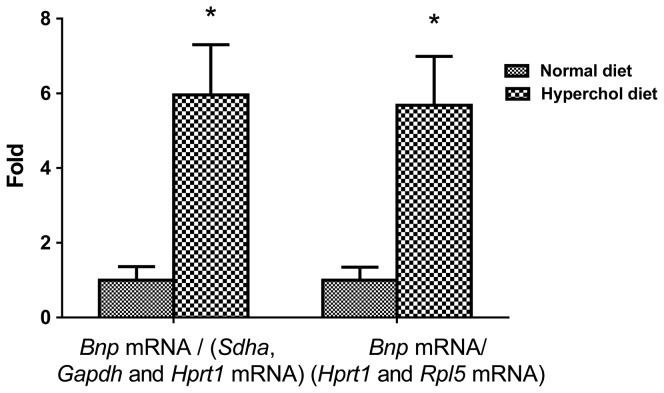
Left ventricular diastolic dysfunction (LVDD) is characterized by the disturbance of ventricle's performance due to its abnormal relaxation or to its increased stiffness during the diastolic phase. The molecular mechanisms underlying LVDD remain unknown. We aimed to identify normalization genes for accurate gene-expression analysis of LVDD using quantitative real-time PCR (RT-PCR) in a new rabbit model of LVDD. Eighteen rabbits were fed with a normal diet (n = 7) or a 0.5% cholesterol-enriched diet supplemented with vitamin D2 (n = 11) for an average of 14.5 weeks. We validated the presence of LVDD in this model using echocardiography for diastolic function assessment. RT-PCR was performed using cDNA derived from left ventricle samples to measure the stability of 10 genes as candidate reference genes (Gapdh, Hprt1, Ppia, Sdha, Rpl5, Actb, Eef1e1, Ywhaz, Pgk1, and G6pd). Using geNorm analysis, we report that Sdha, Gapdh and Hprt1 genes had the highest stability (M <0.2). By contrast, Hprt1 and Rpl5 genes were found to represent the best combination for normalization when using the Normfinder algorithm (stability value of 0.042). Comparison of both normalization strategies highlighted an increase of natriuretic peptides (Bnp and Anp), monocytes chemotactic protein-1 (Mcp-1) and NADPH oxidase subunit (Nox-2) mRNA expressions in ventricle samples of the hypercholesterolemic rabbits compared to controls (P<0.05). This increase correlates with LVDD echocardiographic parameters and most importantly it molecularly validates the presence of the disease in our model. This is the first study emphasizing the selection of stable reference genes for RT-PCR normalization in a rabbit model of LVDD.
左心室舒张功能障碍(LVDD)的特征是心室在舒张期由于舒张异常或僵硬度增加而导致功能紊乱。LVDD的分子机制尚不清楚。我们旨在使用定量实时PCR(RT-PCR)在一种新的LVDD兔模型中鉴定标准化基因,以进行LVDD准确的基因表达分析。18只兔子分别喂食正常饮食(n = 7)或添加维生素D2的0.5%胆固醇丰富饮食(n = 11),平均喂养14.5周。我们使用超声心动图评估舒张功能来验证该模型中LVDD的存在。使用从左心室样本中提取的cDNA进行RT-PCR,以测量10个基因作为候选参考基因(Gapdh、Hprt1、Ppia、Sdha、Rpl5、Actb、Eef1e1、Ywhaz、Pgk1和G6pd)的稳定性。通过geNorm分析,我们报告Sdha、Gapdh和Hprt1基因具有最高的稳定性(M <0.2)。相比之下,当使用Normfinder算法时,发现Hprt1和Rpl5基因是标准化的最佳组合(稳定性值为0.042)。两种标准化策略的比较突出显示,与对照组相比,高胆固醇血症兔子心室样本中利钠肽(Bnp和Anp)、单核细胞趋化蛋白-1(Mcp-1)和NADPH氧化酶亚基(Nox-2)的mRNA表达增加(P<0.05)。这种增加与LVDD超声心动图参数相关,最重要的是,它在分子水平上验证了我们模型中疾病的存在。这是第一项强调在LVDD兔模型中选择稳定参考基因用于RT-PCR标准化的研究。