Liu Hui, Wang Tongtong, Liu Hongbo, Wei Yanjun, Zhao Guofeng, Su Jianzhong, Wu Qiong, Qiao Hong, Zhang Yan
BMC Syst Biol. 2014;8 Suppl 1(Suppl 1):S5. doi: 10.1186/1752-0509-8-S1-S5. Epub 2014 Jan 24.
Type 2 diabetes (T2D) is one of the most common chronic metabolic diseases characterized by insulin resistance and the decrease of insulin secretion. Genetic variation can only explain part of the heritability of T2D, so there need new methods to detect the susceptibility genes of the disease. Epigenetics could establish the interface between the environmental factor and the T2D Pathological mechanism.
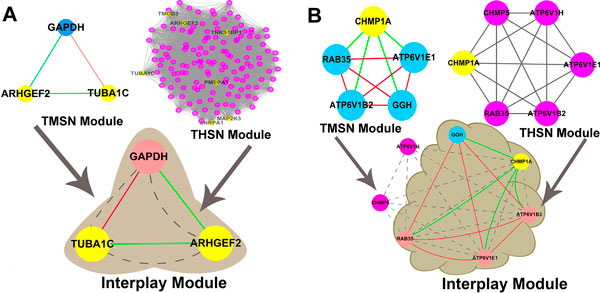
Based on the network theory and by combining epigenetic characteristics with human interactome, the weighted human DNA methylation network (WMPN) was constructed, and a T2D-related subnetwork (TMSN) was obtained through T2D-related differentially methylated genes. It is found that TMSN had a T2D specific network structure that non-fatal metabolic disease causing genes were often located in the topological and functional periphery of network. Combined with chromatin modifications, the weighted chromatin modification network (WCPN) was built, and a T2D-related chromatin modification pattern subnetwork was obtained by the TMSN gene set. TCSN had a densely connected network community, indicating that TMSN and TCSN could represent a collection of T2D-related epigenetic dysregulated sub-pathways. Using the cumulative hypergeometric test, 24 interplay modules of DNA methylation and chromatin modifications were identified. By the analysis of gene expression in human T2D islet tissue, it is found that there existed genes with the variant expression level caused by the aberrant DNA methylation and (or) chromatin modifications, which might affect and promote the development of T2D.
Here we have detected the potential interplay modules of DNA methylation and chromatin modifications for T2D. The study of T2D epigenetic networks provides a new way for understanding the pathogenic mechanism of T2D caused by epigenetic disorders.
2型糖尿病(T2D)是最常见的慢性代谢性疾病之一,其特征为胰岛素抵抗和胰岛素分泌减少。基因变异仅能解释T2D遗传力的一部分,因此需要新方法来检测该疾病的易感基因。表观遗传学能够建立环境因素与T2D病理机制之间的联系。
基于网络理论,通过将表观遗传特征与人类相互作用组相结合,构建了加权人类DNA甲基化网络(WMPN),并通过T2D相关差异甲基化基因获得了一个T2D相关子网(TMSN)。发现TMSN具有T2D特异性网络结构,即非致命性代谢疾病致病基因通常位于网络的拓扑和功能边缘。结合染色质修饰,构建了加权染色质修饰网络(WCPN),并通过TMSN基因集获得了一个T2D相关染色质修饰模式子网。TCSN具有紧密连接的网络群落,表明TMSN和TCSN可代表一组T2D相关的表观遗传失调子途径。使用累积超几何检验,鉴定出24个DNA甲基化与染色质修饰的相互作用模块。通过对人类T2D胰岛组织中基因表达的分析,发现存在因异常DNA甲基化和(或)染色质修饰导致表达水平改变的基因,这些基因可能影响并促进T2D的发展。
我们在此检测到了T2D中DNA甲基化与染色质修饰的潜在相互作用模块。对T2D表观遗传网络的研究为理解由表观遗传紊乱引起的T2D致病机制提供了新途径。