Department of Radiology, University Medical Center Utrecht, Heidelberglaan 100, HP E01,132, 3584 CX, Utrecht, The Netherlands.
BMC Neurol. 2014 Feb 25;14:37. doi: 10.1186/1471-2377-14-37.
Prediction of clinical outcome in the acute stage of ischaemic stroke can be difficult when based on patient characteristics, clinical findings and on non-contrast CT. CT perfusion and CT angiography may provide additional prognostic information and guide treatment in the early stage. We present the study protocol of the Dutch acute Stroke Trial (DUST). The DUST aims to assess the prognostic value of CT perfusion and CT angiography in predicting stroke outcome, in addition to patient characteristics and non-contrast CT. For this purpose, individualised prediction models for clinical outcome after stroke based on the best predictors from patient characteristics and CT imaging will be developed and validated.
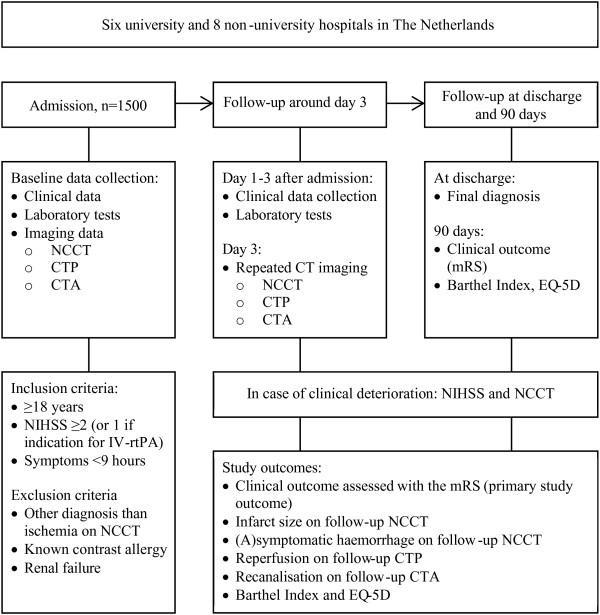
METHODS/DESIGN: The DUST is a prospective multi-centre cohort study in 1500 patients with suspected acute ischaemic stroke. All patients undergo non-contrast CT, CT perfusion and CT angiography within 9 hours after onset of the neurological deficits, and, if possible, follow-up imaging after 3 days. The primary outcome is a dichotomised score on the modified Rankin Scale, assessed at 90 days. A score of 0-2 represents good outcome, and a score of 3-6 represents poor outcome. Three logistic regression models will be developed, including patient characteristics and non-contrast CT (model A), with addition of CT angiography (model B), and CT perfusion parameters (model C). Model derivation will be performed in 60% of the study population, and model validation in the remaining 40% of the patients. Additional prognostic value of the models will be determined with the area under the curve (AUC) from the receiver operating characteristic (ROC) curve, calibration plots, assessment of goodness-of-fit, and likelihood ratio tests.
This study will provide insight in the added prognostic value of CTP and CTA parameters in outcome prediction of acute stroke patients. The prediction models that will be developed in this study may help guide future treatment decisions in the acute stage of ischaemic stroke.
基于患者特征、临床发现和非对比 CT,预测缺血性脑卒中急性期的临床转归可能较为困难。CT 灌注和 CT 血管造影(CTA)可能提供额外的预后信息,并指导早期治疗。我们介绍了荷兰急性脑卒中试验(Dutch acute Stroke Trial,DUST)的研究方案。DUST 的目的是评估 CT 灌注和 CTA 在预测脑卒中转归方面的预后价值,以及患者特征和非对比 CT。为此,将基于患者特征和 CT 影像学的最佳预测因素,为脑卒中后临床转归制定个体化的预测模型,并对其进行验证。
方法/设计:DUST 是一项前瞻性多中心队列研究,纳入了 1500 例疑似急性缺血性脑卒中患者。所有患者在神经功能缺损发生后 9 小时内行非对比 CT、CT 灌注和 CTA 检查,如果可能,在 3 天后进行随访成像。主要结局是 90 天时改良 Rankin 量表的二分评分。0-2 分表示良好结局,3-6 分表示不良结局。将开发 3 个逻辑回归模型,包括患者特征和非对比 CT(模型 A)、添加 CTA(模型 B)和 CT 灌注参数(模型 C)。将在研究人群的 60%中进行模型推导,并在其余 40%的患者中进行模型验证。将通过受试者工作特征(ROC)曲线下面积(AUC)、校准图、拟合优度评估和似然比检验来确定模型的额外预后价值。
该研究将深入了解 CTP 和 CTA 参数在急性脑卒中患者预后预测中的附加预后价值。本研究中开发的预测模型可能有助于指导缺血性脑卒中急性期的未来治疗决策。