Richardson Claire E, Spilker Kerri A, Cueva Juan G, Perrino John, Goodman Miriam B, Shen Kang
Department of Biology, Stanford University, Stanford, United States.
Elife. 2014 Feb 25;3:e01498. doi: 10.7554/eLife.01498.
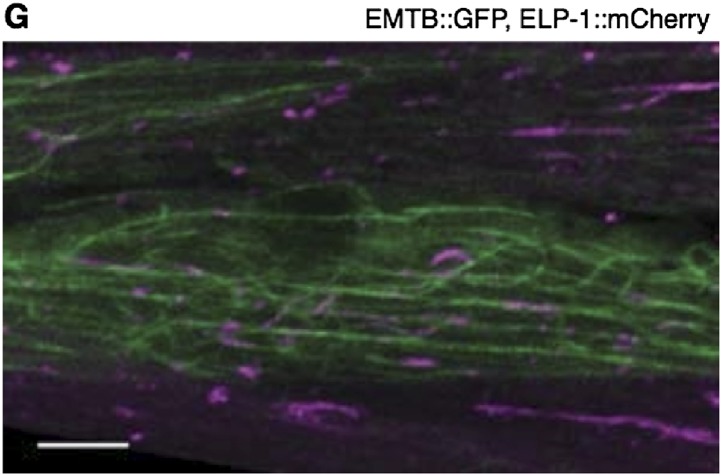
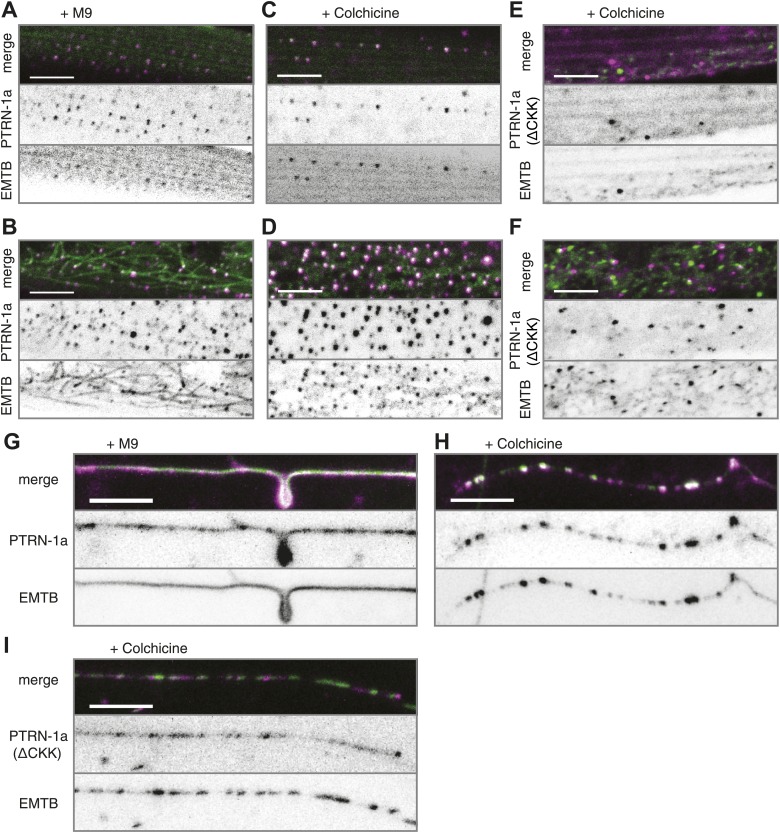
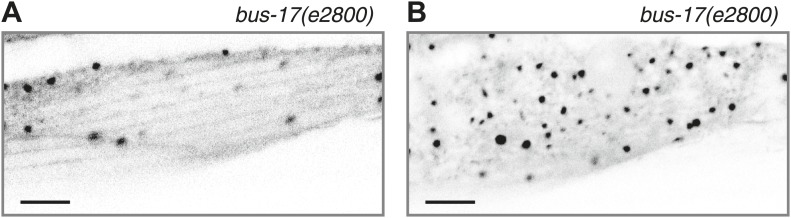
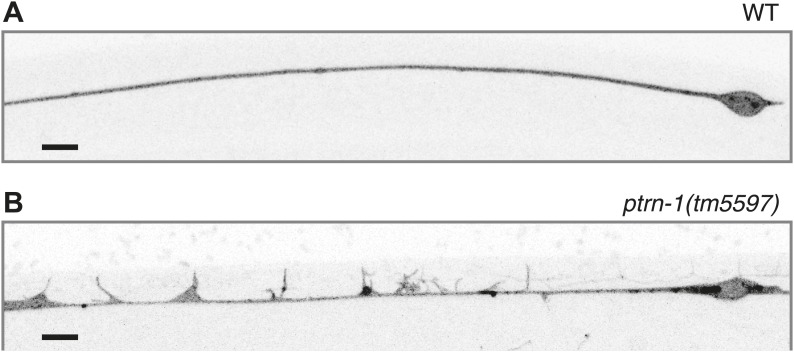
In neuronal processes, microtubules (MTs) provide structural support and serve as tracks for molecular motors. While it is known that neuronal MTs are more stable than MTs in non-neuronal cells, the molecular mechanisms underlying this stability are not fully understood. In this study, we used live fluorescence microscopy to show that the C. elegans CAMSAP protein PTRN-1 localizes to puncta along neuronal processes, stabilizes MT foci, and promotes MT polymerization in neurites. Electron microscopy revealed that ptrn-1 null mutants have fewer MTs and abnormal MT organization in the PLM neuron. Animals grown with a MT depolymerizing drug caused synthetic defects in neurite branching in the absence of ptrn-1 function, indicating that PTRN-1 promotes MT stability. Further, ptrn-1 null mutants exhibited aberrant neurite morphology and synaptic vesicle localization that is partially dependent on dlk-1. Our results suggest that PTRN-1 represents an important mechanism for promoting MT stability in neurons. DOI: http://dx.doi.org/10.7554/eLife.01498.001.
在神经元突起中,微管(MTs)提供结构支撑并作为分子马达的轨道。虽然已知神经元微管比非神经元细胞中的微管更稳定,但其稳定性背后的分子机制尚未完全了解。在本研究中,我们使用实时荧光显微镜显示秀丽隐杆线虫的CAMSAP蛋白PTRN-1定位于沿神经元突起的斑点,稳定微管焦点,并促进神经突中的微管聚合。电子显微镜显示ptrn-1基因敲除突变体在PLM神经元中的微管较少且微管组织异常。在缺乏ptrn-1功能的情况下,用微管解聚药物培养的动物在神经突分支中导致合成缺陷,表明PTRN-1促进微管稳定性。此外,ptrn-1基因敲除突变体表现出异常的神经突形态和突触小泡定位,这部分依赖于dlk-1。我们的结果表明,PTRN-1代表了促进神经元中微管稳定性的重要机制。DOI:http://dx.doi.org/10.7554/eLife.01498.001。