Dasarathy Srinivasan, Dasarathy Jaividhya, Khiyami Amer, Yerian Lisa, Hawkins Carol, Sargent Ruth, McCullough Arthur J
Departments of *Gastroenterology †Pathobiology ∥Pathology, Cleveland Clinic Departments of ¶Gastroenterology ‡Family Medicine §Pathology, MetroHealth Medical Center, Cleveland, OH.
J Clin Gastroenterol. 2015 Feb;49(2):137-44. doi: 10.1097/MCG.0000000000000099.
Nonalcoholic steatohepatitis (NASH) is common and severe in patients with diabetes mellitus. Although, there are no effective treatments for NASH in diabetic patients, preliminary reports suggest that polyunsaturated fatty acids (PUFA) may be beneficial in these patients.
A prospective, randomized, double-blind placebo-controlled study (NCT 00323414) was performed in NASH patients with diabetes. Clinicaltrials.gov (NCT 00323414).
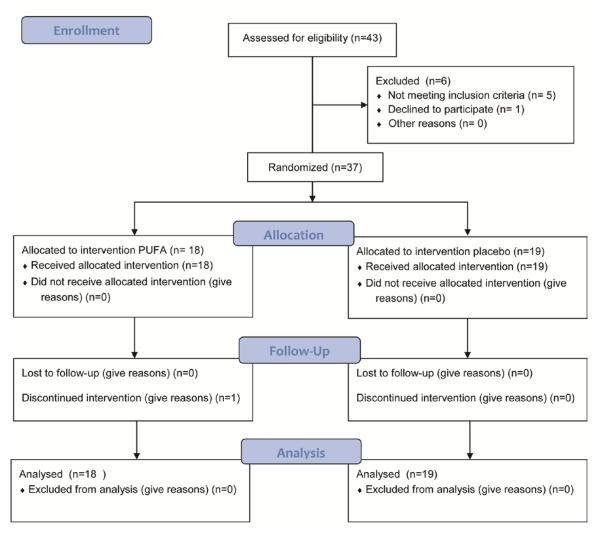
A total of 37 patients (50.6 ± 9.8 y) with well-controlled diabetes (HbA1C<8.5%) were randomized to receive either PUFA containing eicosapentaenoic acid (2160 mg) and docosahexaenoic acid (1440 mg) daily or an isocaloric, identical placebo containing corn oil for 48 weeks under CONSORT guidelines. Clinical, demographics, biochemical laboratory tests, body composition using DEXA, and liver biopsy were performed at randomization and at the end of treatment. Liver biopsy was scored by the NASH CRN criteria. An intention-to-treat analysis was performed.
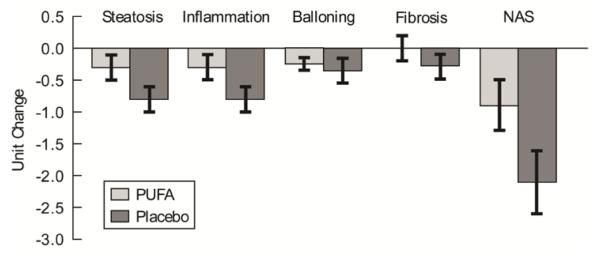
At inclusion, sex, age, body weight, biochemical tests, glucose control, and liver histology were similar in the 2 treatment groups. There was no change in liver enzymes, body weight, or body composition during the study in either group. At the end of the treatment, hepatic steatosis and the activity score improved (P<0.05) and lobular inflammation worsened (P<0.001) with placebo but was unchanged with PUFA. At the end of the treatment, insulin resistance (serum glucose and HOMA) worsened with PUFA but not placebo.
PUFA provided no benefit over placebo in NASH patients with diabetes. The effects of PUFA on histology and insulin resistance were inferior to placebo. These data provide no support for PUFA supplements in NASH.
非酒精性脂肪性肝炎(NASH)在糖尿病患者中常见且严重。尽管目前尚无针对糖尿病患者NASH的有效治疗方法,但初步报告表明多不饱和脂肪酸(PUFA)可能对这些患者有益。
在患有NASH的糖尿病患者中进行了一项前瞻性、随机、双盲、安慰剂对照研究(NCT 00323414)。Clinicaltrials.gov(NCT 00323414)。
共有37例糖尿病控制良好(糖化血红蛋白<8.5%)的患者(年龄50.6±9.8岁),根据CONSORT指南随机分为两组,一组每天接受含二十碳五烯酸(2160毫克)和二十二碳六烯酸(1440毫克)的PUFA,另一组接受含玉米油的等热量、相同安慰剂,为期48周。在随机分组时和治疗结束时进行临床、人口统计学、生化实验室检查、使用双能X线吸收法(DEXA)测量身体成分以及肝活检。肝活检按照NASH临床研究网络(NASH CRN)标准进行评分。进行意向性分析。
入组时,两个治疗组在性别、年龄、体重、生化检查、血糖控制和肝组织学方面相似。在研究期间,两组的肝酶、体重或身体成分均无变化。治疗结束时,安慰剂组的肝脂肪变性和活动评分有所改善(P<0.05),小叶炎症加重(P<0.001),而PUFA组无变化。治疗结束时,PUFA组的胰岛素抵抗(血清葡萄糖和稳态模型评估法)加重,而安慰剂组未加重。
在患有NASH的糖尿病患者中,PUFA并不比安慰剂更有益。PUFA对组织学和胰岛素抵抗的影响不如安慰剂。这些数据不支持在NASH中补充PUFA。