Department of Psychology and Prevention Science Institute, University of Oregon Eugene, OR, USA.
Developmental Cognitive Neuroscience Laboratory, Department of Psychology and Office of Research, University of Nebraska-Lincoln Lincoln, NE, USA.
Front Psychol. 2014 Feb 17;5:107. doi: 10.3389/fpsyg.2014.00107. eCollection 2014.
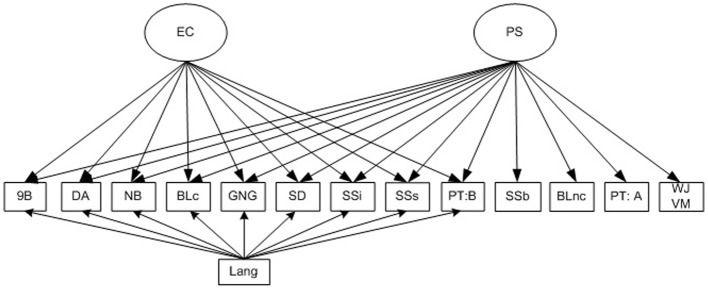
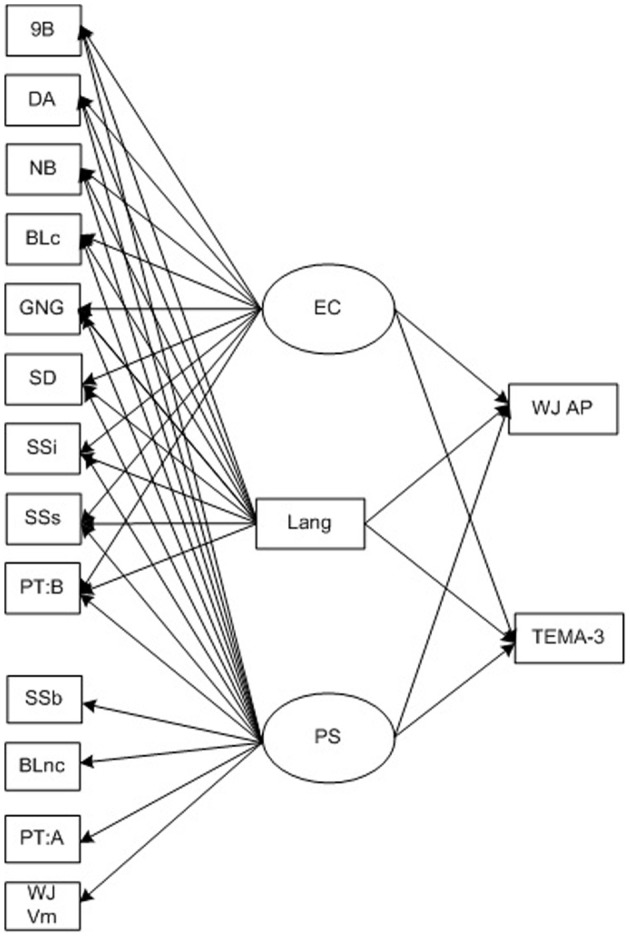
Early executive control (EC) predicts a range of academic outcomes and shows particularly strong associations with children's mathematics achievement. Nonetheless, a major challenge for EC research lies in distinguishing EC from related cognitive constructs that also are linked to achievement outcomes. Developmental cascade models suggest that children's information processing speed is a driving mechanism in cognitive development that supports gains in working memory, inhibitory control and associated cognitive abilities. Accordingly, individual differences in early executive task performance and their relation to mathematics may reflect, at least in part, underlying variation in children's processing speed. The aims of this study were to: (1) examine the degree of overlap between EC and processing speed at different preschool age points; and (2) determine whether EC uniquely predicts children's mathematics achievement after accounting for individual differences in processing speed. As part of a longitudinal, cohort-sequential study, 388 children (50% boys; 44% from low income households) completed the same battery of EC tasks at ages 3, 3.75, 4.5, and 5.25 years. Several of the tasks incorporated baseline speeded naming conditions with minimal EC demands. Multidimensional latent models were used to isolate the variance in executive task performance that did not overlap with baseline processing speed, covarying for child language proficiency. Models for separate age points showed that, while EC did not form a coherent latent factor independent of processing speed at age 3 years, it did emerge as a distinct factor by age 5.25. Although EC at age 3 showed no distinct relation with mathematics achievement independent of processing speed, EC at ages 3.75, 4.5, and 5.25 showed independent, prospective links with mathematics achievement. Findings suggest that EC and processing speed are tightly intertwined in early childhood. As EC becomes progressively decoupled from processing speed with age, it begins to take on unique, discriminative importance for children's mathematics achievement.
早期执行控制(EC)预测了一系列学术成果,并且与儿童的数学成绩表现出特别强烈的关联。尽管如此,EC 研究的一个主要挑战在于将 EC 与相关的认知结构区分开来,这些认知结构也与成就结果有关。发展级联模型表明,儿童的信息处理速度是认知发展的驱动机制,它支持工作记忆、抑制控制和相关认知能力的提高。因此,早期执行任务表现的个体差异及其与数学的关系可能至少部分反映了儿童处理速度的潜在差异。本研究的目的是:(1)检验 EC 与不同学前年龄点的加工速度之间的重叠程度;(2)确定在考虑到加工速度的个体差异后,EC 是否可以独特地预测儿童的数学成绩。作为一项纵向、队列序列研究的一部分,388 名儿童(50%为男孩;44%来自低收入家庭)在 3、3.75、4.5 和 5.25 岁时完成了相同的 EC 任务组。其中一些任务包含了基本的快速命名条件,对 EC 的要求最小。多维潜在模型用于分离执行任务表现中与基本处理速度不重叠的方差,同时协变量为儿童语言能力。针对不同年龄点的模型表明,虽然 EC 在 3 岁时没有形成一个独立于处理速度的连贯潜在因素,但到 5.25 岁时它确实成为一个独特的因素。尽管 3 岁时的 EC 与处理速度独立时与数学成绩没有明显的关系,但 3.75、4.5 和 5.25 岁时的 EC 与数学成绩有独立的、前瞻性的联系。研究结果表明,EC 和加工速度在幼儿期紧密交织在一起。随着 EC 随着年龄的增长逐渐与加工速度分离,它开始对儿童的数学成绩表现具有独特的、区分性的重要性。