Vásquez-Limeta Alejandra, Wagstaff Kylie M, Ortega Arturo, Crouch Dorothy H, Jans David A, Cisneros Bulmaro
Departamento de Genética y Biología Molecular, Centro de Investigación y Estudios Avanzados del Instituto Politécnico Nacional (CINVESTAV-IPN), México D.F., Mexico.
Nuclear Signalling Laboratory, Department of Biochemistry and Molecular Biology, Monash University, Clayton, Victoria, Australia.
PLoS One. 2014 Mar 5;9(3):e90629. doi: 10.1371/journal.pone.0090629. eCollection 2014.
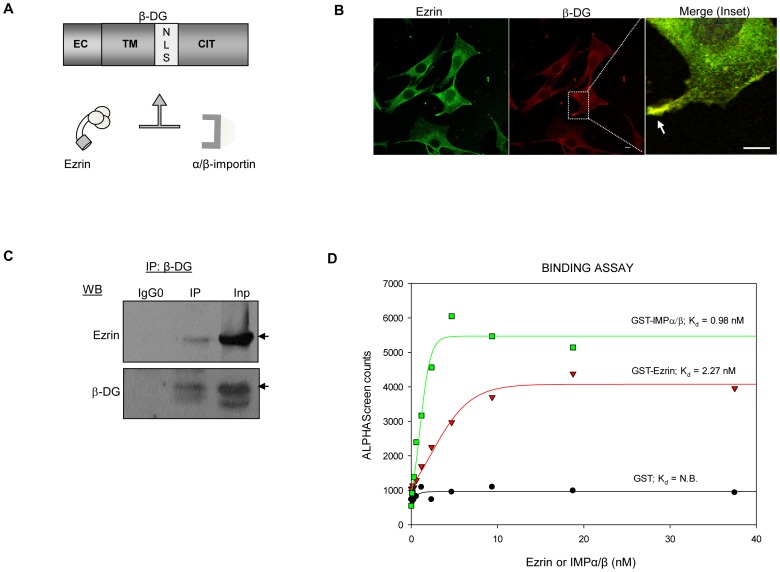
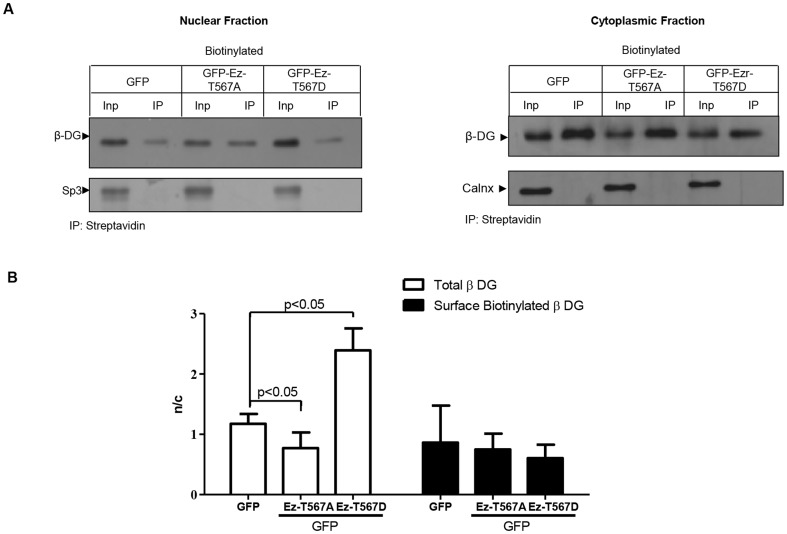
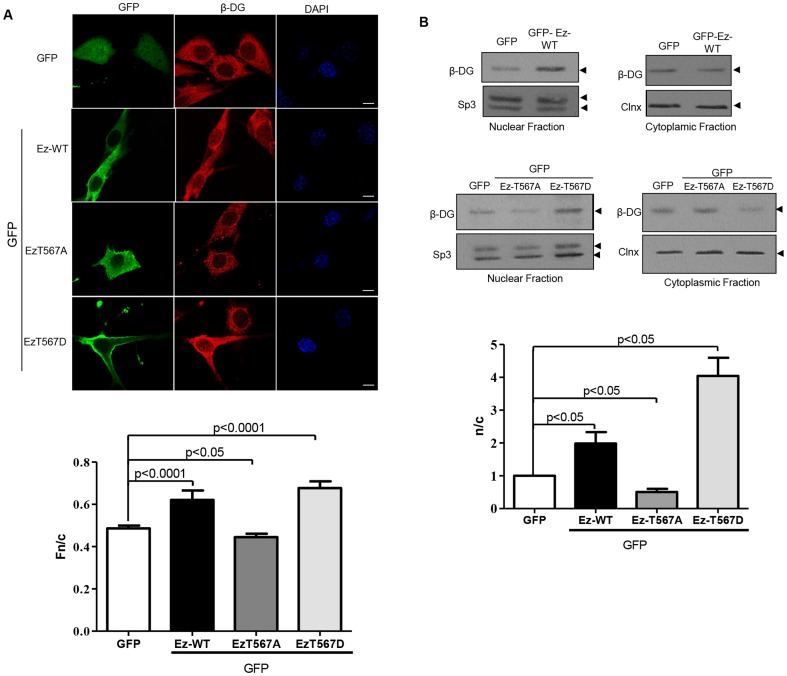
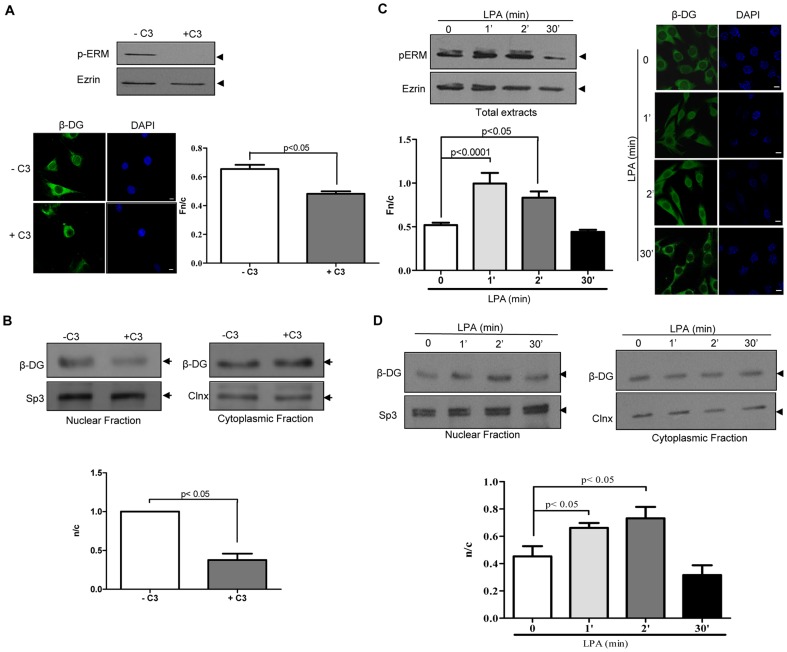
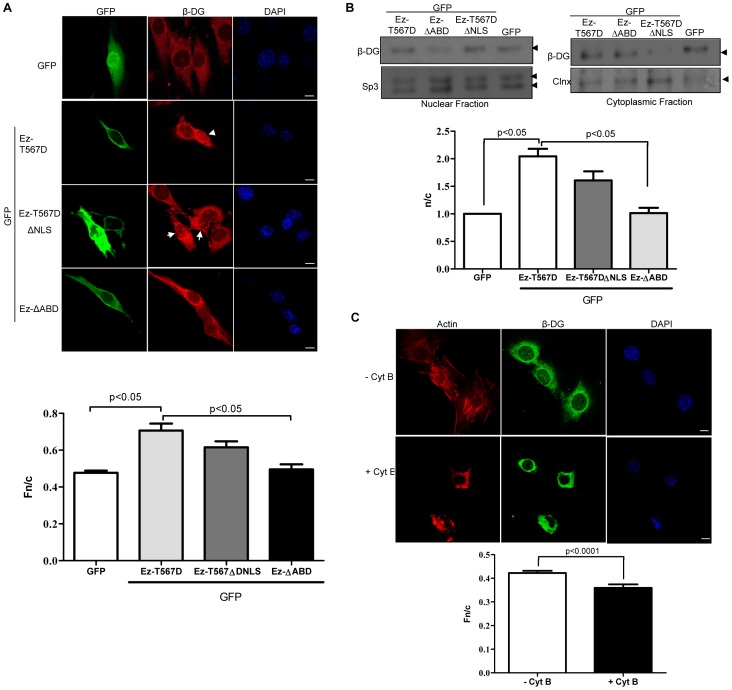
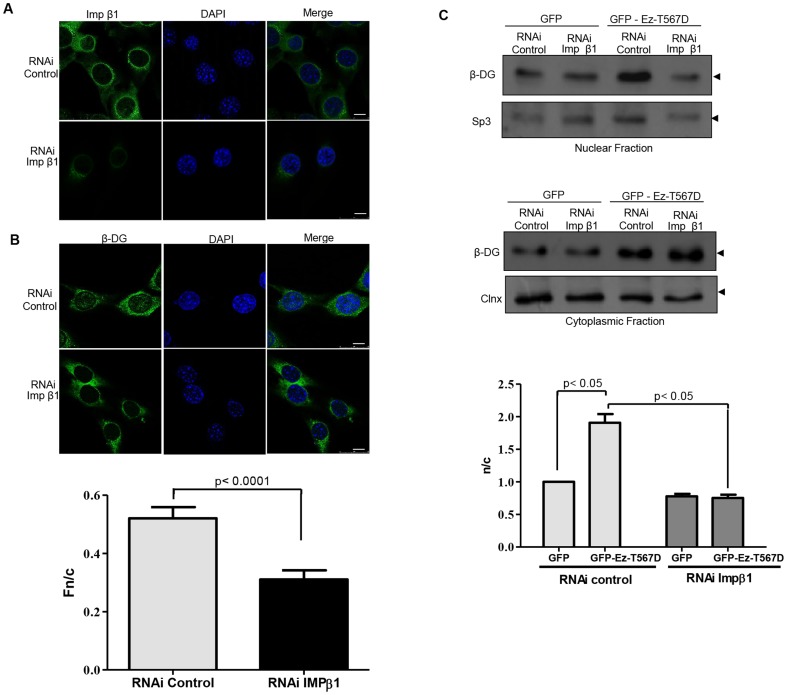
The β-dystroglycan (β-DG) protein has the ability to target to multiple sites in eukaryotic cells, being a member of diverse protein assemblies including the transmembranal dystrophin-associated complex, and a nuclear envelope-localised complex that contains emerin and lamins A/C and B1. We noted that the importin α2/β1-recognised nuclear localization signal (NLS) of β-DG is also a binding site for the cytoskeletal-interacting protein ezrin, and set out to determine whether ezrin binding might modulate β-DG nuclear translocation for the first time. Unexpectedly, we found that ezrin enhances rather than inhibits β-DG nuclear translocation in C2C12 myoblasts. Both overexpression of a phosphomimetic activated ezrin variant (Ez-T567D) and activation of endogenous ezrin through stimulation of the Rho pathway resulted in both formation of actin-rich surface protrusions and significantly increased nuclear translocation of β-DG as shown by quantitative microscopy and subcellular fractionation/Western analysis. In contrast, overexpression of a nonphosphorylatable inactive ezrin variant (Ez-T567A) or inhibition of Rho signaling, decreased nuclear translocation of β-DG concomitant with a lack of cell surface protrusions. Further, a role for the actin cytoskeleton in ezrin enhancement of β-DG nuclear translocation was implicated by the observation that an ezrin variant lacking its actin-binding domain failed to enhance nuclear translocation of β-DG, while disruption of the actin cytoskeleton led to a reduction in β-DG nuclear localization. Finally, we show that ezrin-mediated cytoskeletal reorganization enhances nuclear translocation of the cytoplasmic but not the transmembranal fraction of β-DG. This is the first study showing that cytoskeleton reorganization can modulate nuclear translocation of β-DG, with the implication that β-DG can respond to cytoskeleton-driven changes in cell morphology by translocating from the cytoplasm to the nucleus to orchestrate nuclear processes in response to the functional requirements of the cell.
β-肌营养不良蛋白聚糖(β-DG)蛋白能够靶向真核细胞中的多个位点,它是多种蛋白质组装体的成员,包括跨膜肌营养不良蛋白相关复合物以及一种定位于核膜的复合物,该复合物包含emerin和核纤层蛋白A/C及B1。我们注意到β-DG的输入蛋白α2/β1识别的核定位信号(NLS)也是细胞骨架相互作用蛋白埃兹蛋白(ezrin)的结合位点,并着手首次确定埃兹蛋白结合是否可能调节β-DG的核转运。出乎意料的是,我们发现埃兹蛋白增强而非抑制C2C12成肌细胞中β-DG的核转运。磷酸化模拟激活的埃兹蛋白变体(Ez-T567D)的过表达以及通过刺激Rho途径激活内源性埃兹蛋白,均导致富含肌动蛋白的表面突起形成,并且如定量显微镜和亚细胞分级分离/蛋白质免疫印迹分析所示,β-DG的核转运显著增加。相反,不可磷酸化的无活性埃兹蛋白变体(Ez-T567A)的过表达或Rho信号传导的抑制,伴随着细胞表面突起的缺乏,降低了β-DG的核转运。此外,肌动蛋白细胞骨架在埃兹蛋白增强β-DG核转运中的作用通过以下观察得以体现:缺乏肌动蛋白结合结构域的埃兹蛋白变体未能增强β-DG的核转运,而肌动蛋白细胞骨架的破坏导致β-DG核定位减少。最后,我们表明埃兹蛋白介导的细胞骨架重组增强了β-DG细胞质部分而非跨膜部分的核转运。这是第一项表明细胞骨架重组可调节β-DG核转运的研究,并暗示β-DG可通过从细胞质转运至细胞核以协调核过程来响应细胞骨架驱动的细胞形态变化,从而满足细胞的功能需求。