Grözinger Franziska, Thein Jürgen, Feldhaar Heike, Rödel Mark-Oliver
Department of Animal Ecology and Tropical Biology (Zoology III), Theodor-Boveri-Institute (Biocenter of the University), Würzburg, Germany; Museum für Naturkunde Berlin, Leibniz Institute for Research on Evolution and Biodiversity, Berlin, Germany; Berlin-Brandenburg Institute of Advanced Biodiversity Research (BBIB), Berlin, Germany.
Büro für Faunistik und Umweltbildung, Hassfurt, Germany.
PLoS One. 2014 Mar 5;9(3):e89982. doi: 10.1371/journal.pone.0089982. eCollection 2014.
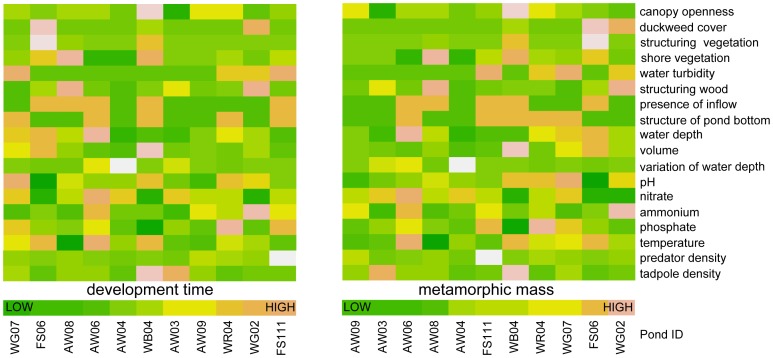
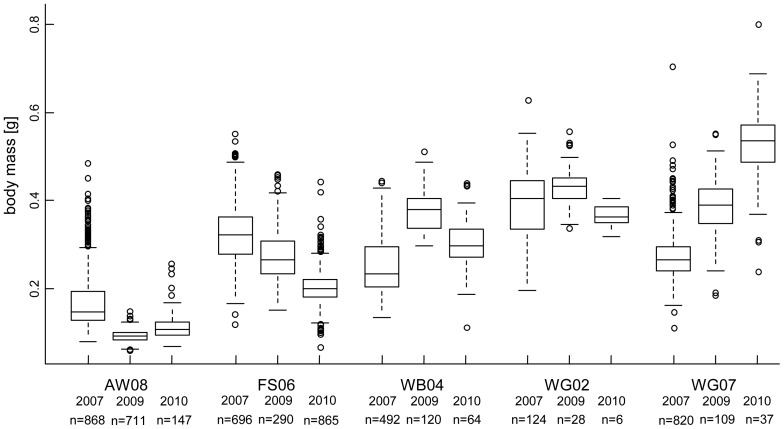
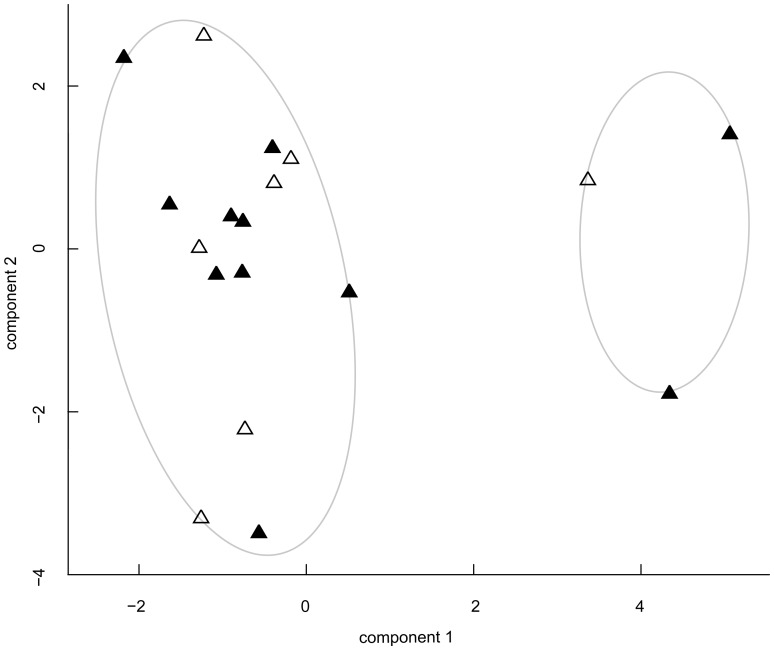
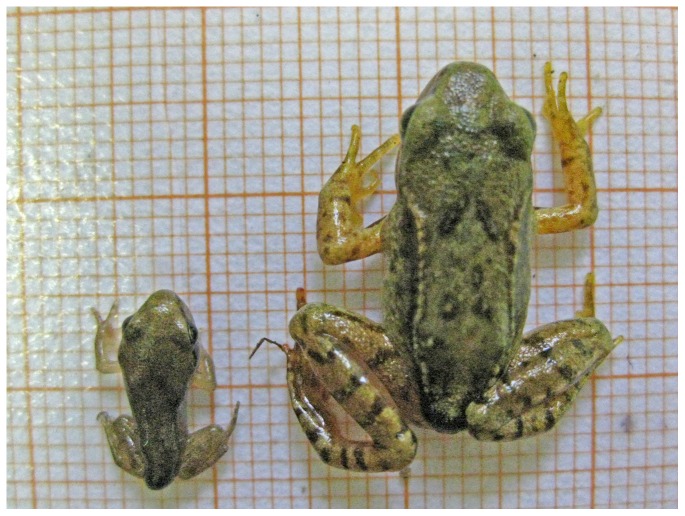
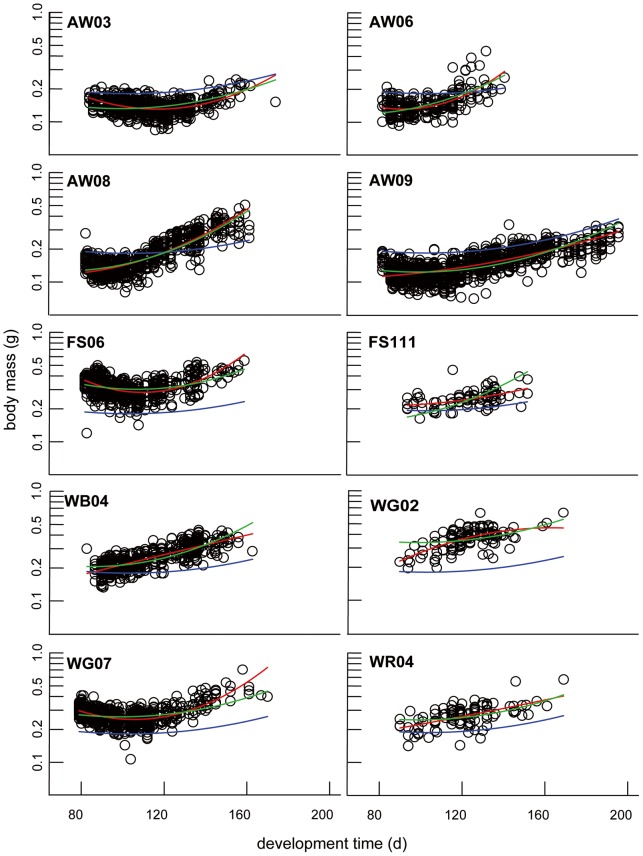
In order to understand adaptation processes and population dynamics, it is central to know how environmental parameters influence performance of organisms within populations, including their phenotypes. The impact of single or few particular parameters in concert was often assessed in laboratory and mesocosm experiments. However, under natural conditions, with many biotic and abiotic factors potentially interacting, outcomes on phenotypic changes may be different. To study the potential environmental impact on realized phenotypic plasticity within a natural population, we assessed metamorphic traits (developmental time, size and body mass) in an amphibian species, the European common frog Rana temporaria, since a) larval amphibians are known to exhibit high levels of phenotypic plasticity of these traits in response to habitat parameters and, b) the traits' features may strongly influence individuals' future performance and fitness. In 2007 we studied these metamorphic traits in 18 ponds spread over an area of 28 km2. A subset of six ponds was reinvestigated in 2009 and 2010. This study revealed locally high variances in metamorphic traits in this presumed generalist species. We detected profound differences between metamorphing froglets (up to factor ten); both between and within ponds, on a very small geographic scale. Parameters such as predation and competition as well as many other pond characteristics, generally expected to have high impact on development, could not be related to the trait differences. We observed high divergence of patterns of mass at metamorphosis between ponds, but no detectable pattern when metamorphic traits were compared between ponds and years. Our results indicate that environment alone, i.e. as experienced by tadpoles sharing the same breeding pond, can only partly explain the variability of metamorphic traits observed. This emphasizes the importance to assess variability of reaction norms on the individual level to explain within-population variability.
为了理解适应过程和种群动态,关键在于了解环境参数如何影响种群内生物的表现,包括它们的表型。单个或少数几个特定参数共同作用的影响通常在实验室和中宇宙实验中进行评估。然而,在自然条件下,许多生物和非生物因素可能相互作用,表型变化的结果可能会有所不同。为了研究对自然种群中实现的表型可塑性的潜在环境影响,我们评估了一种两栖动物欧洲普通蛙(Rana temporaria)的变态特征(发育时间、大小和体重),原因如下:a)已知两栖动物幼体对栖息地参数会表现出这些特征的高水平表型可塑性;b)这些特征可能会强烈影响个体未来的表现和适应性。2007年,我们在面积达28平方公里的18个池塘中研究了这些变态特征。2009年和2010年对其中6个池塘的子集进行了重新调查。这项研究揭示了在这个假定的广适性物种中,变态特征在局部存在很大差异。我们在非常小的地理尺度上检测到变态幼蛙之间(差异高达10倍)以及池塘之间和池塘内部存在显著差异。诸如捕食和竞争等参数以及许多其他通常预期对发育有很大影响的池塘特征,与这些特征差异并无关联。我们观察到不同池塘之间变态时的体重模式存在很大差异,但在比较不同池塘和年份的变态特征时未发现可检测到的模式。我们的结果表明,仅环境因素,即同一繁殖池塘中的蝌蚪所经历的环境,只能部分解释所观察到的变态特征的变异性。这强调了在个体水平评估反应规范变异性以解释种群内变异性的重要性。