Purcell Renee, McInnes Susan, Halcomb Elizabeth J
School of Nursing & Midwifery, University of Wollongong, Wollongong, NSW, Australia.
BMC Fam Pract. 2014 Mar 7;15:43. doi: 10.1186/1471-2296-15-43.
There has been growing interest regarding the impact of telemonitoring and its ability to reduce the increasing burden of chronic diseases, including chronic cardiovascular disease (CVD), on healthcare systems. A number of randomised trials have been undertaken internationally and synthesised into various systematic reviews to establish an evidence base for this model of care. This study sought to synthesise and critically evaluate this large body of evidence to inform clinicians, researchers and policy makers.
A systematic review of systematic reviews investigating the impact of telemonitoring interventions in the primary care management of CVD was conducted. Reviews were included if they explored primary care based telemonitoring in either CVD, heart failure or hypertension, were reported in the English language and were published between 2000 and 2013. Data was extracted by one reviewer and checked by a second reviewer using a standardised form. Two assessors then rated the quality of each review using the Overview Quality Assessment Questionnaire (OQAQ).
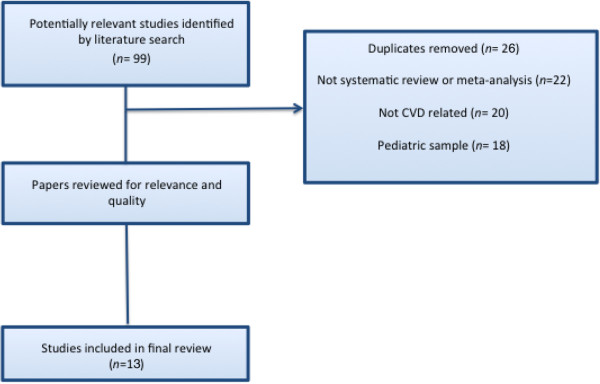
Of the 13 included reviews, four focused on telemonitoring interventions in hypertension or CVD management and the remaining 9 reviews investigated telemonitoring in HF management. Seven reviews scored a five or above on the OQAQ evidencing good quality reviews. Findings suggest that telemonitoring can contribute to significant reductions in blood pressure, decreased all-cause and HF related hospitalisations, reduced all-cause mortality and improved quality of life. Telemonitoring was also demonstrated to reduce health care costs and appears acceptable to patients.
Telemonitoring has the potential to enhance primary care management of CVD by improving patient outcomes and reducing health costs. However, further research needs to explore the specific elements of telemonitoring interventions to determine the relative value of the various elements. Additionally, the ways in which telemonitoring care improves health outcomes needs to be further explored to understand the nature of these interventions.
远程监测及其减轻包括慢性心血管疾病(CVD)在内的慢性病对医疗系统日益增加的负担的能力所产生的影响,已引发越来越多的关注。国际上已开展了多项随机试验,并综合成各种系统评价,以为这种护理模式建立证据基础。本研究旨在综合并批判性地评估这一大量证据,为临床医生、研究人员和政策制定者提供参考。
对调查远程监测干预在CVD初级保健管理中的影响的系统评价进行了系统回顾。纳入的评价需探讨基于初级保健的远程监测在CVD、心力衰竭或高血压中的应用,以英文发表且发表于2000年至2013年之间。由一名审阅者提取数据,并由另一名审阅者使用标准化表格进行核对。然后,两名评估者使用概述质量评估问卷(OQAQ)对每个评价的质量进行评分。
在纳入的13项评价中,4项关注高血压或CVD管理中的远程监测干预,其余9项评价调查了心力衰竭管理中的远程监测。7项评价在OQAQ上的得分达到5分或以上,证明是高质量的评价。研究结果表明,远程监测可显著降低血压,减少全因和与心力衰竭相关的住院次数,降低全因死亡率并改善生活质量。远程监测还被证明可降低医疗成本,且患者似乎可以接受。
远程监测有可能通过改善患者预后和降低医疗成本来加强CVD的初级保健管理。然而,需要进一步研究探索远程监测干预的具体要素,以确定各要素的相对价值。此外,需要进一步探索远程监测护理改善健康结局的方式,以了解这些干预措施的本质。