Department of Biomedical Engineering and Impedance Imaging Research Center, Kyung Hee University, 446-701 Yongin, Korea.
Biomed Eng Online. 2014 Mar 8;13(1):24. doi: 10.1186/1475-925X-13-24.
The spectroscopic conductivity distribution of tissue can help to explain physiological and pathological status. Dual frequency conductivity imaging by combining Magnetic Resonance Electrical Property Tomography (MREPT) and Magnetic Resonance Electrical Impedance Tomography (MREIT) has been recently proposed. MREIT can provide internal conductivity distributions at low frequency (below 1 kHz) induced by an external injecting current. While MREPT can provide conductivity at the Larmor frequency related to the strength of the magnetic field. Despite this potential to describe the membrane properties using spectral information, MREPT and MREIT techniques currently suffer from weak signals and noise amplification as they both reply on differentiation of measured phase data.
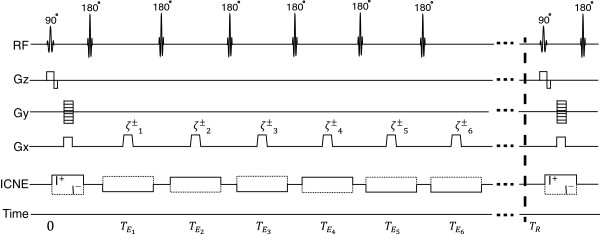
We proposed a method to optimize the measured phase signal by finding weighting factors according to the echo signal for MREPT and MREIT using the ICNE (Injected current nonlinear encoding) multi-echo pulse sequence. Our target weights are chosen to minimize the measured noise. The noise standard deviations were precisely analyzed for the optimally weighted magnetic flux density and the phase term of the positive-rotating magnetic field. To enhance the quality of dual-frequency conductivity images, we applied the denoising method based on the reaction-diffusion equation with the estimated noise standard deviations. A real experiment was performed with a hollow cylindrical object made of thin insulating film with holes to control the apparent conductivity using ion mobility and an agarose gel cylinder wrapped in an insulating film without holes to show different spectroscopic conductivities.
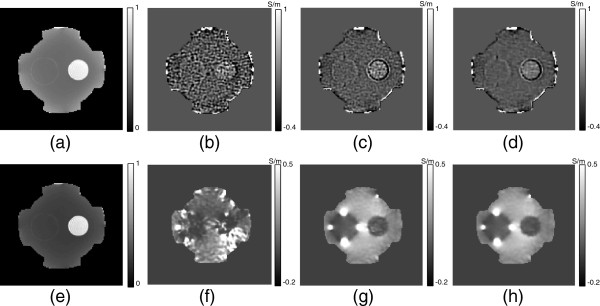
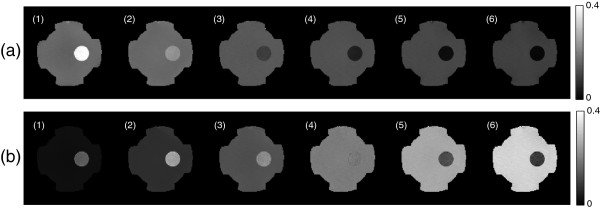
The ability to image different conductivity characteristics in MREPT and MREIT from a single MR scan was shown by including the two objects with different spectroscopic conductivities. Using the six echo signals, we computed the optimized weighting factors for each echo. The qualities of conductivity images for MREPT and MREIT were improved by optimization of the phase map. The proposed method effectively reduced the random noise artifacts for both MREIT and MREPT.
We enhanced the dual conductivity images using the optimally weighted magnetic flux density and the phase term of positive-rotating magnetic field based on the analysis of the noise standard deviations and applying the optimization and denoising methods.
组织的光谱电导率分布有助于解释生理和病理状态。最近提出了结合磁共振电阻抗断层成像(MREPT)和磁共振电阻抗成像(MREIT)的双频电导率成像。MREIT 可以提供外部注入电流在低频(低于 1 kHz)下诱导的内部电导率分布。而 MREPT 可以提供与磁场强度相关的拉莫尔频率下的电导率。尽管有使用光谱信息描述膜特性的潜力,但 MREPT 和 MREIT 技术目前由于都依赖于测量相位数据的差异,因此信号较弱且噪声放大。
我们提出了一种通过根据 MREPT 和 MREIT 的回波信号找到加权因子的方法来优化测量相位信号,该方法使用了 ICNE(注入电流非线性编码)多回波脉冲序列。我们的目标权重是选择来最小化测量噪声。对于优化后的磁通密度和正旋磁场的相位项,我们对测量噪声的标准偏差进行了精确分析。为了提高双频电导率图像的质量,我们应用了基于扩散方程的去噪方法,并根据估计的噪声标准偏差进行了去噪。通过使用带有孔的薄绝缘膜制成的空心圆柱形物体和包裹在无孔绝缘膜中的琼脂糖凝胶圆柱体来控制离子迁移率的表观电导率,进行了真实实验,以显示不同的光谱电导率。
通过包括具有不同光谱电导率的两个物体,在单次磁共振扫描中显示了 MREPT 和 MREIT 成像不同电导率特性的能力。使用六个回波信号,我们为每个回波计算了优化的加权因子。通过优化相位图,提高了 MREPT 和 MREIT 的电导率图像质量。该方法有效地降低了 MREIT 和 MREPT 的随机噪声伪影。
我们通过分析噪声标准偏差并应用优化和去噪方法,使用优化后的正旋磁场磁通密度和相位项增强了双电导率图像。