Uckun F M, Ledbetter J A
Department of Therapeutic Radiology-Radiation Oncology, University of Minnesota, Minneapolis 55455.
Proc Natl Acad Sci U S A. 1988 Nov;85(22):8603-7. doi: 10.1073/pnas.85.22.8603.
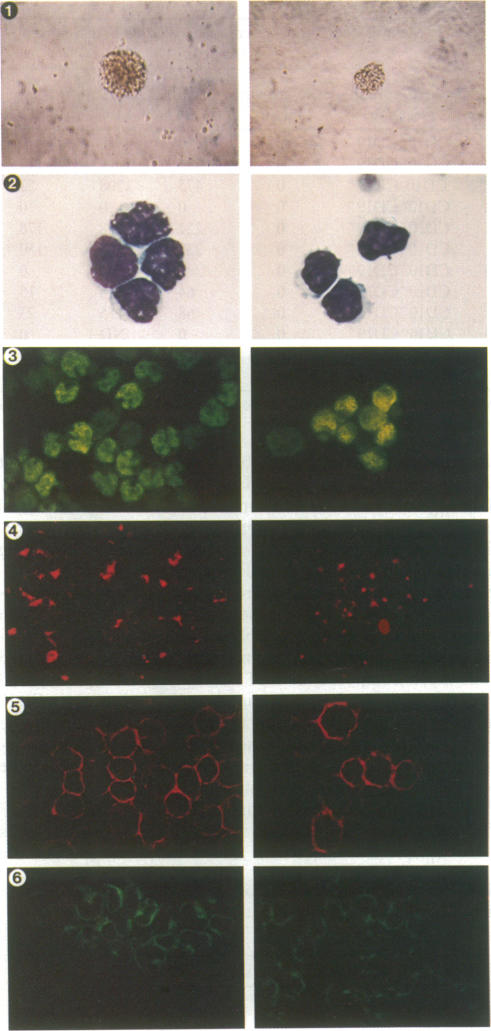
The early stages of normal human B-cell differentiation were studied by flow cytometry and cell sorting based on expression of CD10 (CALLA) and CD19 antigens in fetal liver. Both CD10+ CD19+ and CD10+ CD19- precursor populations proliferated in vitro to form B-cell precursor colonies under stimulation from low molecular weight B-cell growth factor (L-BCGF) or recombinant interleukin 3 but did not respond to high molecular weight B-cell growth factor (H-BCGF). The colonies derived from the CD10+ CD19- fraction showed induction of CD19 expression in 10-50% of growing cells, suggesting that CD10 expression precedes CD19 expression in B-cell ontogeny. This hypothesis was corroborated by less-differentiated marker profiles of the progeny of CD10+ CD19- B-cell precursors as compared to CD10+ CD19+ B-cell precursors in BCGF-stimulated cultures and by higher percentages of CD10+CD19- versus CD10-CD19+ B-cell precursors. CD19 crosslinking on normal fetal liver or bone marrow B-cell precursors was associated with an increase in cytoplasmic calcium concentration, but was inhibitory for colony formation. Leukemic B-cell precursors from acute lymphoblastic leukemias (ALLs) differed from normal B-cell precursors in their in vitro proliferative responses, since (i) they responded not only to L-BCGF and rIL-3 but also to H-BCGF and (ii) their proliferation was stimulated rather than inhibited by CD19 crosslinking. A clonogenic leukemic counterpart for the CD10+CD19- normal B-cell precursor population does not exist among malignant cells from B-cell precursor ALL patients, suggesting that the CD19 receptor may be involved in leukemogenesis of human B-cell precursor ALL.
通过流式细胞术以及基于胎儿肝脏中CD10(CALLA)和CD19抗原表达的细胞分选技术,对正常人B细胞分化的早期阶段进行了研究。在低分子量B细胞生长因子(L-BCGF)或重组白细胞介素3的刺激下,CD10+CD19+和CD10+CD19-前体细胞群均可在体外增殖形成B细胞前体集落,但对高分子量B细胞生长因子(H-BCGF)无反应。来自CD10+CD19-组分的集落在10%-50%的生长细胞中显示出CD19表达的诱导,这表明在B细胞个体发育中CD10表达先于CD19表达。与BCGF刺激培养中的CD10+CD19+ B细胞前体相比,CD10+CD19- B细胞前体后代的分化标志物谱不那么分化,以及CD10+CD19- B细胞前体相对于CD10-CD19+ B细胞前体的百分比更高,这一假设得到了证实。正常胎儿肝脏或骨髓B细胞前体上的CD19交联与细胞质钙浓度的增加有关,但对集落形成具有抑制作用。急性淋巴细胞白血病(ALL)的白血病B细胞前体在体外增殖反应方面与正常B细胞前体不同,因为(i)它们不仅对L-BCGF和rIL-3有反应,而且对H-BCGF也有反应,并且(ii)它们的增殖受到CD19交联的刺激而非抑制。在B细胞前体ALL患者的恶性细胞中不存在与CD10+CD19-正常B细胞前体群体相对应的克隆性白血病细胞,这表明CD19受体可能参与了人类B细胞前体ALL的白血病发生过程。