Key Laboratory of Materials Physics, Institute of Solid State Physics, CAS, and Department of Physics, University of Science and Technology of China, Hefei 230031, China.
1] Key Laboratory of Materials Physics, Institute of Solid State Physics, CAS, and Department of Physics, University of Science and Technology of China, Hefei 230031, China [2] Beijing Computational Science Research Center, Beijing 100084, China [3] Kavli Institute for Theoretical Physics China, CAS, Beijing 100190, China.
Sci Rep. 2014 Mar 12;4:4358. doi: 10.1038/srep04358.
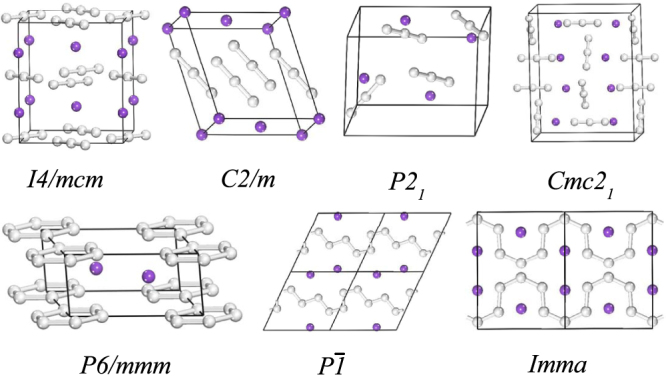
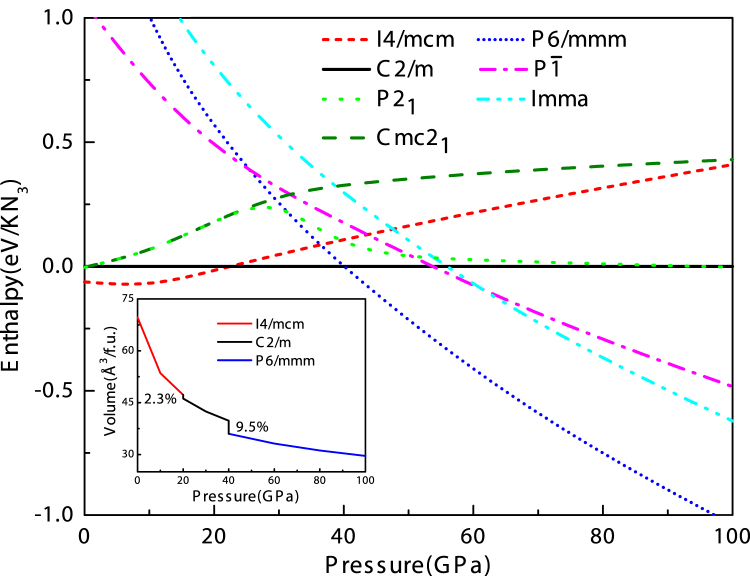
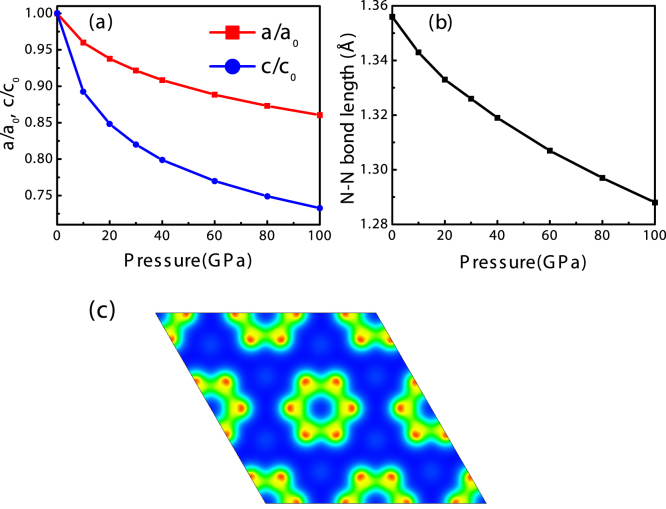
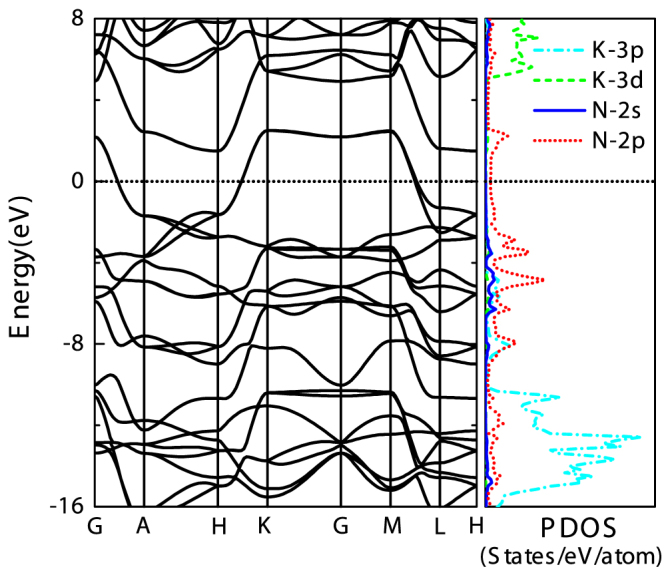
The first-principles method and the evolutionary algorithm are used to identify stable high pressure phases of potassium azide (KN3). It has been verified that the stable phase with space group I4/mcm below 22 GPa, which is consistent with the experimental result, will transform into the C2/m phase with pressure increasing. These two phases are insulator with N(-)(3) anions. A metallic phase with P6/mmm symmetry is preferred above 40 GPa, and the N atoms in this structure form six-membered rings which are important for understanding the pressure effect on N(-)(3) anions and phase transitions of KN3. Above the studied pressure (100 GPa), a polymerization of N6 rings may be obtained as the result of the increasing compactness.
运用第一性原理方法和演化算法来确定叠氮化钾(KN3)的稳定高压相。验证了在 22 GPa 以下,具有空间群 I4/mcm 的稳定相将随着压力的增加而转变为 C2/m 相。这两个相都是 N(-)(3)阴离子的绝缘体。在 40 GPa 以上,具有 P6/mmm 对称的金属相更占优势,而在这个结构中的 N 原子形成六元环,这对于理解 N(-)(3)阴离子的压力效应和 KN3 的相转变非常重要。在研究的压力(100 GPa)以上,由于越来越紧凑,N6 环的聚合可能会得到。