Department of Obstetrics and Gynecology, Shengjing Hospital, China Medical University, Shenyang 110004, China.
BMC Cancer. 2014 Mar 14;14:188. doi: 10.1186/1471-2407-14-188.
BRCA mutations are the main known hereditary factor for ovarian cancer. Notably, emerging evidence indicates that the glucocorticoid receptor (GR) has drawn considerable interest in ovarian cancer development. However, dynamic cross-talk between BRCA1 and GR signaling pathways are poorly understood.
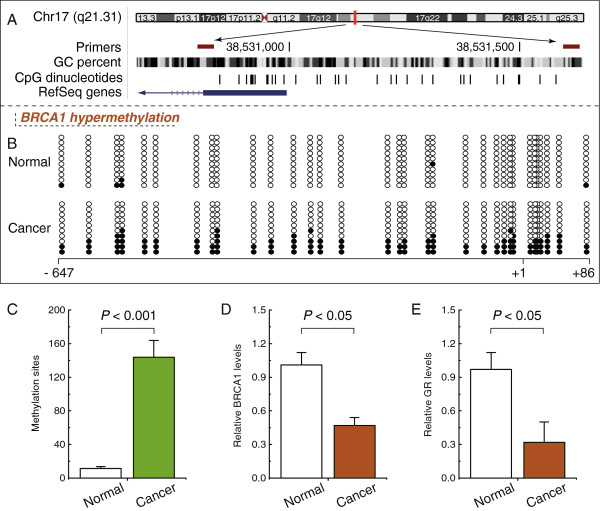
The regulatory effects of BRCA on GR were assessed in 146 serous ovarian cancer patients (28 pairs of BRCA1-mutated or not, 23 pairs of BRCA2-mutated or not, and 22 pairs with hypermethylated BRCA1 promoter or not). BRCA1 promoter methylation was analyzed by bisulfite sequencing using primers flanking the core promoter region. Expression levels of BRCA1 and GR were assessed by immunohistochemistry and real-time PCR. Regression analysis was used to examine the possible relationship between BRCA1 and GR expression levels. The knockdown and overexpression of BRCA1 were achieved using a lentiviral vector in 293 T cells, SKOV3 ovarian cancer cells, and primary non-mutated and BRCA1-mutated ovarian cancer cells.
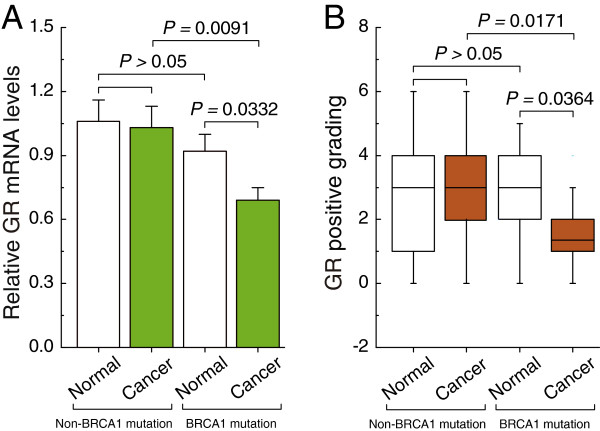
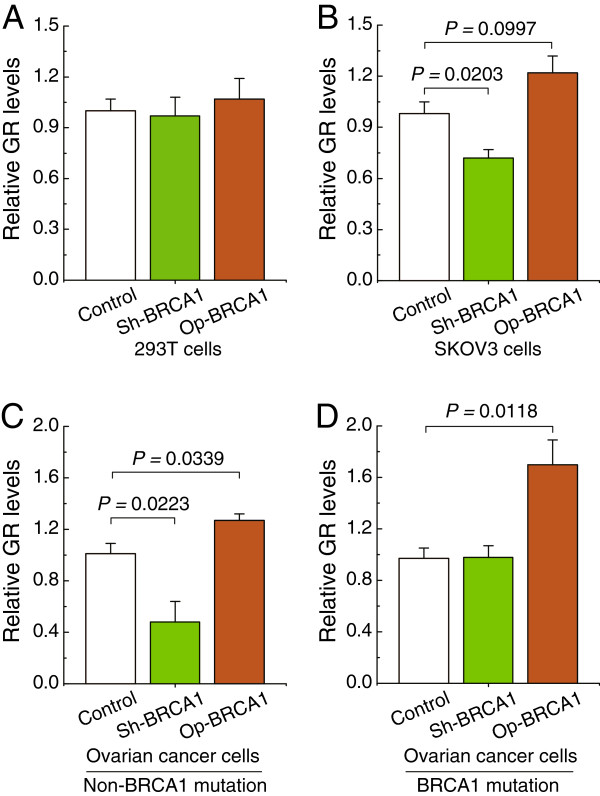
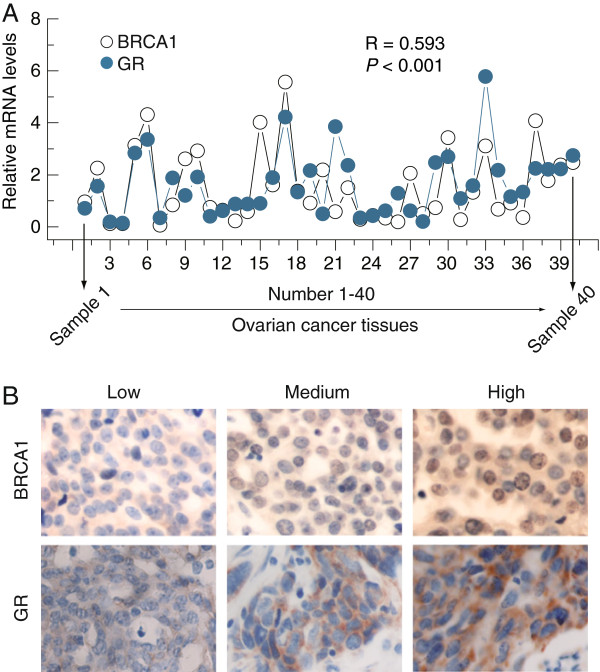
GR expression levels were unchanged in non-BRCA1-mutated, non-BRCA2-mutated and BRCA2-mutated ovarian cancer compared to their normal tissues; BRCA1 repression (BRCA1 mutation or BRCA1 promoter hypermethylation) ovarian cancer showed decreased GR levels compared to normal tissue; there was a positive correlation between BRCA1 and GR expression in human ovarian cancer specimens; BRCA1 knockdown was effective at inhibiting GR expression, and overexpression of BRCA1 induces an increase in GR levels in ovarian cancer cells.
These results suggest that GR may be a potential target for BRCA1 in ovarian cancer progression.
BRCA 突变是卵巢癌的主要遗传性因素。值得注意的是,新出现的证据表明,糖皮质激素受体(GR)在卵巢癌发展中引起了相当大的关注。然而,BRCA1 和 GR 信号通路之间的动态相互作用仍知之甚少。
在 146 名浆液性卵巢癌患者(28 对 BRCA1 突变或未突变、23 对 BRCA2 突变或未突变、22 对 BRCA1 启动子高甲基化或未甲基化)中评估了 BRCA 对 GR 的调节作用。使用侧翼核心启动子区域的引物通过亚硫酸氢盐测序分析 BRCA1 启动子甲基化。通过免疫组织化学和实时 PCR 评估 BRCA1 和 GR 的表达水平。回归分析用于检查 BRCA1 和 GR 表达水平之间的可能关系。使用慢病毒载体在 293T 细胞、SKOV3 卵巢癌细胞以及非突变和 BRCA1 突变的原发性卵巢癌细胞中实现 BRCA1 的敲低和过表达。
与正常组织相比,非 BRCA1 突变、非 BRCA2 突变和 BRCA2 突变的卵巢癌中 GR 表达水平不变;与正常组织相比,BRCA1 抑制(BRCA1 突变或 BRCA1 启动子高甲基化)卵巢癌中 GR 水平降低;在人卵巢癌标本中,BRCA1 和 GR 表达之间存在正相关;BRCA1 敲低可有效抑制 GR 表达,BRCA1 的过表达可诱导卵巢癌细胞中 GR 水平升高。
这些结果表明,GR 可能是 BRCA1 在卵巢癌进展中的潜在靶标。