Li Min, Song Lu-Jun, Qin Xin-Yu
Department of General Surgery, Zhongshan Hospital, Fudan University, Shanghai, China.
J Cell Mol Med. 2014 May;18(5):749-58. doi: 10.1111/jcmm.12270. Epub 2014 Mar 14.
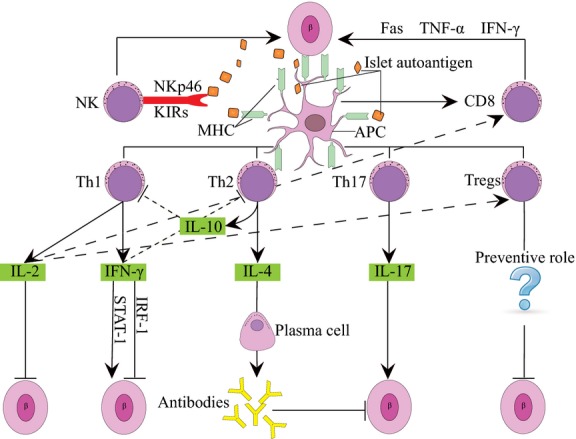
Type 1 diabetes is an autoimmune disease caused by the immune-mediated destruction of insulin-producing pancreatic β cells. In recent years, the incidence of type 1 diabetes continues to increase. It is supposed that genetic, environmental and immune factors participate in the damage of pancreatic β cells. Both the immune regulation and the immune response are involved in the pathogenesis of type 1 diabetes, in which cellular immunity plays a significant role. For the infiltration of CD4(+) and CD8(+) T lymphocyte, B lymphocytes, natural killer cells, dendritic cells and other immune cells take part in the damage of pancreatic β cells, which ultimately lead to type 1 diabetes. This review outlines the cellular immunological mechanism of type 1 diabetes, with a particular emphasis to T lymphocyte and natural killer cells, and provides the effective immune therapy in T1D, which is approached at three stages. However, future studies will be directed at searching for an effective, safe and long-lasting strategy to enhance the regulation of a diabetogenic immune system with limited toxicity and without global immunosuppression.
1型糖尿病是一种自身免疫性疾病,由免疫介导的胰岛素生成胰腺β细胞破坏引起。近年来,1型糖尿病的发病率持续上升。据推测,遗传、环境和免疫因素参与了胰腺β细胞的损伤。免疫调节和免疫反应均参与1型糖尿病的发病机制,其中细胞免疫起着重要作用。对于CD4(+)和CD8(+) T淋巴细胞、B淋巴细胞、自然杀伤细胞、树突状细胞等免疫细胞的浸润参与了胰腺β细胞的损伤,最终导致1型糖尿病。本文综述了1型糖尿病的细胞免疫机制,特别强调了T淋巴细胞和自然杀伤细胞,并提供了1型糖尿病的有效免疫治疗方法,该方法分三个阶段进行。然而,未来的研究将致力于寻找一种有效、安全且持久的策略,以增强对具有有限毒性且无全身免疫抑制的致糖尿病免疫系统的调节。