Zhang Xiaoai, Chen Xi, Zhai Yun, Cui Ying, Cao Pengbo, Zhang Hongxing, Wu Zhihao, Li Peiyao, Yu Lixa, Xia Xia, He Fuchu, Zhou Gangqiao
State Key Laboratory of Proteomics, Beijing Proteome Research Center, Beijing Institute of Radiation Medicine, Beijing, P. R. China; State Key Laboratory of Pathogen and Biosecurity, Beijing Institute of Microbiology and Epidemiology, Beijing, P. R. China.
State Key Laboratory of Proteomics, Beijing Proteome Research Center, Beijing Institute of Radiation Medicine, Beijing, P. R. China.
PLoS One. 2014 Mar 14;9(3):e92135. doi: 10.1371/journal.pone.0092135. eCollection 2014.
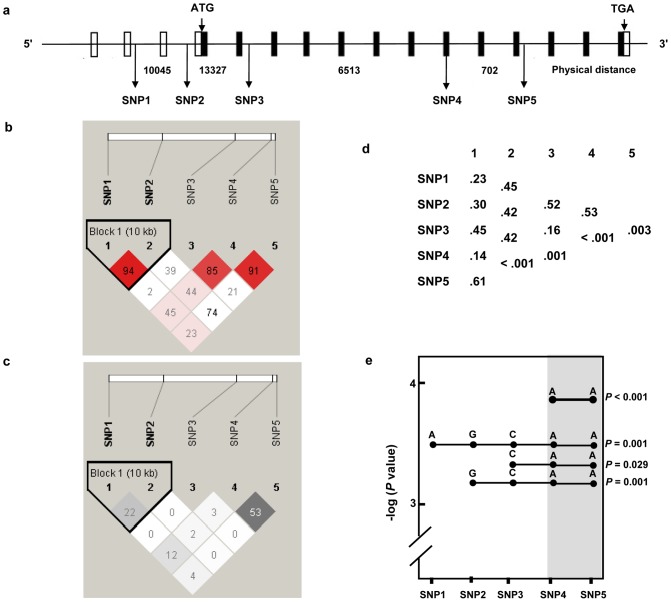
Phosphatase and tensin homolog (PTEN), v-akt murine thymoma viral oncogene homolog 1 (AKT1), mouse double minute 2 (MDM2) and p53 play important roles in the development of cancer. We examined whether the single nucleotide polymorphisms (SNPs) in the PTEN, AKT1, MDM2 and p53 genes were related to the risk and severity of nasopharyngeal carcinoma (NPC) in the Chinese population. Seven SNPs [p53 rs1042522, PTEN rs11202592, AKT1 SNP1-5 (rs3803300, rs1130214, rs3730358, rs1130233 and rs2494732)] were genotyped in 593 NPC cases and 480 controls by PCR direct sequencing or PCR-RFLP analysis. Multivariate logistic regression analysis was used to calculate adjusted odds ratios (ORs) and 95% confidence intervals (CIs). None of the polymorphisms alone was associated with the risk or severity of NPC. However, haplotype analyses indicated that a two-SNP core haplotype (SNP4-5, AA) in AKT1 was associated with a significantly increased susceptibility to NPC risk (adjusted OR = 3.87, 95% CI = 1.96-7.65; P<0.001). Furthermore, there was a significantly increased risk of NPC associated with the combined risk genotypes (i.e., p53 rs1042522 Arg/Pro + Pro/Pro, MDM2 rs2279244 G/T + G/G, PTEN rs11202592 C/C, AKT1 rs1130233 A/A). Compared with the low-risk group (0-2 combined risk genotypes), the high-risk group (3-4 combined risk genotypes) was associated with a significantly increased susceptibility to NPC risk (adjusted OR = 1.67, 95% CI = 1.12-2.50; P = 0.012). Our results suggest that genetic variants in the PTEN, AKT1, MDM2 and p53 tumor suppressor-oncoprotein network may play roles in mediating the susceptibility to NPC in Chinese populations.
磷酸酶和张力蛋白同源物(PTEN)、v-akt小鼠胸腺瘤病毒癌基因同源物1(AKT1)、小鼠双微体2(MDM2)和p53在癌症发展中起重要作用。我们研究了PTEN、AKT1、MDM2和p53基因中的单核苷酸多态性(SNP)是否与中国人群鼻咽癌(NPC)的风险和严重程度相关。通过PCR直接测序或PCR-RFLP分析,对593例NPC病例和480例对照进行了7个SNP [p53 rs1042522、PTEN rs11202592、AKT1 SNP1-5(rs3803300、rs1130214、rs3730358、rs1130233和rs2494732)]的基因分型。采用多因素logistic回归分析计算调整后的比值比(OR)和95%置信区间(CI)。单独的多态性均与NPC的风险或严重程度无关。然而,单倍型分析表明,AKT1中的一个双SNP核心单倍型(SNP4-5,AA)与NPC风险的易感性显著增加相关(调整后的OR = 3.87,95% CI = 1.96-7.65;P<0.001)。此外,与联合风险基因型(即p53 rs1042522 Arg/Pro + Pro/Pro、MDM2 rs2279244 G/T + G/G、PTEN rs11202592 C/C、AKT1 rs1130233 A/A)相关的NPC风险显著增加。与低风险组(0-2个联合风险基因型)相比,高风险组(3-4个联合风险基因型)与NPC风险易感性显著增加相关(调整后的OR = 1.67,95% CI = 1.12-2.50;P = 0.012)。我们的结果表明,PTEN、AKT1、MDM2和p53肿瘤抑制蛋白-癌蛋白网络中的基因变异可能在介导中国人群对NPC的易感性中起作用。