Gao Lu, Lu Qin, Huang Li-Jie, Ruan Lin-Hui, Yang Jian-Jing, Huang Wei-Long, ZhuGe Wei-Shan, Zhang Yong-Liang, Fu Biao, Jin Kun-Lin, ZhuGe Qi-Chuan
Department of Neurosurgery, First Affiliated Hospital, Wenzhou Medical University, Wenzhou 325000, Zhejiang, China.
Zhejiang Provincial Key Laboratory of Aging and Neurological Disorder Research, First Affiliated Hospital, Wenzhou Medical University, Wenzhou 325000, Zhejiang, China.
Int J Mol Sci. 2014 Mar 13;15(3):4431-41. doi: 10.3390/ijms15034431.
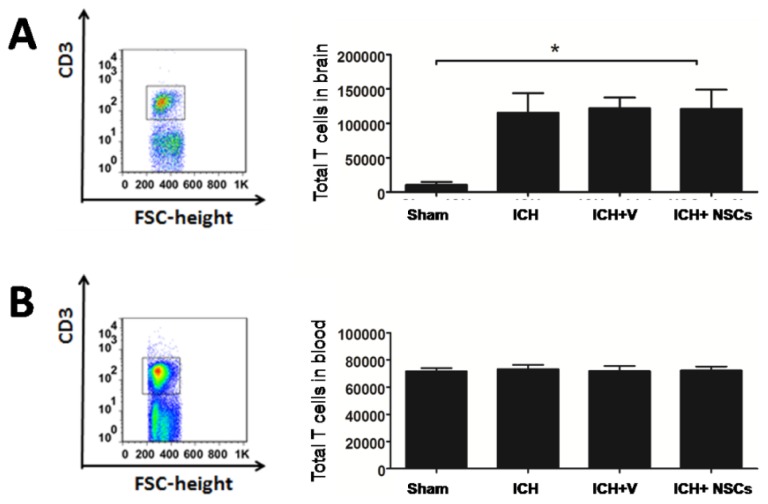
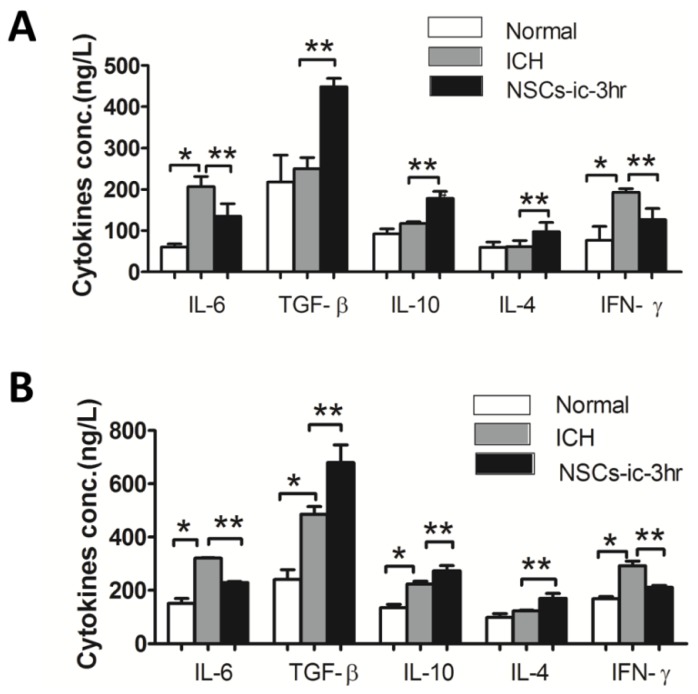
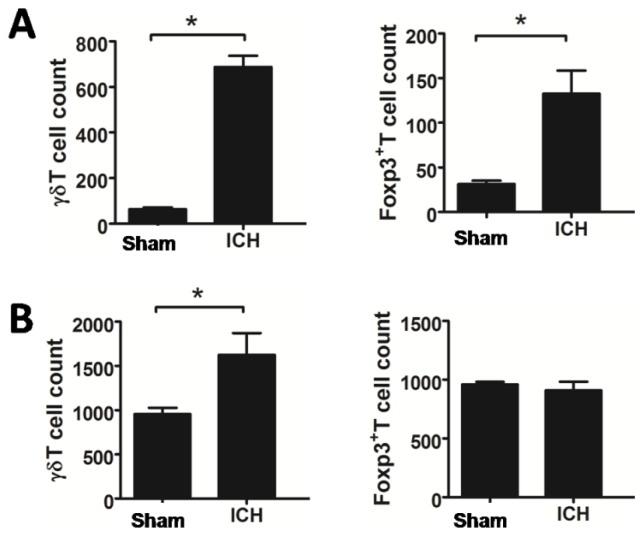
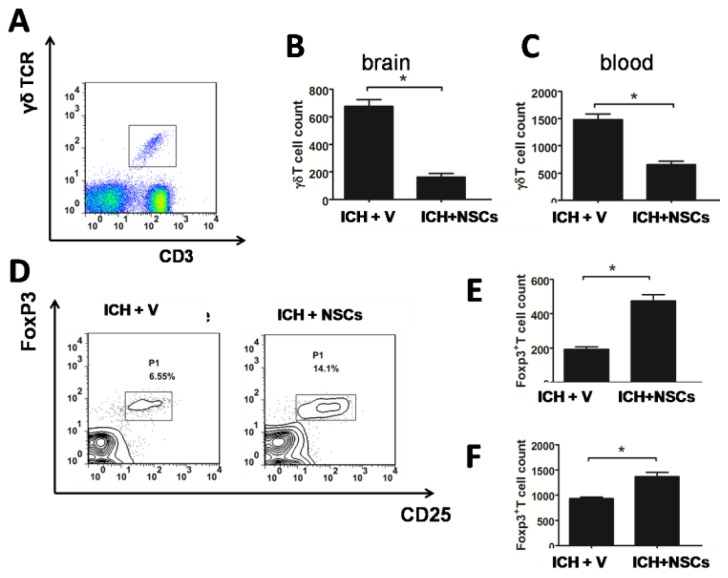
The immune system, particularly T lymphocytes and cytokines, has been implicated in the progression of brain injury after intracerebral hemorrhage (ICH). Although studies have shown that transplanted neural stem cells (NSCs) protect the central nervous system (CNS) from inflammatory damage, their effects on subpopulations of T lymphocytes and their corresponding cytokines are largely unexplored. Here, rats were subjected to ICH and NSCs were intracerebrally injected at 3 h after ICH. The profiles of subpopulations of T cells in the brain and peripheral blood were analyzed by flow cytometry. We found that regulatory T (Treg) cells in the brain and peripheral blood were increased, but γδT cells (gamma delta T cells) were decreased, along with increased anti-inflammatory cytokines (IL-4, IL-10 and TGF-β) and decreased pro-inflammatory cytokines (IL-6, and IFN-γ), compared to the vehicle-treated control. Our data suggest that transplanted NSCs protect brain injury after ICH via modulation of Treg and γδT cell infiltration and anti- and pro-inflammatory cytokine release.
免疫系统,尤其是T淋巴细胞和细胞因子,与脑出血(ICH)后脑损伤的进展有关。尽管研究表明,移植的神经干细胞(NSCs)可保护中枢神经系统(CNS)免受炎症损伤,但其对T淋巴细胞亚群及其相应细胞因子的影响在很大程度上尚未得到探索。在此,对大鼠进行脑出血,并在脑出血后3小时脑内注射神经干细胞。通过流式细胞术分析脑和外周血中T细胞亚群的概况。我们发现,与载体处理的对照组相比,脑和外周血中的调节性T(Treg)细胞增加,但γδT细胞(γδT细胞)减少,同时抗炎细胞因子(IL-4、IL-10和TGF-β)增加,促炎细胞因子(IL-6和IFN-γ)减少。我们的数据表明,移植的神经干细胞通过调节Treg和γδT细胞浸润以及抗炎和促炎细胞因子的释放来保护脑出血后的脑损伤。