Swain J E, Kim P, Spicer J, Ho S S, Dayton C J, Elmadih A, Abel K M
Department of Psychiatry, University of Michigan, USA; Center for Human Growth and Development, University of Michigan, USA; Department of Psychology, University of Michigan, USA.
Department of Psychology, University of Denver, USA.
Brain Res. 2014 Sep 11;1580:78-101. doi: 10.1016/j.brainres.2014.03.007. Epub 2014 Mar 15.
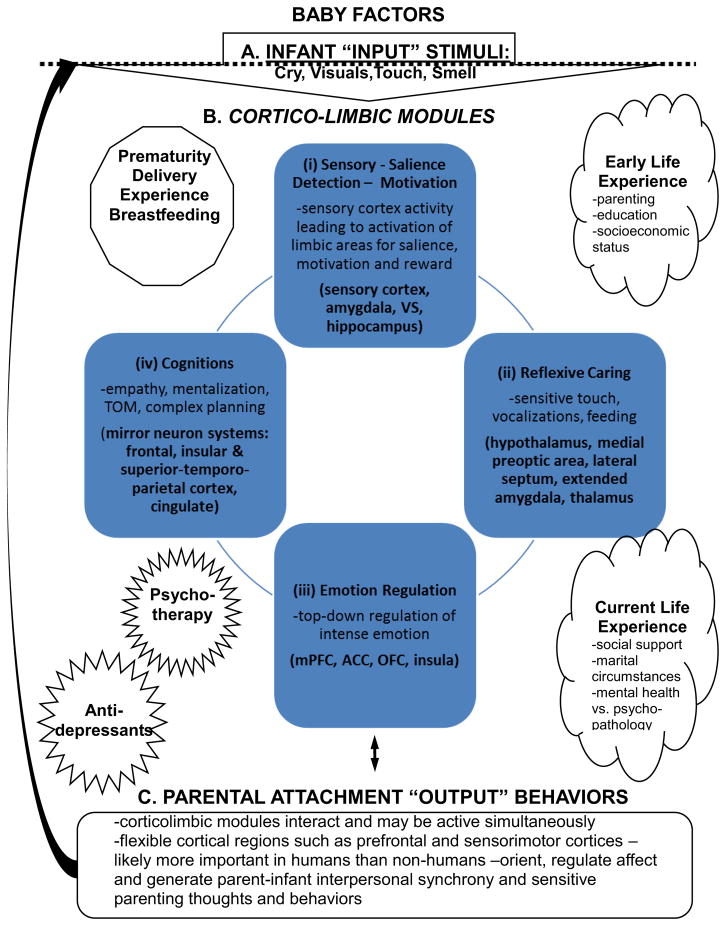
Brain networks that govern parental response to infant signals have been studied with imaging techniques over the last 15 years. The complex interaction of thoughts and behaviors required for sensitive parenting enables the formation of each individual's first social bonds and critically shapes development. This review concentrates on magnetic resonance imaging experiments which directly examine the brain systems involved in parental responses to infant cues. First, we introduce themes in the literature on parental brain circuits studied to date. Next, we present a thorough chronological review of state-of-the-art fMRI studies that probe the parental brain with a range of baby audio and visual stimuli. We also highlight the putative role of oxytocin and effects of psychopathology, as well as the most recent work on the paternal brain. Taken together, a new model emerges in which we propose that cortico-limbic networks interact to support parental brain responses to infants. These include circuitry for arousal/salience/motivation/reward, reflexive/instrumental caring, emotion response/regulation and integrative/complex cognitive processing. Maternal sensitivity and the quality of caregiving behavior are likely determined by the responsiveness of these circuits during early parent-infant experiences. The function of these circuits is modifiable by current and early-life experiences, hormonal and other factors. Severe deviation from the range of normal function in these systems is particularly associated with (maternal) mental illnesses - commonly, depression and anxiety, but also schizophrenia and bipolar disorder. Finally, we discuss the limits and extent to which brain imaging may broaden our understanding of the parental brain given our current model. Developments in the understanding of the parental brain may have profound implications for long-term outcomes in families across risk, resilience and possible interventions. This article is part of a Special Issue entitled Oxytocin and Social Behav.
在过去15年里,人们运用成像技术对支配父母对婴儿信号做出反应的大脑网络进行了研究。敏感育儿所需的思想与行为的复杂互动,促成了个体最初的社会纽带的形成,并对其发育起着关键的塑造作用。本综述聚焦于磁共振成像实验,这些实验直接考察了参与父母对婴儿线索做出反应的大脑系统。首先,我们介绍迄今为止有关父母大脑回路的文献中的主题。接下来,我们按时间顺序全面回顾了最前沿的功能磁共振成像研究,这些研究通过一系列婴儿的音频和视觉刺激来探究父母的大脑。我们还强调了催产素的假定作用、精神病理学的影响,以及有关父性大脑的最新研究成果。综合来看,一个新的模型浮现出来,我们提出皮质-边缘网络相互作用以支持父母大脑对婴儿的反应。这些反应包括与唤醒/显著性/动机/奖赏、反射性/工具性关爱、情绪反应/调节以及整合性/复杂认知加工相关的神经回路。母亲的敏感性和育儿行为的质量可能取决于这些回路在早期亲子互动经历中的反应能力。这些回路的功能会因当前和早期生活经历、激素及其他因素而发生改变。这些系统中严重偏离正常功能范围的情况尤其与(母亲的)精神疾病相关——常见的有抑郁症和焦虑症,还有精神分裂症和双相情感障碍。最后,鉴于我们当前的模型,我们讨论了脑成像在拓宽我们对父母大脑理解方面的局限性和程度。对父母大脑理解的进展可能对处于风险、具备复原力及可能进行干预的家庭的长期结果产生深远影响。本文是名为《催产素与社会行为》特刊的一部分。