Malin Steven K, del Rincon Juan Pablo, Huang Hazel, Kirwan John P
1Department of Pathobiology, Lerner Research Institute, Cleveland Clinic, Cleveland, OH; 2Department of Nutrition, School of Medicine, Case Western Reserve University, Cleveland, OH; and 3Metabolic Translational Research Center, Endocrinology and Metabolism Institute, Cleveland Clinic, Cleveland, OH.
Med Sci Sports Exerc. 2014 Nov;46(11):2085-90. doi: 10.1249/MSS.0000000000000338.
Fetuin-A is a novel hepatokine, and there is preliminary evidence that it may contribute to the pathogenesis of type 2 diabetes. Exercise reduces fetuin-A, but the specific metabolic effects particularly as they relate to the regulation of insulin resistance are unknown. This led us to examine the effect of exercise training on circulating fetuin-A in relation to skeletal muscle and/or hepatic insulin resistance in obese adults.
Twenty older adults (66.3 ± 0.9 yr; body mass index, 34.1 ± 1.2 kg · m(-1)) participated in this prospective 12-wk study and underwent supervised exercise training (5 d · wk(-1), 60 min · d(-1) at approximately 85% HRmax). Insulin resistance was assessed using the euglycemic-hyperinsulinemic clamp (40 mU · m(-2) · min(-1)) with isotope dilution ([6,6-H2]-glucose). Skeletal muscle insulin sensitivity (rate of glucose disposal), hepatic insulin resistance (rate of glucose appearance × fasting insulin), metabolic flexibility (respiratory quotient clamp - respiratory quotient fasting), fetuin-A, high-molecular weight adiponectin, high-sensitivity C-reactive protein, leptin, and body fat (dual energy x-ray absorptiometry) were measured before and after the intervention.
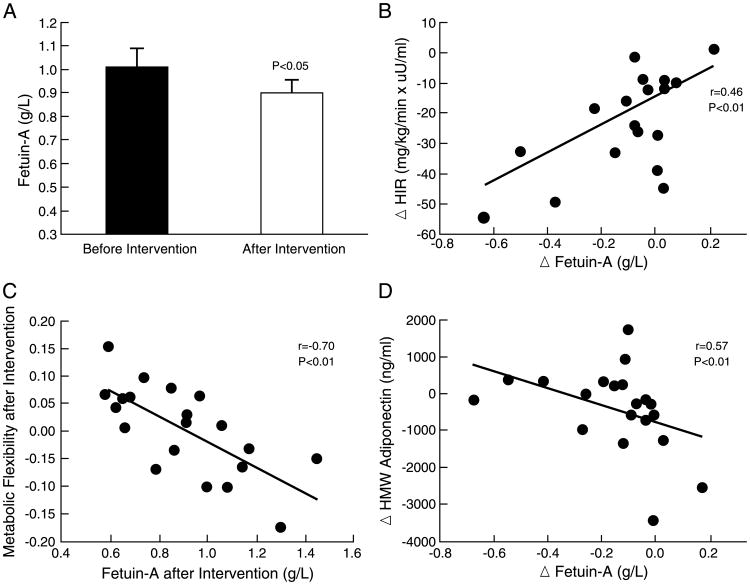
Exercise reduced body fat, high-sensitivity C-reactive protein, leptin and hepatic as well as skeletal muscle insulin resistance (each, P < 0.05). Fetuin-A was decreased by approximately 8% (pre, 1.01 ± 0.08, vs post, 0.89 ± 0.06 g · L(-1); P < 0.05) after the intervention, and lower fetuin-A after exercise correlated with lower hepatic insulin resistance (r = -0.46, P < 0.01), increased metabolic flexibility (r = -0.70, P < 0.01) and high-molecular weight adiponectin (r = -0.57, P < 0.01).
Fetuin-A may contribute to exercise training-induced improvements in hepatic insulin resistance, CHO utilization, and inflammation in older obese adults. Further work is required to determine the cellular mechanism(s) of action for fetuin-A because this hepatokine is related to type 2 diabetes risk.
胎球蛋白-A是一种新型肝源性激素,初步证据表明它可能参与2型糖尿病的发病机制。运动可降低胎球蛋白-A水平,但具体的代谢效应,尤其是与胰岛素抵抗调节相关的效应尚不清楚。这促使我们研究运动训练对肥胖成年人循环胎球蛋白-A水平的影响,以及其与骨骼肌和/或肝脏胰岛素抵抗的关系。
20名老年人(66.3±0.9岁;体重指数,34.1±1.2kg·m⁻¹)参与了这项为期12周的前瞻性研究,并接受了监督下的运动训练(每周5天,每天60分钟,运动强度约为最大心率的85%)。使用正常血糖-高胰岛素钳夹技术(40mU·m⁻²·min⁻¹)和同位素稀释法([6,6-H₂]-葡萄糖)评估胰岛素抵抗。在干预前后测量骨骼肌胰岛素敏感性(葡萄糖处置率)、肝脏胰岛素抵抗(葡萄糖出现率×空腹胰岛素)、代谢灵活性(呼吸商钳夹-空腹呼吸商)、胎球蛋白-A、高分子量脂联素、高敏C反应蛋白、瘦素和体脂(双能X线吸收法)。
运动降低了体脂、高敏C反应蛋白、瘦素以及肝脏和骨骼肌的胰岛素抵抗(均P<0.05)。干预后胎球蛋白-A水平降低了约8%(干预前,1.01±0.08,干预后,0.89±0.06g·L⁻¹;P<0.05),运动后较低的胎球蛋白-A水平与较低的肝脏胰岛素抵抗相关(r=-0.46,P<0.01),代谢灵活性增加(r=-0.70,P<0.01)和高分子量脂联素增加(r=-0.57,P<0.01)。
胎球蛋白-A可能有助于运动训练改善老年肥胖成年人的肝脏胰岛素抵抗、碳水化合物利用和炎症。由于这种肝源性激素与2型糖尿病风险相关,因此需要进一步研究以确定胎球蛋白-A的细胞作用机制。