Lehmann Andreas, Kliewer Andrea, Märtens Jan Carlo, Nagel Falko, Schulz Stefan
Institute of Pharmacology and Toxicology, Jena University Hospital, Friedrich-Schiller-University, Jena, Germany.
PLoS One. 2014 Mar 17;9(3):e91526. doi: 10.1371/journal.pone.0091526. eCollection 2014.
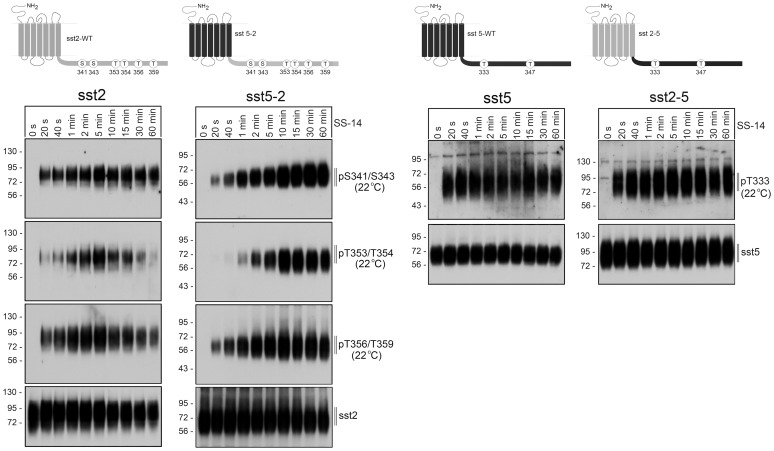
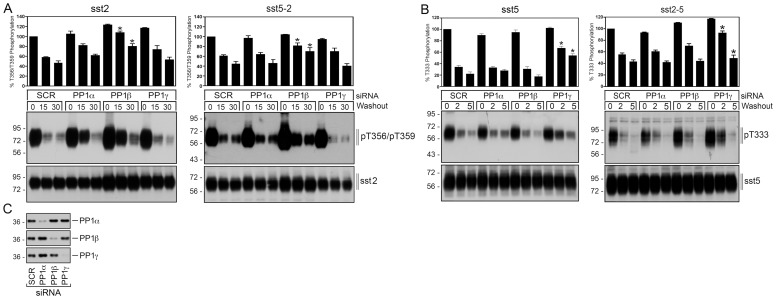
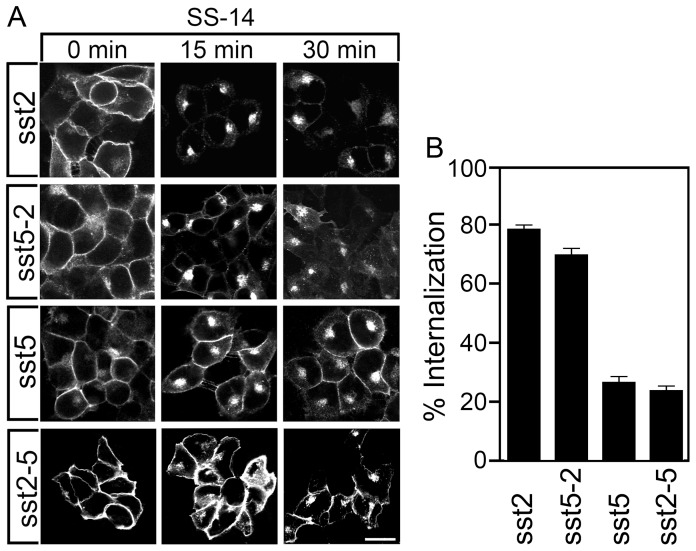
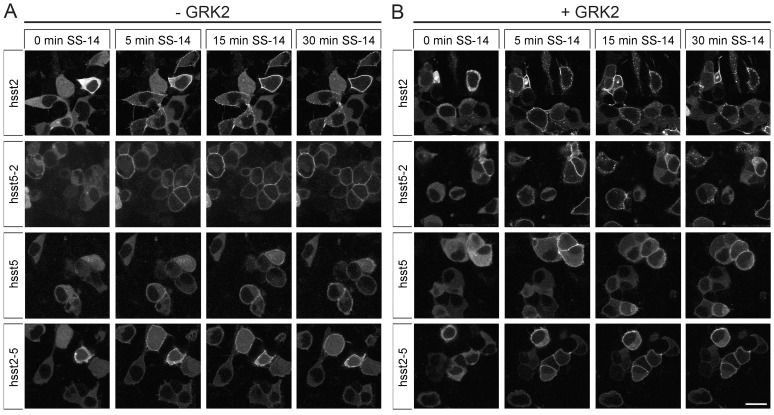
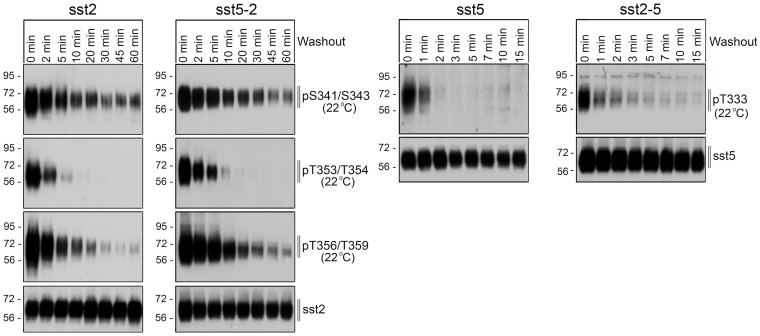
We have recently identified protein phosphatase 1β (PP1β) as G protein-coupled receptor (GPCR) phosphatase for the sst2 somatostatin receptor using siRNA knockdown screening. By contrast, for the sst5 somatostatin receptor we identified protein phosphatase 1γ (PP1γ) as GPCR phosphatase using the same approach. We have also shown that sst2 and sst5 receptors differ substantially in the temporal dynamics of their dephosphorylation and trafficking patterns. Whereas dephosphorylation and recycling of the sst2 receptor requires extended time periods of ∼30 min, dephosphorylation and recycling of the sst5 receptor is completed in less than 10 min. Here, we examined which receptor domains determine the selection of phosphatases for receptor dephosphorylation. We found that generation of tail-swap mutants between sst2 and sst5 was required and sufficient to reverse the patterns of dephosphorylation and trafficking of these two receptors. In fact, siRNA knockdown confirmed that the sst5 receptor carrying the sst2 tail is predominantly dephosphorylated by PP1β, whereas the sst2 receptor carrying the sst5 tail is predominantly dephosphorylated by PP1γ. Thus, the GPCR phosphatase responsible for dephosphorylation of individual somatostatin receptor subtypes is primarily determined by their different carboxyl-terminal receptor domains. This phosphatase specificity has in turn profound consequences for the dephosphorylation dynamics and trafficking patterns of GPCRs.
我们最近通过小干扰RNA敲低筛选,确定蛋白磷酸酶1β(PP1β)是促生长激素抑制素受体2(sst2)的G蛋白偶联受体(GPCR)磷酸酶。相比之下,对于促生长激素抑制素受体5(sst5),我们使用相同方法确定蛋白磷酸酶1γ(PP1γ)是其GPCR磷酸酶。我们还表明,sst2和sst5受体在去磷酸化的时间动态和转运模式上有很大差异。sst2受体的去磷酸化和再循环需要约30分钟的较长时间,而sst5受体的去磷酸化和再循环在不到10分钟内即可完成。在此,我们研究了哪些受体结构域决定了用于受体去磷酸化的磷酸酶选择。我们发现,在sst2和sst5之间产生尾部交换突变体是必要且足以逆转这两种受体的去磷酸化和转运模式的。事实上,小干扰RNA敲低证实,携带sst2尾部的sst5受体主要由PP1β去磷酸化,而携带sst5尾部的sst2受体主要由PP1γ去磷酸化。因此,负责单个促生长激素抑制素受体亚型去磷酸化的GPCR磷酸酶主要由它们不同的羧基末端受体结构域决定。这种磷酸酶特异性反过来对GPCR的去磷酸化动态和转运模式产生深远影响。