Jing Xiuna, Shi Qiaoyun, Bi Wei, Zeng Zhifen, Liang Yanran, Wu Xia, Xiao Songhua, Liu Jun, Yang Lianhong, Tao Enxiang
Department of Neurology, Sun Yat-sen Memorial Hospital of Sun Yat-sen University, Guangzhou, People's Republic of China.
Department of Radiology, School of Medicine, Stanford University, Stanford, California, United States of America.
PLoS One. 2014 Mar 17;9(3):e92110. doi: 10.1371/journal.pone.0092110. eCollection 2014.
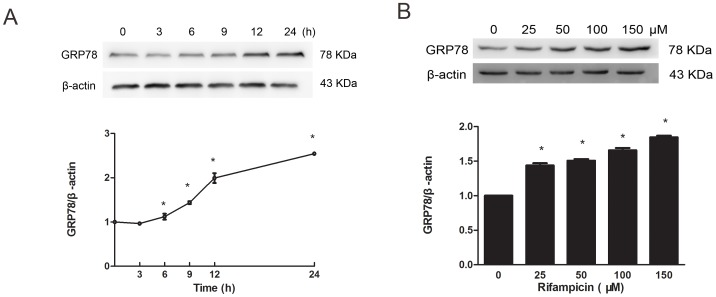
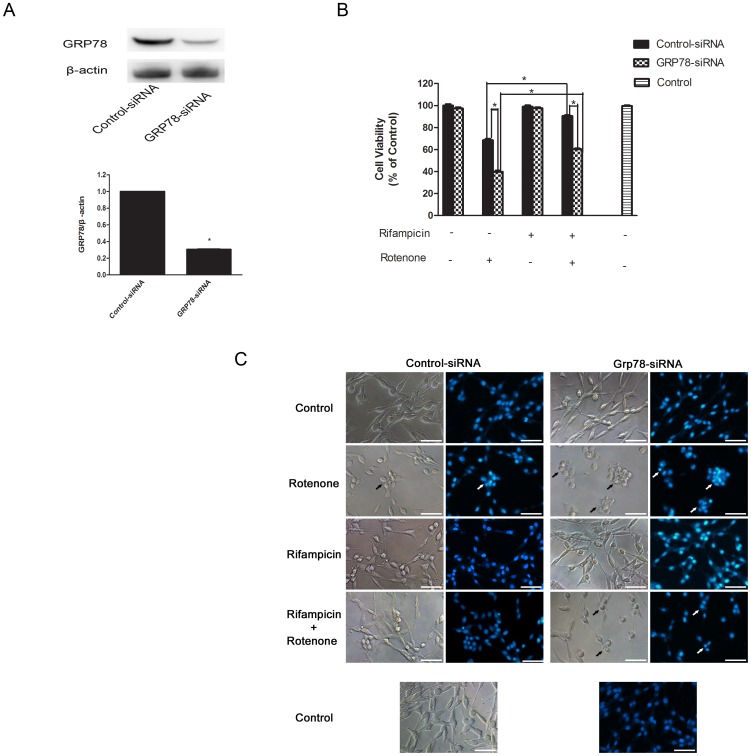
Rifampicin has been proposed as a therapeutic candidate for Parkinson's disease (PD). We previously showed that rifampicin was neuroprotective in PD models in vivo and in vitro. However, the molecular mechanisms underlying are not fully elucidated. In this study, using the comprehensive proteomic analysis, we identified that the 78 kDa glucose-regulated protein (GRP78), a hallmark of the unfolded protein response (UPR), was upregulated in rifampicin-treated PC12 cells. Western blot analysis confirmed GRP78 activation. GRP78 functions cytoprotectively in stressed cells, therefore, we hypothesized that GRP78 mediated rifampicin-induced neuroprotection. Using RNA interference, we found that GRP78 gene knockdown significantly attenuated the neuroprotective effects of rifampicin. Next, we examined three UPR transducers, namely, protein kinase RNA-like endoplasmic reticulum kinase (PERK), inositol requiring kinase α (IREα) and activating transcription factor 6 (ATF 6), and how they regulated rifampicin-stimulated GRP78 expression. Our results showed that PERK, eukaryotic initiation factor 2α (eIF2α), and activating transcription factor 4 (ATF4) were activated in rifampicin-treated PC12 cells. Silencing the ATF4 gene using RNAi inhibited GRP78 stimulation. Interestingly, we did not detect significant IREα activation, X-box binding protein 1 mRNA splicing, or ATF6 cleavage up to 24 h after rifampicin treatment. Taken together, our data suggested that rifampicin induced GRP78 via the PERK-eIF2α-ATF4 pathway to protect neurons against rotenone-induced cell damage. Targeting molecules in this pathway could be a novel therapeutic approach for PD treatment.
利福平已被提议作为帕金森病(PD)的一种治疗候选药物。我们之前表明,利福平在体内和体外的PD模型中具有神经保护作用。然而,其潜在的分子机制尚未完全阐明。在本研究中,我们使用综合蛋白质组学分析,发现在利福平处理的PC12细胞中,未折叠蛋白反应(UPR)的一个标志——78 kDa葡萄糖调节蛋白(GRP78)上调。蛋白质印迹分析证实了GRP78的激活。GRP78在应激细胞中发挥细胞保护功能,因此,我们推测GRP78介导了利福平诱导的神经保护作用。使用RNA干扰,我们发现GRP78基因敲低显著减弱了利福平的神经保护作用。接下来,我们检测了三种UPR转导因子,即蛋白激酶RNA样内质网激酶(PERK)、肌醇需求激酶α(IREα)和激活转录因子6(ATF 6),以及它们如何调节利福平刺激的GRP78表达。我们的结果表明,在利福平处理的PC12细胞中,PERK、真核起始因子2α(eIF2α)和激活转录因子4(ATF4)被激活。使用RNAi沉默ATF4基因可抑制GRP78的刺激。有趣的是,在利福平处理后长达24小时,我们未检测到显著的IREα激活、X盒结合蛋白1 mRNA剪接或ATF6裂解。综上所述,我们的数据表明,利福平通过PERK-eIF2α-ATF4途径诱导GRP78,以保护神经元免受鱼藤酮诱导的细胞损伤。靶向该途径中的分子可能是一种治疗PD的新方法。