
鞋底弯曲点位置的变化会影响步态时的足底负荷分布模式。
Variation in the location of the shoe sole flexion point influences plantar loading patterns during gait.
机构信息
EMGO + Institute for health and care research, department of general practice and elderly care medicine, VU University Medical Centre, Postbus 7057, 1007 MB Amsterdam, The Netherlands.
出版信息
J Foot Ankle Res. 2014 Mar 19;7(1):20. doi: 10.1186/1757-1146-7-20.
BACKGROUND
Several footwear design characteristics are known to have detrimental effects on the foot. However, one characteristic that has received relatively little attention is the point where the sole flexes in the sagittal plane. Several footwear assessment forms assume that this should ideally be located directly under the metarsophalangeal joints (MTPJs), but this has not been directly evaluated. The aim of this study was therefore to assess the influence on plantar loading of different locations of the shoe sole flexion point.
METHOD
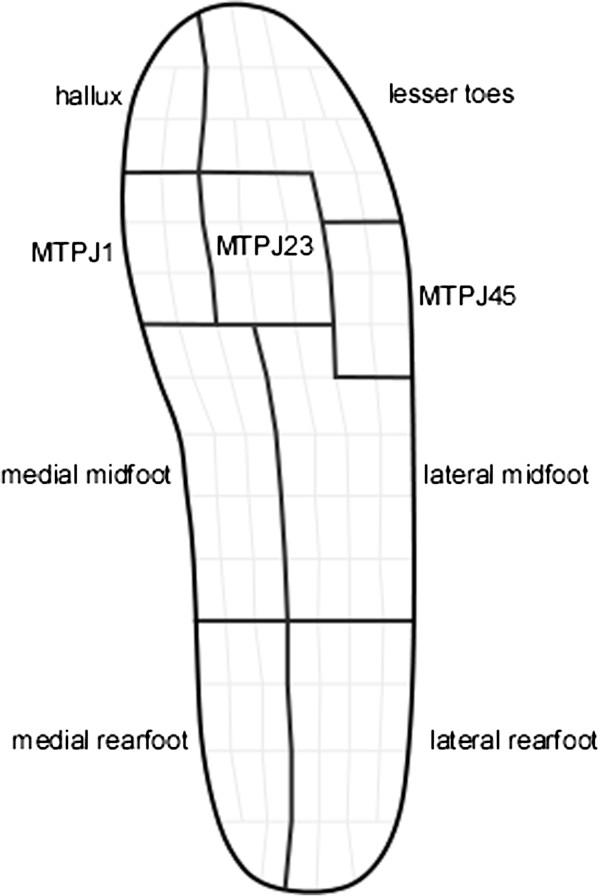
Twenty-one asymptomatic females with normal foot posture participated. Standardised shoes were incised directly underneath the metatarsophalangeal joints, proximal to the MTPJs or underneath the midfoot. The participants walked in a randomised sequence of the three shoes whilst plantar loading patterns were obtained using the Pedar® in-shoe pressure measurement system. The foot was divided into nine anatomically important masks, and peak pressure (PP), contact time (CT) and pressure time integral (PTI) were determined. A ratio of PP and PTI between MTPJ2-3/MTPJ1 was also calculated.
RESULTS
Wearing the shoe with the sole flexion point located proximal to the MTPJs resulted in increased PP under MTPJ 4-5 (6.2%) and decreased PP under the medial midfoot compared to the sub-MTPJ flexion point (-8.4%). Wearing the shoe with the sole flexion point located under the midfoot resulted in decreased PP, CT and PTI in the medial and lateral hindfoot (PP: -4.2% and -5.1%, CT: -3.4% and -6.6%, PTI: -6.9% and -5.7%) and medial midfoot (PP: -5.9% CT: -2.9% PTI: -12.2%) compared to the other two shoes.
CONCLUSION
The findings of this study indicate that the location of the sole flexion point of the shoe influences plantar loading patterns during gait. Specifically, shoes with a sole flexion point located under the midfoot significantly decrease the magnitude and duration of loading under the midfoot and hindfoot, which may be indicative of an earlier heel lift.
背景
已知几种鞋类设计特征会对脚部造成不利影响。然而,有一个特征相对较少受到关注,那就是鞋底在矢状面弯曲的点。一些鞋类评估表假设这个点应该理想地位于跖趾关节(MTPJ)下方,但这并没有得到直接评估。因此,本研究的目的是评估鞋底弯曲点的不同位置对足底压力分布的影响。
方法
21 名姿势正常的无症状女性参与了本研究。在标准化的鞋子上,在跖趾关节下方、MTPJ 近端或中足部下方直接切割。参与者按照随机顺序穿着这三双鞋行走,同时使用 Pedar®足底压力测量系统获取足底压力分布模式。足部被分为九个解剖学上重要的区域,测量峰值压力(PP)、接触时间(CT)和压力时间积分(PTI)。还计算了 MTPJ2-3/MTPJ1 之间的 PP 和 PTI 比值。
结果
穿着鞋底弯曲点位于 MTPJ 近端的鞋子,导致 MTPJ 4-5 处的 PP 增加(6.2%),内侧中足部的 PP 减少(-8.4%)。穿着鞋底弯曲点位于中足部下方的鞋子,导致内侧和外侧足跟(PP:-4.2% 和-5.1%,CT:-3.4% 和-6.6%,PTI:-6.9% 和-5.7%)以及内侧中足部(PP:-5.9% CT:-2.9% PTI:-12.2%)的 PP、CT 和 PTI 减少。
结论
本研究的结果表明,鞋子鞋底弯曲点的位置会影响步态中的足底压力分布模式。具体来说,鞋底弯曲点位于中足部下方的鞋子会显著降低中足部和足跟的压力大小和持续时间,这可能表明脚跟抬得更早。


 Zotero 插件