Bults Marloes, Beaujean Desirée, Wijkmans Clementine, Richardus Jan Hendrik, Voeten Hélène
Municipal Public Health Service Rotterdam-Rijnmond, P,O, Box 70032, 3000 Rotterdam, LP, The Netherlands.
BMC Public Health. 2014 Mar 20;14:263. doi: 10.1186/1471-2458-14-263.
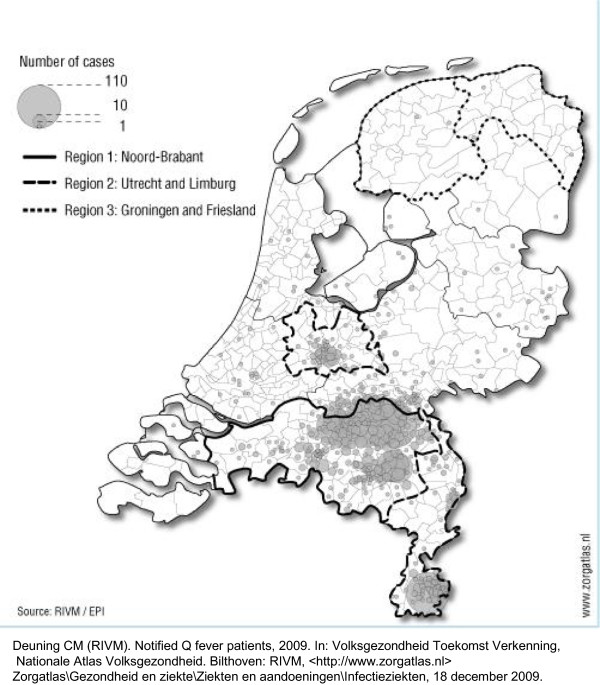
Over the past years, Q fever has become a major public health problem in the Netherlands, with a peak of 2,357 human cases in 2009. In the first instance, Q fever was mainly a local problem of one province with a high density of large dairy goat farms, but in 2009 an alarming increase of Q fever cases was observed in adjacent provinces. The aim of this study was to identify trends over time and regional differences in public perceptions and behaviors, as well as predictors of preventive behavior regarding Q fever.
One cross-sectional survey (2009) and two follow-up surveys (2010, 2012) were performed. Adults, aged≥18 years, that participated in a representative internet panel were invited (survey 1, n=1347; survey 2, n=1249; survey 3, n=1030).
Overall, public perceptions and behaviors regarding Q fever were consistent with the trends over time in the numbers of new human Q fever cases in different epidemiological regions and the amount of media attention focused on Q fever in the Netherlands. However, there were remarkably low levels of perceived vulnerability and perceived anxiety, particularly in the region of highest incidence, where three-quarters of the total cases occurred in 2009. Predictors of preventive behavior were being female, older aged, having Q fever themselves or someone in their household, more knowledge, and higher levels of perceived severity, anxiety and (self-) efficacy.
During future outbreaks of (zoonotic) infectious diseases, it will be important to instil a realistic sense of vulnerability by providing the public with accurate information on the risk of becoming infected. This should be given in addition to information about the severity of the disease, the efficacy of measures, and instructions for minimising infection risk with appropriate, feasible preventative measures. Furthermore, public information should be adapted to regional circumstances.
在过去几年中,Q热已成为荷兰的一个主要公共卫生问题,2009年人类病例达到峰值2357例。起初,Q热主要是一个拥有高密度大型奶山羊养殖场的省份的局部问题,但在2009年,相邻省份的Q热病例出现了惊人的增长。本研究的目的是确定公众认知和行为随时间的趋势以及区域差异,以及Q热预防行为的预测因素。
进行了一项横断面调查(2009年)和两项随访调查(2010年、2012年)。邀请了参与具有代表性的互联网小组的18岁及以上成年人(调查1,n = 1347;调查2,n = 1249;调查3,n = 1030)。
总体而言,公众对Q热的认知和行为与不同流行地区新的人类Q热病例数量随时间的趋势以及荷兰媒体对Q热的关注程度一致。然而,感知到的易感性和焦虑水平非常低,特别是在发病率最高的地区,2009年四分之三的病例发生在该地区。预防行为的预测因素包括女性、年龄较大、本人或其家庭成员患有Q热、知识更多以及更高水平的感知严重性、焦虑和(自我)效能感。
在未来(人畜共患)传染病爆发期间,通过向公众提供关于感染风险的准确信息来灌输现实的易感性意识将非常重要。除了关于疾病严重性、措施有效性以及通过适当、可行的预防措施将感染风险降至最低的说明外,还应提供此信息。此外,公共信息应根据区域情况进行调整。