Pirastu Nicola, Kooyman Maarten, Traglia Michela, Robino Antonietta, Willems Sara M, Pistis Giorgio, d'Adamo Pio, Amin Najaf, d'Eustacchio Angela, Navarini Luciano, Sala Cinzia, Karssen Lennart C, van Duijn Cornelia, Toniolo Daniela, Gasparini Paolo
Institute for Maternal and Child Health, Istituto Di Ricovero e Cura a Carattere Scientifico "Burlo Garofolo," Trieste, Italy; Department of Medical, Surgical and Health Sciences, University of Trieste, Trieste, Italy.
Genetic Epidemiology Unit, Department of Epidemiology, Erasmus Medical Center, Rotterdam, The Netherlands.
PLoS One. 2014 Mar 19;9(3):e92065. doi: 10.1371/journal.pone.0092065. eCollection 2014.
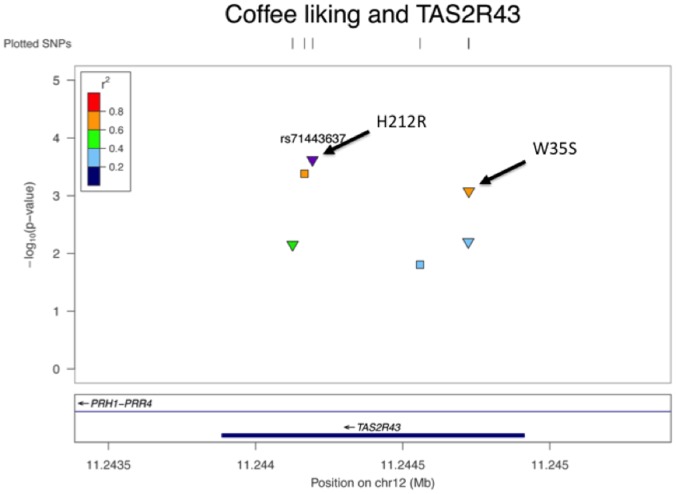
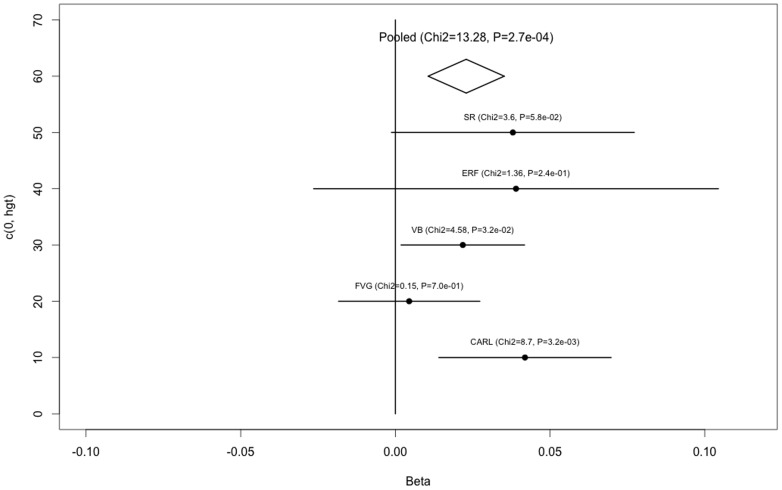
Coffee, one of the most popular beverages in the world, contains many different physiologically active compounds with a potential impact on people's health. Despite the recent attention given to the genetic basis of its consumption, very little has been done in understanding genes influencing coffee preference among different individuals. Given its markedly bitter taste, we decided to verify if bitter receptor genes (TAS2Rs) variants affect coffee liking. In this light, 4066 people from different parts of Europe and Central Asia filled in a field questionnaire on coffee liking. They have been consequently recruited and included in the study. Eighty-eight SNPs covering the 25 TAS2R genes were selected from the available imputed ones and used to run association analysis for coffee liking. A significant association was detected with three SNP: one synonymous and two functional variants (W35S and H212R) on the TAS2R43 gene. Both variants have been shown to greatly reduce in vitro protein activity. Surprisingly the wild type allele, which corresponds to the functional form of the protein, is associated to higher liking of coffee. Since the hTAS2R43 receptor is sensible to caffeine, we verified if the detected variants produced differences in caffeine bitter perception on a subsample of people coming from the FVG cohort. We found a significant association between differences in caffeine perception and the H212R variant but not with the W35S, which suggests that the effect of the TAS2R43 gene on coffee liking is mediated by caffeine and in particular by the H212R variant. No other significant association was found with other TAS2R genes. In conclusion, the present study opens new perspectives in the understanding of coffee liking. Further studies are needed to clarify the role of the TAS2R43 gene in coffee hedonics and to identify which other genes and pathways are involved in its genetics.
咖啡是世界上最受欢迎的饮品之一,含有许多不同的生理活性化合物,可能会对人们的健康产生影响。尽管最近人们关注到咖啡消费的遗传基础,但在了解影响不同个体咖啡偏好的基因方面,所做的工作很少。鉴于咖啡明显的苦味,我们决定验证苦味受体基因(TAS2Rs)的变异是否会影响对咖啡的喜好。鉴于此,来自欧洲和中亚不同地区的4066人填写了一份关于咖啡喜好的实地调查问卷。随后他们被招募并纳入研究。从现有的推算单核苷酸多态性(SNP)中选择了覆盖25个TAS2R基因的88个SNP,用于对咖啡喜好进行关联分析。检测到与三个SNP存在显著关联:一个同义变异和TAS2R43基因上的两个功能性变异(W35S和H212R)。这两个变异均已显示在体外能大大降低蛋白质活性。令人惊讶的是,与蛋白质功能形式相对应的野生型等位基因与对咖啡的更高喜好相关。由于hTAS2R43受体对咖啡因敏感,我们在来自弗留利-威尼斯朱利亚大区(FVG)队列的一部分人群中验证了检测到的变异是否会在咖啡因苦味感知上产生差异。我们发现咖啡因感知差异与H212R变异之间存在显著关联,但与W35S变异无关,这表明TAS2R43基因对咖啡喜好的影响是由咖啡因介导的,特别是由H212R变异介导。未发现与其他TAS2R基因有其他显著关联。总之,本研究为理解咖啡喜好开辟了新的视角。需要进一步研究来阐明TAS2R43基因在咖啡享乐主义中的作用,并确定其他哪些基因和途径参与其遗传学。