Byun Ji-Won, Lee Hyeon-Sook, Song Sun-Uk, Lee Si-Won, Kim Soon-Ki, Kim Woo-Chul, Lee Moon-Hee, Choi Gwang-Seong
Department of Dermatology, Inha University School of Medicine, Incheon, Korea.
Clinical Research Center, Inha University School of Medicine, Incheon, Korea.
Ann Dermatol. 2014 Feb;26(1):53-60. doi: 10.5021/ad.2014.26.1.53. Epub 2014 Feb 17.
New antitumor therapeutic strategies aim to combine different approaches that are able to induce tumor-specific effector and memory T cell responses that might control tumor growth. Dendritic cells (DCs) have the capacity to induce antigen-specific cytotoxic T lymphocytes. We have previously shown that the combined treatment of paclitaxel chemotherapy (Chemo) and injection of DCs led to complete tumor regression.
The goal of this study was to evaluate synergistic antitumor effect of a triple combination treatment comprising radiotherapy, paclitaxel Chemo and intratumoral injection of syngeneic bone marrow-derived DCs on murine fibrosarcoma, compared to other single or double combination treatments.
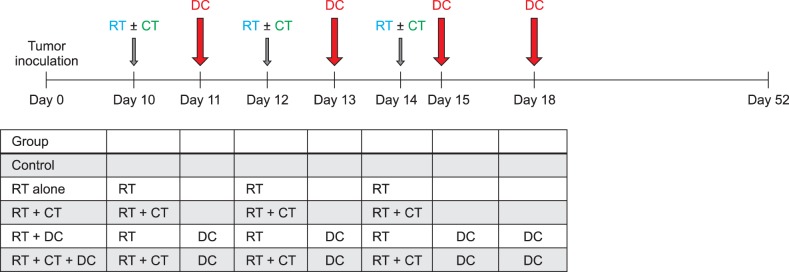
For the murine fibrosarcoma model, naïve C57BL/6 mice were inoculated intradermally with 2×10(3) MCA102 cells in the right upper flank. Mice were assigned to five groups (untreatedcontrol, RT alone, RT+Chemo, RT+DC, and RT+Chemo+DC), with eight mice in each group. In vitro cytotoxicity assays were performed to assess the immune activity. The persistence of tumor-specific immunity was determined by second tumor challenge in mice with complete tumor regression.
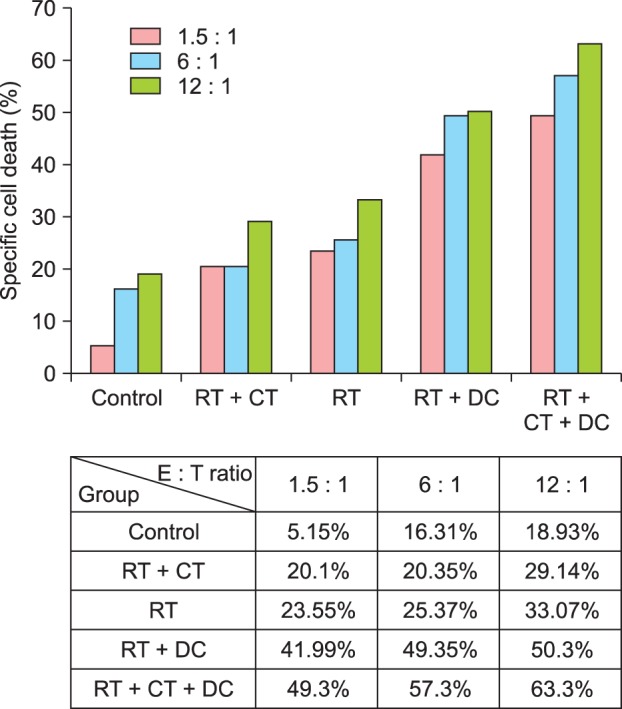
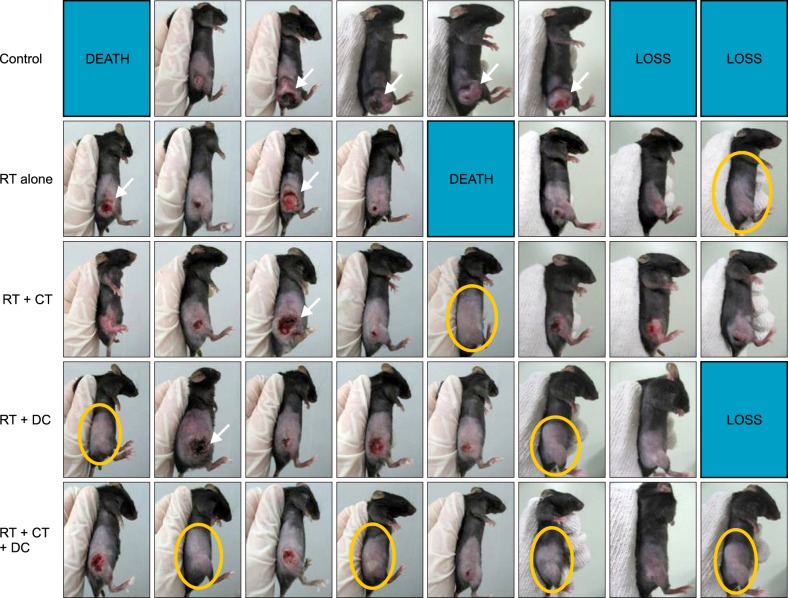
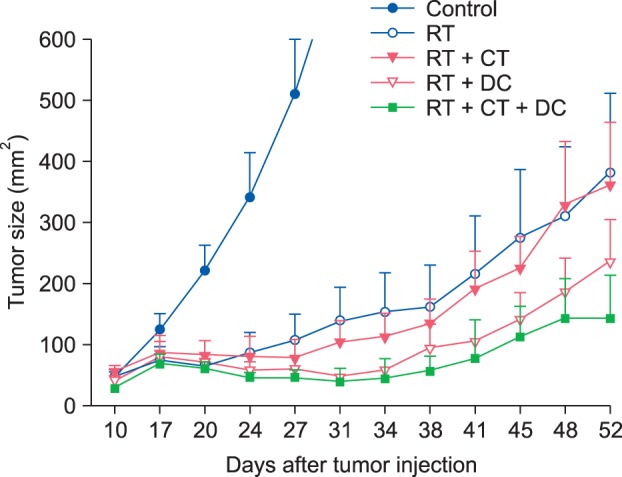
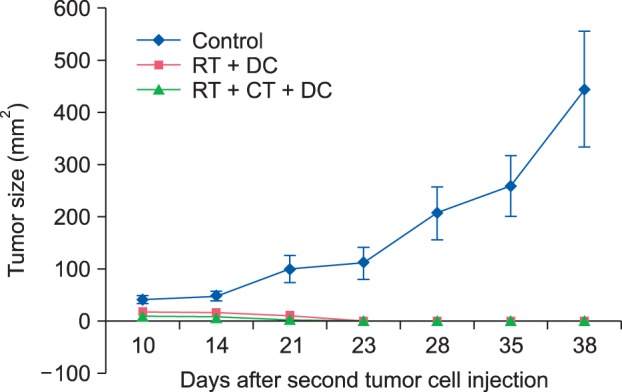
The triple combination treatment showed a significantly enhanced therapeutic efficacy by decreasing tumor size and inducing complete tumor regression, resulting in a cure of 50% of mice. The results of in vitro cytotoxicity assays and the second tumor challenge experiment strongly indicated the induction of a tumor-specific cytotoxic T lymphocyte response and acquisition of prolonged tumor immunity.
These findings suggest that the triple combination treatment can be a promising strategy for the treatment of murine fibrosarcoma.
新的抗肿瘤治疗策略旨在联合不同方法,诱导肿瘤特异性效应T细胞和记忆T细胞反应,从而控制肿瘤生长。树突状细胞(DC)有能力诱导抗原特异性细胞毒性T淋巴细胞。我们之前已表明,紫杉醇化疗(化疗)与DC注射联合治疗可导致肿瘤完全消退。
本研究的目的是评估与其他单药或联合治疗相比,放疗、紫杉醇化疗和肿瘤内注射同基因骨髓来源的DC三联联合治疗对小鼠纤维肉瘤的协同抗肿瘤作用。
对于小鼠纤维肉瘤模型,将2×10³个MCA102细胞皮内接种于初免C57BL/6小鼠的右上腹。将小鼠分为五组(未治疗对照组、单纯放疗组、放疗+化疗组、放疗+DC组和放疗+化疗+DC组),每组8只小鼠。进行体外细胞毒性试验以评估免疫活性。通过对肿瘤完全消退的小鼠进行第二次肿瘤攻击来确定肿瘤特异性免疫的持久性。
三联联合治疗通过减小肿瘤大小并诱导肿瘤完全消退,显示出显著增强的治疗效果,使50%的小鼠治愈。体外细胞毒性试验和第二次肿瘤攻击实验的结果有力地表明诱导了肿瘤特异性细胞毒性T淋巴细胞反应并获得了延长的肿瘤免疫。
这些发现表明,三联联合治疗可能是治疗小鼠纤维肉瘤的一种有前景的策略。