Division of Molecular and Clinical Genetics, Medical Institute of Bioregulation, Kyushu University, 3-1-1, Maidashi, Higashi-ku, Fukuoka 812-8582, Japan.
Division of Molecular and Clinical Genetics, Medical Institute of Bioregulation, Kyushu University, 3-1-1, Maidashi, Higashi-ku, Fukuoka 812-8582, Japan ; Department of Advanced Molecular and Cell Therapy, Kyushu University Hospital, 3-1-1, Maidashi, Higashi-ku, Fukuoka 812-8582, Japan.
FEBS Open Bio. 2014 Feb 21;4:213-9. doi: 10.1016/j.fob.2014.02.007. eCollection 2014.
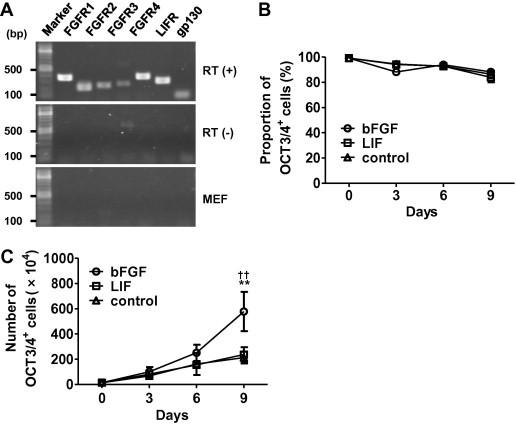
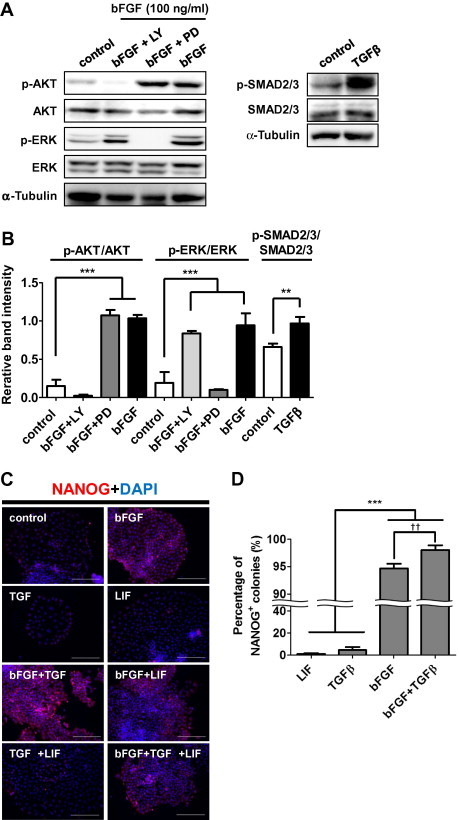
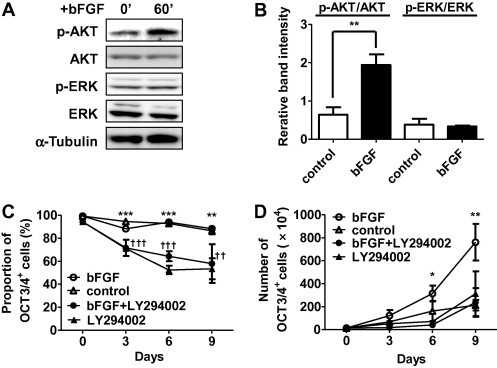
Common marmoset (CM) is widely recognized as a useful non-human primate for disease modeling and preclinical studies. Thus, embryonic stem cells (ESCs) derived from CM have potential as an appropriate cell source to test human regenerative medicine using human ESCs. CM ESCs have been established by us and other groups, and can be cultured in vitro. However, the growth factors and downstream pathways for self-renewal of CM ESCs are largely unknown. In this study, we found that basic fibroblast growth factor (bFGF) rather than leukemia inhibitory factor (LIF) promoted CM ESC self-renewal via the activation of phosphatidylinositol-3-kinase (PI3K)-protein kinase B (AKT) pathway on mouse embryonic fibroblast (MEF) feeders. Moreover, bFGF and transforming growth factor β (TGFβ) signaling pathways cooperatively maintained the undifferentiated state of CM ESCs under feeder-free condition. Our findings may improve the culture techniques of CM ESCs and facilitate their use as a preclinical experimental resource for human regenerative medicine.
普通狨猴(CM)被广泛认为是一种用于疾病建模和临床前研究的有用的非人类灵长类动物。因此,源自 CM 的胚胎干细胞(ESC)具有作为测试使用人 ESC 的人类再生医学的合适细胞来源的潜力。我们和其他小组已经建立了 CM ESC,可以在体外培养。然而,CM ESC 自我更新的生长因子和下游途径在很大程度上是未知的。在这项研究中,我们发现碱性成纤维细胞生长因子(bFGF)而非白血病抑制因子(LIF)通过在小鼠胚胎成纤维细胞(MEF)饲养细胞上激活磷脂酰肌醇-3-激酶(PI3K)-蛋白激酶 B(AKT)途径促进 CM ESC 自我更新。此外,bFGF 和转化生长因子β(TGFβ)信号通路在无饲养条件下协同维持 CM ESC 的未分化状态。我们的发现可能会改进 CM ESC 的培养技术,并促进它们作为人类再生医学的临床前实验资源的使用。