Steffensen Ane Y, Dandanell Mette, Jønson Lars, Ejlertsen Bent, Gerdes Anne-Marie, Nielsen Finn C, Hansen Thomas vO
Center for Genomic Medicine, Rigshospitalet, University of Copenhagen, Copenhagen, Denmark.
Department of Oncology, Rigshospitalet, Copenhagen, Denmark.
Eur J Hum Genet. 2014 Dec;22(12):1362-8. doi: 10.1038/ejhg.2014.40. Epub 2014 Mar 26.
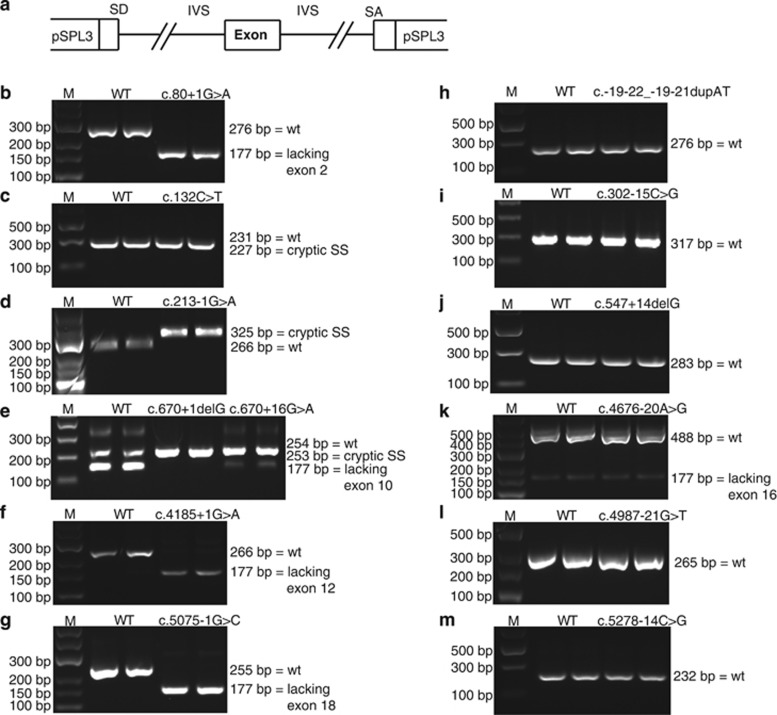
Mutational screening of the breast cancer susceptibility gene BRCA1 leads to the identification of numerous pathogenic variants such as frameshift and nonsense variants, as well as large genomic rearrangements. The screening moreover identifies a large number of variants, for example, missense, silent, and intron variants, which are classified as variants of unknown clinical significance owing to the lack of causal evidence. Variants of unknown clinical significance can potentially have an impact on splicing and therefore functional examinations are warranted to classify whether these variants are pathogenic or benign. Here we validate a mini-gene splicing assay by comparing the results of 24 variants with previously published data from RT-PCR analysis on RNA from blood samples/lymphoblastoid cell lines. The analysis showed an overall concordance of 100%. In addition, we investigated 13 BRCA1 variants of unknown clinical significance or putative variants affecting splicing by in silico analysis and mini-gene splicing assay. Both the in silico analysis and mini-gene splicing assay classified six BRCA1 variants as pathogenic (c.80+1G>A, c.132C>T (p.=), c.213-1G>A, c.670+1delG, c.4185+1G>A, and c.5075-1G>C), whereas six BRCA1 variants were classified as neutral (c.-19-22_-19-21dupAT, c.302-15C>G, c.547+14delG, c.4676-20A>G, c.4987-21G>T, and c.5278-14C>G) and one BRCA1 variant remained unclassified (c.670+16G>A). In conclusion, our study emphasizes that in silico analysis and mini-gene splicing assays are important for the classification of variants, especially if no RNA is available from the patient. This knowledge is crucial for proper genetic counseling of patients and their family members.
对乳腺癌易感基因BRCA1进行突变筛查可鉴定出众多致病变异,如移码突变和无义突变,以及大片段基因组重排。此外,筛查还鉴定出大量变异,例如错义突变、沉默突变和内含子变异,由于缺乏因果证据,这些变异被归类为临床意义不明的变异。临床意义不明的变异可能会对剪接产生影响,因此有必要进行功能检查以确定这些变异是致病的还是良性的。在这里,我们通过将24个变异的结果与先前发表的来自血液样本/淋巴母细胞系RNA的RT-PCR分析数据进行比较,验证了一种小基因剪接检测方法。分析显示总体一致性为100%。此外,我们通过计算机分析和小基因剪接检测方法研究了13个临床意义不明的BRCA1变异或影响剪接的推定变异。计算机分析和小基因剪接检测方法均将6个BRCA1变异归类为致病变异(c.80+1G>A、c.132C>T (p.=)、c.213-1G>A、c.670+1delG、c.4185+1G>A和c.5075-1G>C),而6个BRCA1变异被归类为中性变异(c.-19-22_-19-21dupAT、c.302-15C>G、c.547+14delG、c.4676-20A>G、c.4987-21G>T和c.5278-14C>G),还有1个BRCA1变异未分类(c.670+16G>A)。总之,我们的研究强调计算机分析和小基因剪接检测方法对于变异分类很重要,特别是在无法从患者获取RNA的情况下。这一知识对于为患者及其家庭成员提供适当的遗传咨询至关重要。