Fleseriu Maria
Northwest Pituitary Center, and Departments of Medicine and Neurological Surgery, Oregon Health & Science University 3181 SW Sam Jackson Park Road (BTE 472), Portland, Oregon 97239 USA.
F1000Prime Rep. 2014 Mar 3;6:18. doi: 10.12703/P6-18. eCollection 2014.
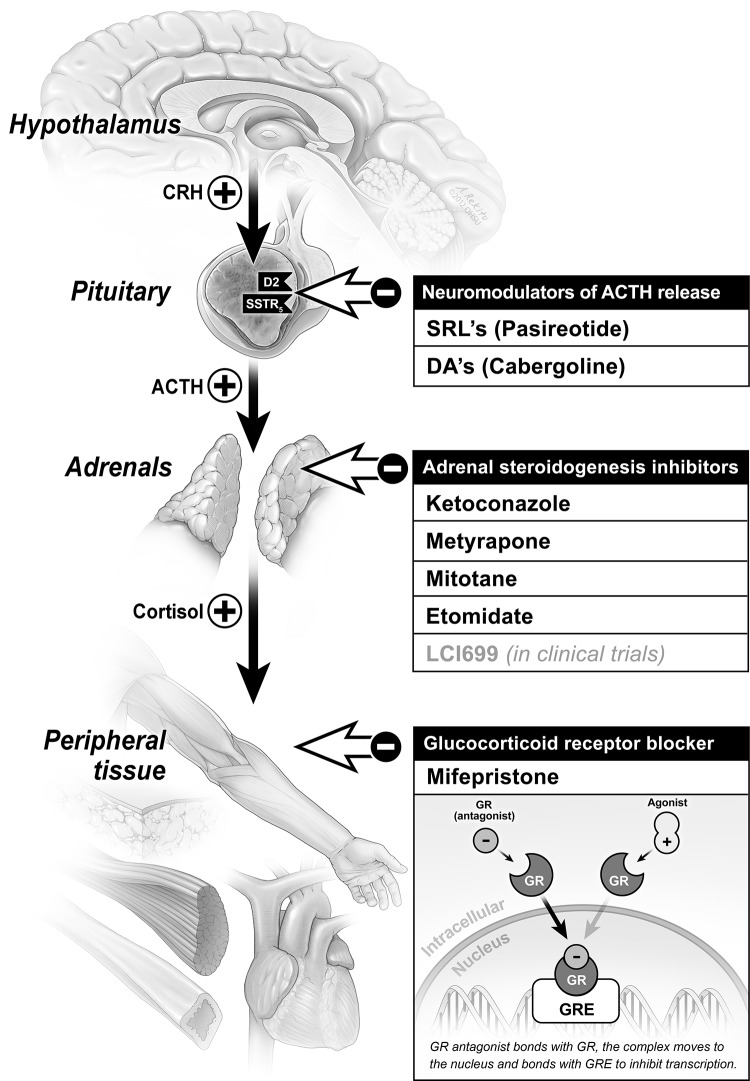
Cushing's disease is a condition of hypercortisolism caused by an adrenocorticotropic hormone (ACTH)-secreting pituitary adenoma. While rare, it is associated with significant morbidity and mortality, which suggests that early and aggressive intervention is required. The primary, definitive therapy for patients with Cushing's disease in the majority of patients is pituitary surgery, generally performed via a transsphenoidal approach. However, many patients will not achieve remission or they will have recurrences. The consequences of persistent hypercortisolism are severe and, as such, early identification of those patients at risk of treatment failure is exigent. Medical management of Cushing's disease patients plays an important role in achieving long-term remission after failed transsphenoidal surgery, while awaiting effects of radiation or before surgery to decrease the hypercortisolemia and potentially reducing perioperative complications and improving outcome. Medical therapies include centrally acting agents, adrenal steroidogenesis inhibitors and glucocorticoid receptor blockers. Furthermore, several new agents are in clinical trials. To normalize the devastating disease effects of hypercortisolemia, it is paramount that successful patient disease management includes individualized, multidisciplinary care, with close collaboration between endocrinologists, neurosurgeons, radiation oncologists, and general surgeons. This commentary will focus on recent advances in the medical treatment of Cushing's, with a focus on newly approved ACTH modulators and glucocorticoid receptor blockers.
库欣病是一种由分泌促肾上腺皮质激素(ACTH)的垂体腺瘤引起的皮质醇增多症。虽然罕见,但它与显著的发病率和死亡率相关,这表明需要早期积极干预。对于大多数库欣病患者,主要的确定性治疗方法是垂体手术,通常通过经蝶窦入路进行。然而,许多患者无法实现缓解或会复发。持续性皮质醇增多症的后果很严重,因此,迫切需要尽早识别那些有治疗失败风险的患者。在经蝶窦手术失败后,库欣病患者的药物治疗在实现长期缓解方面起着重要作用,同时等待放疗效果或在手术前降低高皮质醇血症,可能减少围手术期并发症并改善预后。药物治疗包括中枢作用药物、肾上腺类固醇生成抑制剂和糖皮质激素受体阻滞剂。此外,几种新药正在进行临床试验。为了使高皮质醇血症的破坏性疾病影响恢复正常,成功的患者疾病管理至关重要,包括个体化、多学科护理,内分泌学家、神经外科医生、放射肿瘤学家和普通外科医生之间密切合作。本评论将重点关注库欣病药物治疗的最新进展,重点是新批准的ACTH调节剂和糖皮质激素受体阻滞剂。