Institute of Structural and Molecular Biology, UCL and Birkbeck, Malet Street, London, WC1E 7HX, UK.
Institut Pasteur, G5 Biologie structurale de la sécrétion bactérienne and UMR 3528-CNRS, 25 rue du Docteur Roux, 75015 Paris, France.
Nature. 2014 Apr 24;508(7497):550-553. doi: 10.1038/nature13081. Epub 2014 Mar 9.
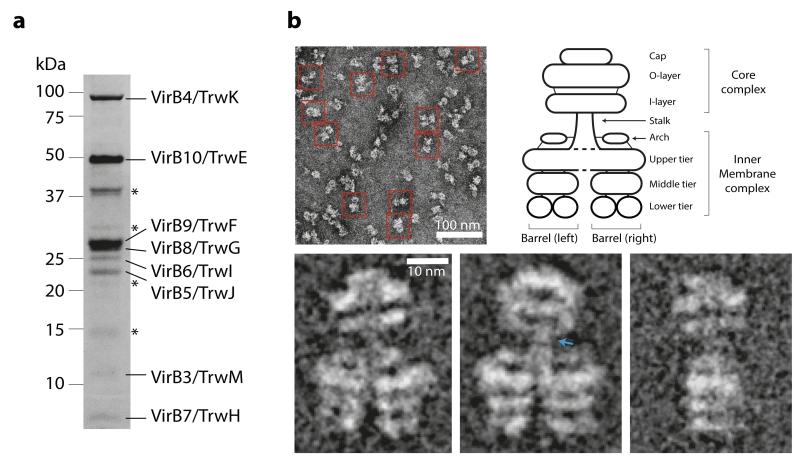
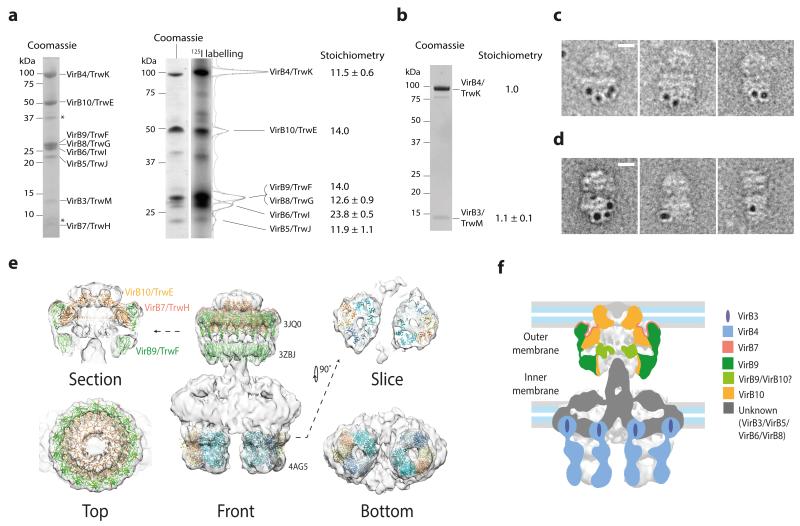
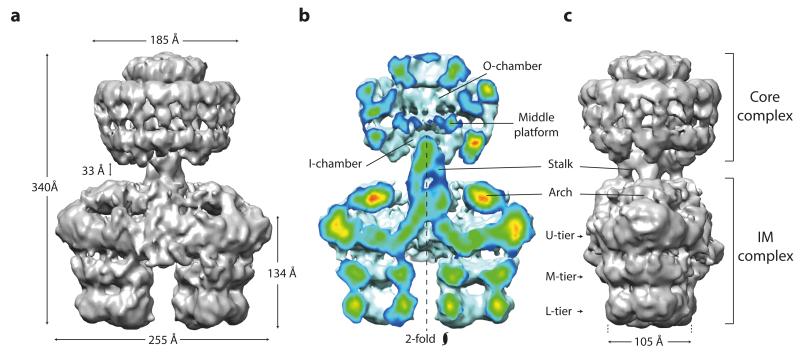
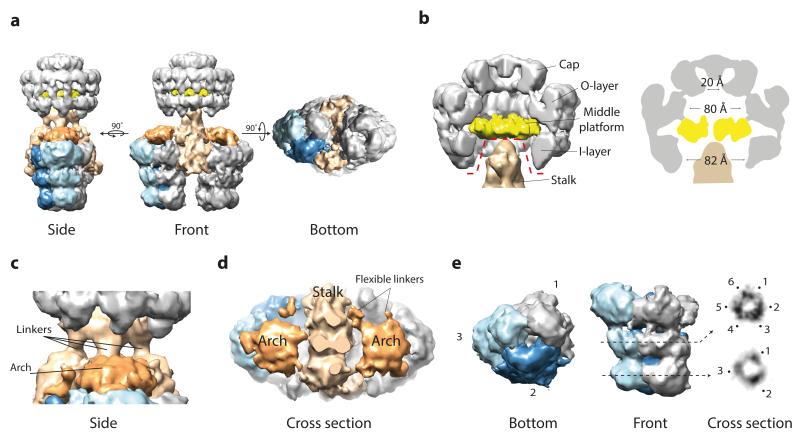
Bacterial type IV secretion systems translocate virulence factors into eukaryotic cells, distribute genetic material between bacteria and have shown potential as a tool for the genetic modification of human cells. Given the complex choreography of the substrate through the secretion apparatus, the molecular mechanism of the type IV secretion system has proved difficult to dissect in the absence of structural data for the entire machinery. Here we use electron microscopy to reconstruct the type IV secretion system encoded by the Escherichia coli R388 conjugative plasmid. We show that eight proteins assemble in an intricate stoichiometric relationship to form an approximately 3 megadalton nanomachine that spans the entire cell envelope. The structure comprises an outer membrane-associated core complex connected by a central stalk to a substantial inner membrane complex that is dominated by a battery of 12 VirB4 ATPase subunits organized as side-by-side hexameric barrels. Our results show a secretion system with markedly different architecture, and consequently mechanism, to other known bacterial secretion systems.
细菌 IV 型分泌系统将毒力因子转运到真核细胞中,在细菌之间分配遗传物质,并且已显示出作为人类细胞遗传修饰工具的潜力。鉴于底物通过分泌装置的复杂编舞,在没有整个机械结构的结构数据的情况下,IV 型分泌系统的分子机制已被证明难以剖析。在这里,我们使用电子显微镜重建了由大肠杆菌 R388 接合质粒编码的 IV 型分泌系统。我们表明,八个蛋白质以复杂的化学计量关系组装在一起,形成一个大约 3000 道尔顿的纳米机器,横跨整个细胞包膜。该结构包括一个与外膜相关的核心复合物,通过中央柄与一个实质性的内膜复合物相连,内膜复合物主要由一组 12 个 VirB4 ATP 酶亚基组成,这些亚基组织成并排的六聚体桶。我们的结果显示了一种具有明显不同架构的分泌系统,因此也具有不同的机制,与其他已知的细菌分泌系统不同。