Division of Cell Biology and Immunology, Department of Pathology, University of Utah, Salt Lake City, UT, USA.
Division of Cell Biology and Immunology, Department of Pathology, University of Utah, Salt Lake City, UT, USA.
Exp Hematol. 2014 Jun;42(6):425-30. doi: 10.1016/j.exphem.2014.03.002. Epub 2014 Mar 24.
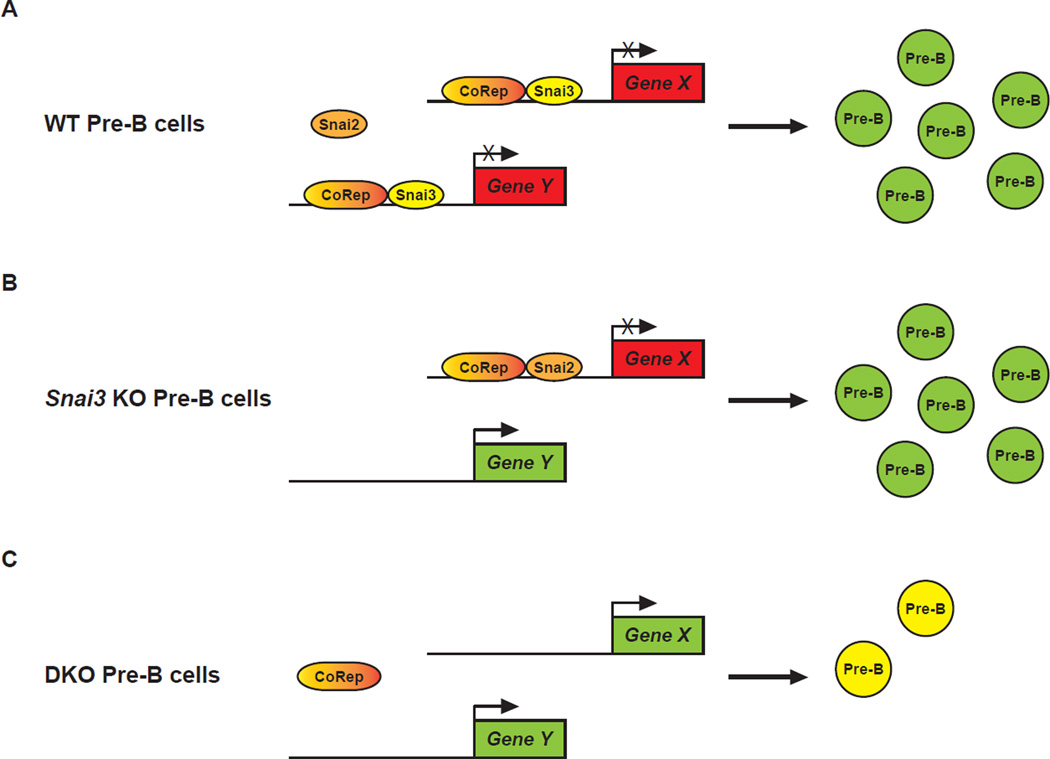
Coordinated gene expression is crucial in facilitating proper lymphoid cell development and function. The precise patterns of gene expression during B- and T-cell development are regulated through a complex interplay between a multitude of transcriptional regulators, both activators and repressors. We have recently identified the Snail family of transcription factors as playing significant and overlapping roles in lymphoid cell development, in that deletion of both SNAI2 and SNAI3 was required to fully impact the generation of mature T and B cells. Analyses using compound heterozygote animals further demonstrated that SNAI2 and SNAI3 were partially haplosufficient and relatively equivalent in their ability to preserve B-cell generation in the bone marrow. In this review, we summarize studies elucidating the role of the Snail family in hematopoiesis, with a focus on lymphoid cell development. Using the Snail family as an example, we discuss the concepts of functional redundancy and strategies employed to assay transcription factor families for intramember compensation.
协调基因表达对于促进淋巴样细胞的正常发育和功能至关重要。B 细胞和 T 细胞发育过程中的精确基因表达模式是通过多种转录因子(激活子和抑制剂)之间的复杂相互作用来调节的。我们最近发现,Snail 家族转录因子在淋巴样细胞发育中发挥着重要的、重叠的作用,因为 SNAI2 和 SNAI3 的缺失都需要完全影响成熟 T 细胞和 B 细胞的生成。使用复合杂合子动物的分析进一步表明,SNAI2 和 SNAI3 在维持骨髓中 B 细胞生成方面具有部分单倍体充足性,并且在能力上相对相当。在这篇综述中,我们总结了阐明 Snail 家族在造血,特别是在淋巴样细胞发育中的作用的研究。我们以 Snail 家族为例,讨论了功能冗余的概念以及用于检测转录因子家族成员之间补偿的策略。