Doi Hideyuki, Heeren Alexandre, Maurage Pierre
Institute for Sustainable Sciences and Development, Hiroshima University, Higashi-Hiroshima, Japan.
Laboratory for Experimental Psychopathology, Psychological Sciences Research Institute, Université Catholique de Louvain, Louvain-la-Neuve, Belgium.
PLoS One. 2014 Mar 27;9(3):e92612. doi: 10.1371/journal.pone.0092612. eCollection 2014.
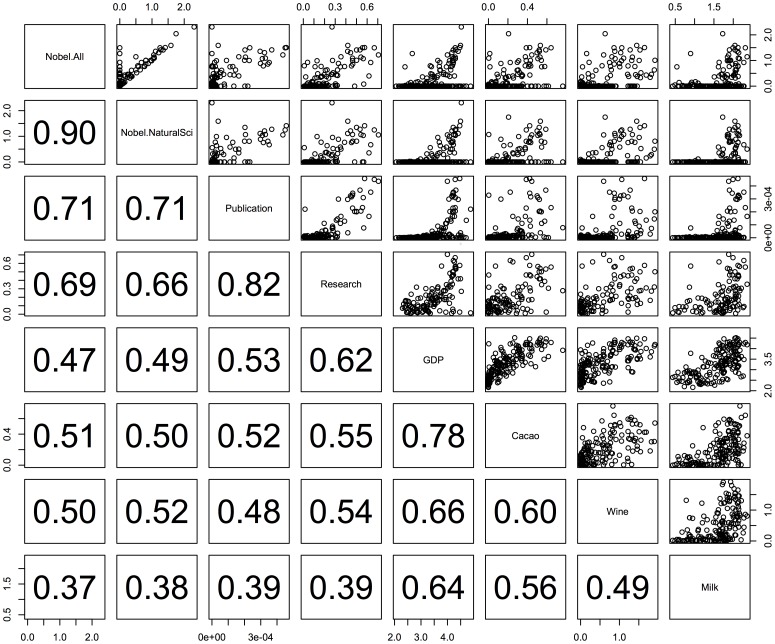
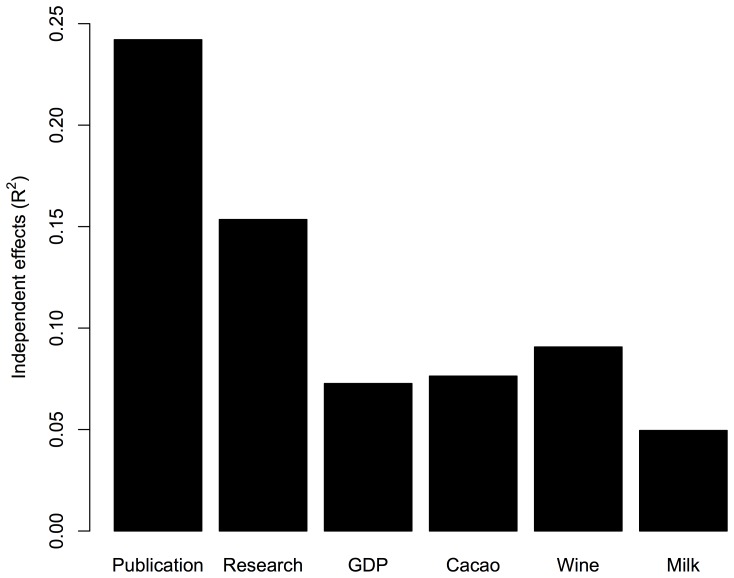
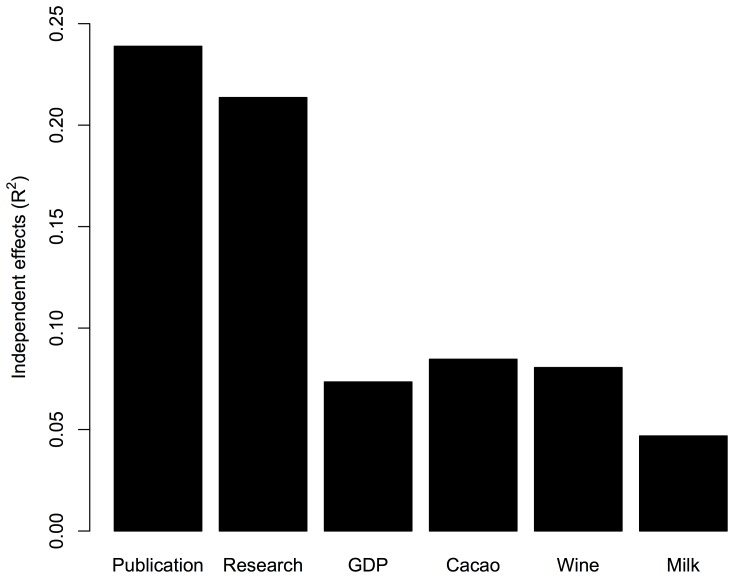
Several recent studies have described a strong correlation between nutritional or economic data and the number of Nobel awards obtained across a large range of countries. This sheds new light on the intriguing question of the key predictors of Nobel awards chances. However, all these studies have been focused on a single predictor and were only based on simple correlation and/or linear model analysis. The main aim of the present study was thus to clarify this debate by simultaneously exploring the influence of food consumption (cacao, milk, and wine), economic variables (gross domestic product) and scientific activity (number of publications and research expenditure) on Nobel awards. An innovative statistical analysis, hierarchical partitioning, has been used because it enables us to reduce collinearity problems by determining and comparing the independent contribution of each factor. Our results clearly indicate that a country's number of Nobel awards can be mainly predicted by its scientific achievements such as number of publications and research expenditure. Conversely, dietary habits and the global economy variable are only minor predictors; this finding contradicts the conclusions of previous studies. Dedicating a large proportion of the GDP to research and to the publication of a high number of scientific papers would thus create fertile ground for obtaining Nobel awards.
最近的几项研究描述了营养或经济数据与众多国家获得诺贝尔奖的数量之间的强相关性。这为诺贝尔奖获奖几率的关键预测因素这一有趣问题提供了新的线索。然而,所有这些研究都只关注单一预测因素,且仅基于简单相关性和/或线性模型分析。因此,本研究的主要目的是通过同时探究食品消费(可可、牛奶和葡萄酒)、经济变量(国内生产总值)和科学活动(出版物数量和研究支出)对诺贝尔奖的影响来澄清这一争论。我们采用了一种创新的统计分析方法——层次划分法,因为它能通过确定和比较每个因素的独立贡献来减少共线性问题。我们的结果清楚地表明,一个国家的诺贝尔奖数量主要可由其科学成就预测,如出版物数量和研究支出。相反,饮食习惯和全球经济变量只是次要预测因素;这一发现与先前研究的结论相矛盾。因此,将很大一部分国内生产总值用于研究并发表大量科学论文将为获得诺贝尔奖创造有利条件。