Kumar Bhavna, Yadav Arti, Hideg Kalman, Kuppusamy Periannan, Teknos Theodoros N, Kumar Pawan
Department of Otolaryngology-Head and Neck Surgery, The Ohio State University, Columbus, Ohio, United States of America; The Ohio State University Comprehensive Cancer Center, The Ohio State University, Columbus, Ohio, United States of America.
The Ohio State University Comprehensive Cancer Center, The Ohio State University, Columbus, Ohio, United States of America.
PLoS One. 2014 Mar 27;9(3):e93208. doi: 10.1371/journal.pone.0093208. eCollection 2014.
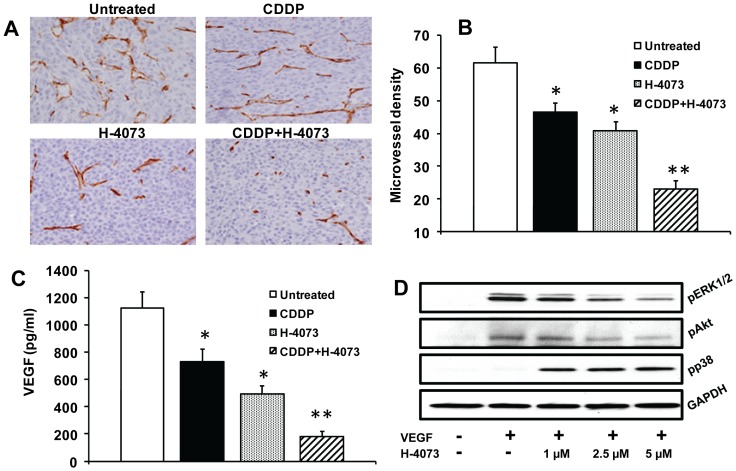
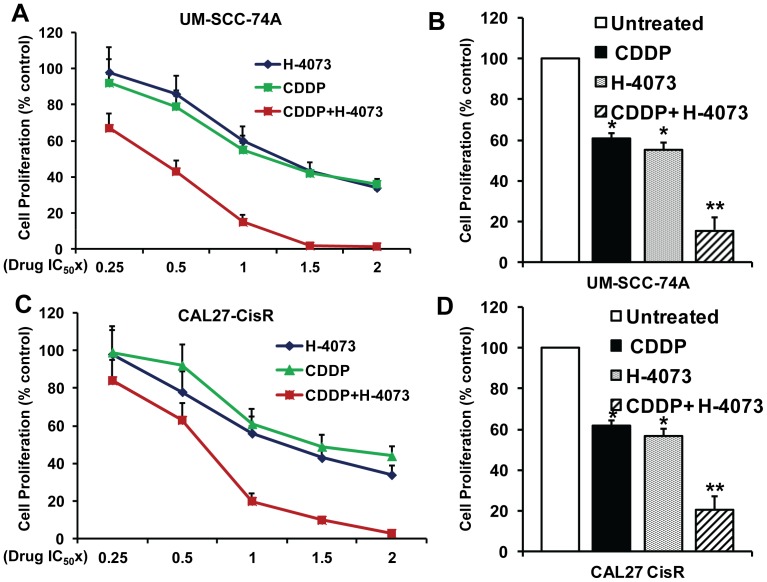
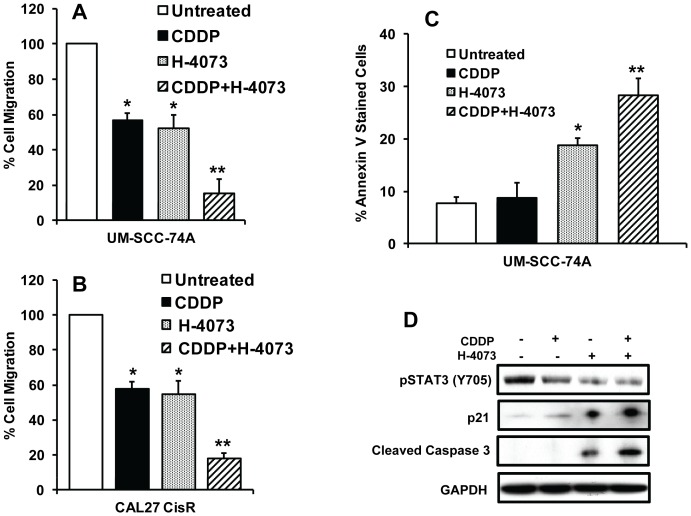
Chemotherapy constitutes the standard modality of treatment for localized head and neck squamous cell carcinomas (HNSCC). However, many patients fail to respond and relapse after this treatments due to the acquisition of chemo-resistance. Therefore, there is an urgent need to develop novel drugs that could reverse the resistant phenotype. Curcumin, the constituent of the spice turmeric has been shown to have anti-inflammatory, anti-oxidant and anti-proliferative properties in several tumor types. However, use of curcumin has been limited due to its poor bio-absorption. Recently, a novel class of curcumin analogs, based on diarylidenylpiperidones (DAP), has been developed by incorporating a piperidone link to the beta-diketone structure and fluoro substitutions on the phenyl groups. In this study, we evaluated the effectiveness of H-4073, a parafluorinated variant of DAP, using both in vitro and in vivo head and neck cancer models. Our results demonstrate that H-4073 is a potent anti-tumor agent and it significantly inhibited cell proliferation in all the HNSCC cell lines tested in a dose-dependent manner. In addition, pretreatment of cisplatin-resistant HNSCC cell lines with H-4073 significantly reversed the chemo-resistance as observed by cell viability assay (MTT), apoptosis assay (Annexin V binding) and cleaved caspase-3 (Western blot). H-4073 mediated its anti-tumor effects by inhibiting JAK/STAT3, FAK, Akt and VEGF signaling pathways that play important roles in cell proliferation, migration, survival and angiogenesis. In the SCID mouse xenograft model, H-4073 significantly enhanced the anti-tumor and anti-angiogenesis effects of cisplatin, with no added systemic toxicity. Interestingly, H-4073 inhibited tumor angiogenesis by blocking VEGF production by tumor cells as well as directly inhibiting endothelial cell function. Taken together, our results suggest that H-4073 is a potent anti-tumor agent and it can be used to overcome chemotherapy resistance in HNSCC.
化疗是局部头颈部鳞状细胞癌(HNSCC)的标准治疗方式。然而,许多患者在接受这种治疗后由于获得化疗耐药性而治疗失败且复发。因此,迫切需要开发能够逆转耐药表型的新型药物。姜黄素是香料姜黄的成分,已显示在多种肿瘤类型中具有抗炎、抗氧化和抗增殖特性。然而,由于其生物吸收性差,姜黄素的应用受到限制。最近,通过在β-二酮结构上引入哌啶酮连接并在苯基上进行氟取代,开发了一类基于二芳基烯基哌啶酮(DAP)的新型姜黄素类似物。在本研究中,我们使用体外和体内头颈部癌模型评估了DAP的对氟代变体H-4073的有效性。我们的结果表明,H-4073是一种有效的抗肿瘤药物,它以剂量依赖的方式显著抑制了所有测试的HNSCC细胞系中的细胞增殖。此外,用H-4073对顺铂耐药的HNSCC细胞系进行预处理,通过细胞活力测定(MTT)、凋亡测定(膜联蛋白V结合)和裂解的半胱天冬酶-3(蛋白质印迹法)观察到,显著逆转了化疗耐药性。H-4073通过抑制在细胞增殖、迁移、存活和血管生成中起重要作用的JAK/STAT3、FAK、Akt和VEGF信号通路来介导其抗肿瘤作用。在SCID小鼠异种移植模型中,H-4073显著增强了顺铂的抗肿瘤和抗血管生成作用,且无额外的全身毒性。有趣的是,H-4073通过阻断肿瘤细胞产生VEGF以及直接抑制内皮细胞功能来抑制肿瘤血管生成。综上所述,我们的结果表明H-4073是一种有效的抗肿瘤药物,可用于克服HNSCC中的化疗耐药性。